The debate over whether the Federal Reserve or the Bank of Japan will raise interest rates intensifies, with USD/JPY hovering around 155.40 awaiting policy guidance.
2026-09-16 10:06:08
The USD/JPY pair remained around 155.40 in early Asian trading on Wednesday, entering a period of consolidation after a recent rebound. The market is currently avoiding large bets due to the upcoming interest rate decisions from the Federal Reserve and the Bank of Japan this week. The core contradiction in the market lies in the potential for further increases in US interest rates, while Japan is also pushing forward with the normalization of its monetary policy. Changes in the interest rate differential between the USD and JPY will once again become a crucial factor in determining the exchange rate direction. Previously, the USD/JPY pair rebounded from below $153 to around $155, mainly driven by a stronger dollar and rising US Treasury yields. 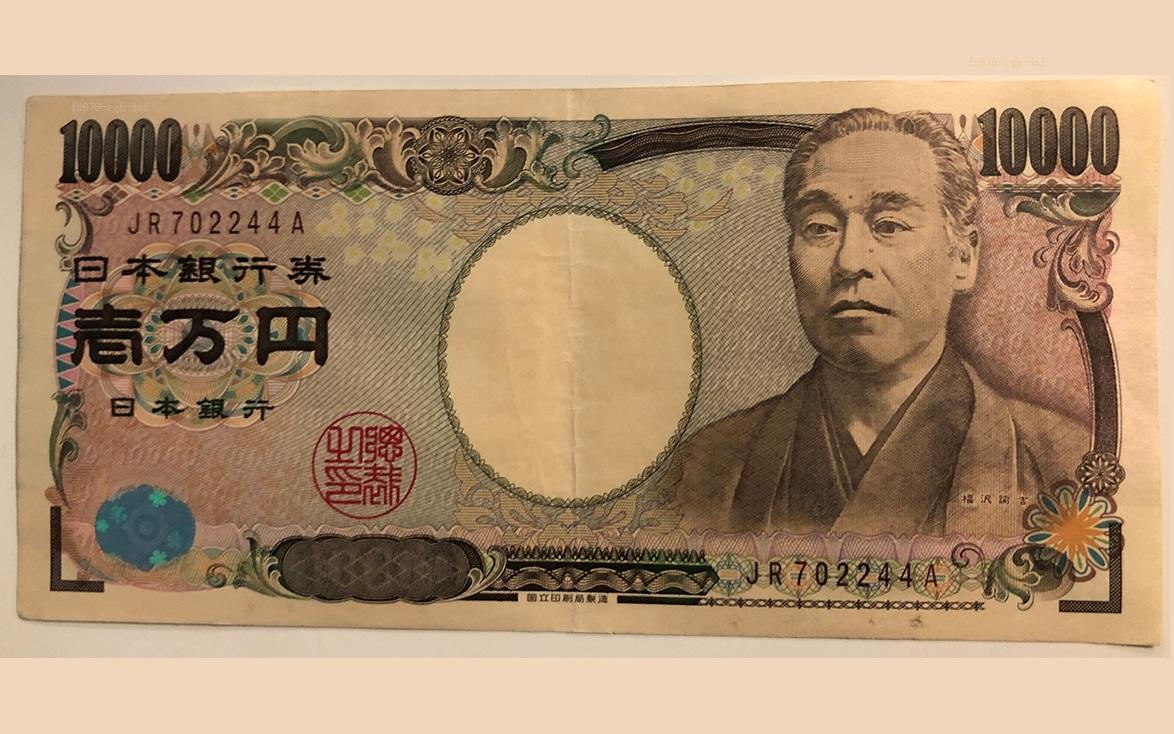 In the US, recent inflation data has continued to reinforce market expectations of monetary policy tightening. August's US consumer price index and core inflation both showed strong stickiness, and coupled with the recent rapid rise in energy prices, market concerns about a resurgence of inflation have increased. The yield on the 10-year US Treasury note touched 5.041% on Tuesday, a new high since 2007, before falling back to around 5%. Rising yields have increased the relative attractiveness of dollar assets and have become an important factor in the recent renewed support for the dollar. The market currently widely expects the Federal Reserve to raise the policy rate by 25 basis points to a range of 3.75%-4.00% on Wednesday, which would be a significant change in this policy cycle. The latest market pricing indicates a probability of approximately 90% to 95% for a 25 basis point rate hike, therefore the interest rate decision itself may have already been largely priced into the dollar. The market will now focus on the policy statement, economic forecasts, and the wording of Fed Chairman Warsh at the post-meeting press conference, especially whether the Fed hints at further room for rate hikes. For USD/JPY, if the Federal Reserve releases a more hawkish policy signal than the market expects, US Treasury yields and the dollar may continue to receive support, pushing the exchange rate to test higher levels. However, since rate hike expectations are already highly priced in, if the final statement does not further reinforce the tightening path, a "buy the rumor, sell the fact" pullback in the dollar cannot be ruled out. Currently, the 10-year US Treasury yield is already near 5%, and whether the yield can continue to rise will be a key short-term variable for USD/JPY. Meanwhile, the Bank of Japan will announce its September interest rate decision on Friday. The market widely expects the Bank of Japan to raise its policy rate by 25 basis points from 1.00% to 1.25%, which would bring Japan's benchmark interest rate to its highest level since April 1995. The market has largely priced in this rate hike, so the Bank of Japan's final rate hike itself may not necessarily drive a sustained appreciation of the yen. Investors are more focused on Kazuo Ueda's statements regarding the future pace of rate hikes and the final interest rate level. Expectations for the Bank of Japan's policy have risen significantly recently, related to changes in Japanese wage and inflationary pressures. The market is currently not only focused on the September rate hike but also assessing whether the Bank of Japan can maintain a relatively rapid pace of policy normalization. If Kazuo Ueda signals a clear move towards further tightening, the yen could gain new buying interest, while USD/JPY could face downward pressure. Conversely, if the Bank of Japan emphasizes after the rate hike that subsequent actions will still depend on economic and price data, the yen's interest rate advantage may improve less quickly than some market expectations. Masafumi Yamamoto, chief foreign exchange strategist at Mizuho Securities, previously stated that even with this rate hike, the Bank of Japan's policy stance is unlikely to be more hawkish than currently expected by the market, and warned of a risk of USD/JPY rebounding towards 157 yen. Meanwhile, Standard Chartered believes that the Bank of Japan's 25 basis point rate hike in September was already largely priced in, and without more hawkish policy guidance, the yen's further upside potential may be limited. From a macroeconomic perspective, USD/JPY is currently being pulled by two opposing forces. On the one hand, rising US oil prices are pushing up inflation expectations, US Treasury yields are rising rapidly, and expectations of a Fed rate hike are strengthening, all of which are favorable for the dollar. On the other hand, the Bank of Japan's impending rate hike, coupled with persistent wage and price pressures in Japan, is fueling market expectations of further easing by Japan, thus providing support for the yen. The coexistence of two forces makes USD/JPY more prone to rapid fluctuations in the short term. Furthermore, high oil prices are not simply a negative or positive factor for the yen. Japan is highly dependent on energy imports, and rising oil prices will increase import costs and expand energy bills, potentially putting short-term pressure on the yen. However, rising energy prices will also push up domestic inflation in Japan, thereby strengthening the Bank of Japan's policy incentive to continue raising interest rates. Therefore, the impact of rising oil prices on USD/JPY depends on whether the market is more focused on the deterioration of Japan's terms of trade or the possibility of further tightening by the Bank of Japan. Currently, the market is gradually shifting from "whether the Fed will raise interest rates" to "whether the Fed will continue to tighten after raising rates" and "how far the Bank of Japan can go after raising rates." This means that the volatility of USD/JPY may be significantly amplified in the coming trading days. Investors need to pay close attention to the Fed's policy statement, Warsh's speech, US Treasury yields, and the Bank of Japan's policy guidance. If both central banks signal further tightening, carry trades may fluctuate repeatedly; if the Fed's policy is hawkish while the Bank of Japan's attitude is relatively cautious, USD/JPY may regain upward momentum. From a daily chart perspective, USD/JPY rebounded after finding support in the 152-153 area, but it remains in a mid-term correction phase. The price is below the Bollinger Band middle line and the 100-day moving average, indicating that the overall trend has not yet clearly reversed. The daily RSI is around 40, suggesting weak market momentum, indicating that the current rebound is more of a corrective move. The first resistance level to watch is the Bollinger Band middle line around 157.15, while the 157.00-157.20 area is also a significant resistance zone. A break above this area would target the 100-day moving average around 159.60, followed by the Bollinger Band upper line around 162.00. On the downside, key support levels are around 153.00 and 152.35. A break below 152.35 could reinforce the daily downtrend. From a 4-hour chart perspective, USD/JPY has rebounded from its previous low near $153 and is currently trading above the 20-period moving average on the 4-hour chart at $154.37. Short-term momentum has improved significantly, with the RSI around 62, indicating a slightly bullish bias. The $155.20-$155.30 area is the first zone to break through. If the price can hold above $155.30, the next target is the 100-period moving average on the 4-hour chart near $156.90; a further break above this level could extend the rebound towards $157. Conversely, if the price continues to be resisted near $155 and breaks below the $154.70-$154.40 area, the short-term rebound will be broken, and the price may retest the support near $153. Given that the Fed and BOJ policy decisions are only two days apart, the technical pattern is likely to be influenced by rapid adjustments in interest rate expectations. Key levels need to be confirmed in conjunction with changes in US Treasury yields and the US dollar index.
 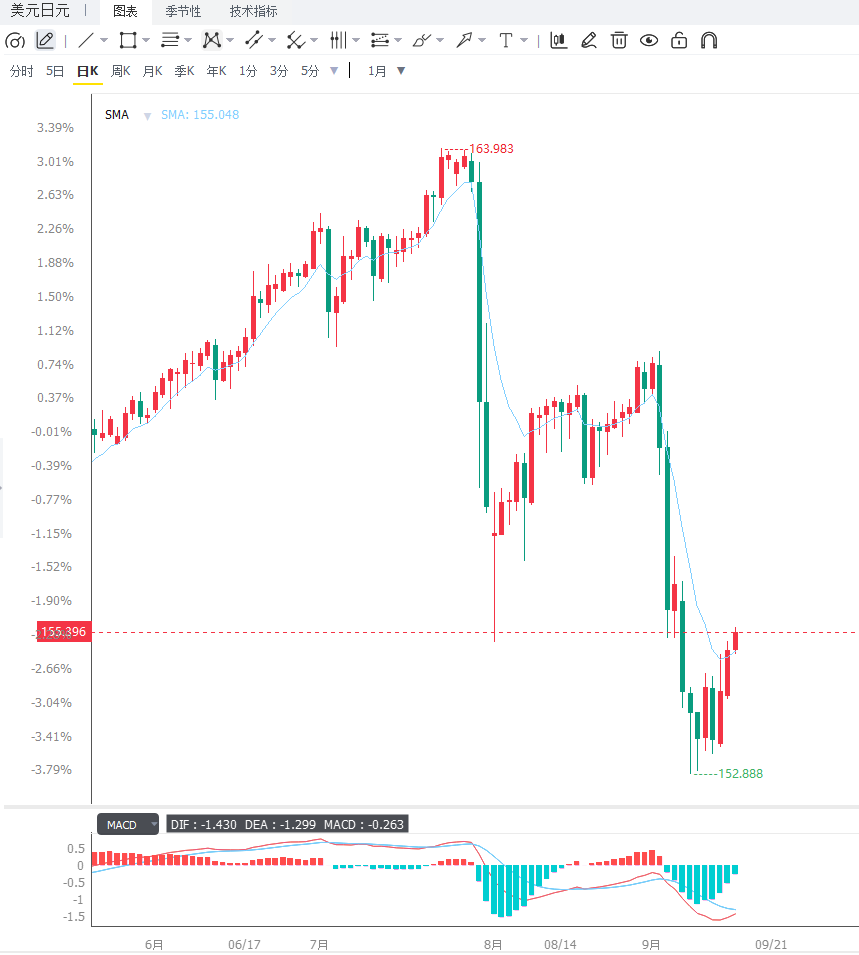 Editor's Summary: The USD/JPY pair is currently at a critical juncture of repricing the policies of two major central banks. Sticky US inflation, rising oil prices, and US Treasury yields exceeding 5% have strengthened short-term support for the dollar, while the Bank of Japan's impending rate hike to 1.25% limits further upside potential for USD/JPY. Short-term market focus will shift from the magnitude of the Fed's rate hikes to subsequent policy guidance, and then to the pace of the Bank of Japan's rate hikes. Technically, 155.30 is a key level for short-term bullish and bearish battles. Resistance is seen around 157, while support levels are at 153 and 152.35. Ultimately, the trend will be determined by whether the USD/JPY interest rate differential continues to widen and whether the Bank of Japan releases clearer signals of continued tightening.
In the US, recent inflation data has continued to reinforce market expectations of monetary policy tightening. August's US consumer price index and core inflation both showed strong stickiness, and coupled with the recent rapid rise in energy prices, market concerns about a resurgence of inflation have increased. The yield on the 10-year US Treasury note touched 5.041% on Tuesday, a new high since 2007, before falling back to around 5%. Rising yields have increased the relative attractiveness of dollar assets and have become an important factor in the recent renewed support for the dollar. The market currently widely expects the Federal Reserve to raise the policy rate by 25 basis points to a range of 3.75%-4.00% on Wednesday, which would be a significant change in this policy cycle. The latest market pricing indicates a probability of approximately 90% to 95% for a 25 basis point rate hike, therefore the interest rate decision itself may have already been largely priced into the dollar. The market will now focus on the policy statement, economic forecasts, and the wording of Fed Chairman Warsh at the post-meeting press conference, especially whether the Fed hints at further room for rate hikes. For USD/JPY, if the Federal Reserve releases a more hawkish policy signal than the market expects, US Treasury yields and the dollar may continue to receive support, pushing the exchange rate to test higher levels. However, since rate hike expectations are already highly priced in, if the final statement does not further reinforce the tightening path, a "buy the rumor, sell the fact" pullback in the dollar cannot be ruled out. Currently, the 10-year US Treasury yield is already near 5%, and whether the yield can continue to rise will be a key short-term variable for USD/JPY. Meanwhile, the Bank of Japan will announce its September interest rate decision on Friday. The market widely expects the Bank of Japan to raise its policy rate by 25 basis points from 1.00% to 1.25%, which would bring Japan's benchmark interest rate to its highest level since April 1995. The market has largely priced in this rate hike, so the Bank of Japan's final rate hike itself may not necessarily drive a sustained appreciation of the yen. Investors are more focused on Kazuo Ueda's statements regarding the future pace of rate hikes and the final interest rate level. Expectations for the Bank of Japan's policy have risen significantly recently, related to changes in Japanese wage and inflationary pressures. The market is currently not only focused on the September rate hike but also assessing whether the Bank of Japan can maintain a relatively rapid pace of policy normalization. If Kazuo Ueda signals a clear move towards further tightening, the yen could gain new buying interest, while USD/JPY could face downward pressure. Conversely, if the Bank of Japan emphasizes after the rate hike that subsequent actions will still depend on economic and price data, the yen's interest rate advantage may improve less quickly than some market expectations. Masafumi Yamamoto, chief foreign exchange strategist at Mizuho Securities, previously stated that even with this rate hike, the Bank of Japan's policy stance is unlikely to be more hawkish than currently expected by the market, and warned of a risk of USD/JPY rebounding towards 157 yen. Meanwhile, Standard Chartered believes that the Bank of Japan's 25 basis point rate hike in September was already largely priced in, and without more hawkish policy guidance, the yen's further upside potential may be limited. From a macroeconomic perspective, USD/JPY is currently being pulled by two opposing forces. On the one hand, rising US oil prices are pushing up inflation expectations, US Treasury yields are rising rapidly, and expectations of a Fed rate hike are strengthening, all of which are favorable for the dollar. On the other hand, the Bank of Japan's impending rate hike, coupled with persistent wage and price pressures in Japan, is fueling market expectations of further easing by Japan, thus providing support for the yen. The coexistence of two forces makes USD/JPY more prone to rapid fluctuations in the short term. Furthermore, high oil prices are not simply a negative or positive factor for the yen. Japan is highly dependent on energy imports, and rising oil prices will increase import costs and expand energy bills, potentially putting short-term pressure on the yen. However, rising energy prices will also push up domestic inflation in Japan, thereby strengthening the Bank of Japan's policy incentive to continue raising interest rates. Therefore, the impact of rising oil prices on USD/JPY depends on whether the market is more focused on the deterioration of Japan's terms of trade or the possibility of further tightening by the Bank of Japan. Currently, the market is gradually shifting from "whether the Fed will raise interest rates" to "whether the Fed will continue to tighten after raising rates" and "how far the Bank of Japan can go after raising rates." This means that the volatility of USD/JPY may be significantly amplified in the coming trading days. Investors need to pay close attention to the Fed's policy statement, Warsh's speech, US Treasury yields, and the Bank of Japan's policy guidance. If both central banks signal further tightening, carry trades may fluctuate repeatedly; if the Fed's policy is hawkish while the Bank of Japan's attitude is relatively cautious, USD/JPY may regain upward momentum. From a daily chart perspective, USD/JPY rebounded after finding support in the 152-153 area, but it remains in a mid-term correction phase. The price is below the Bollinger Band middle line and the 100-day moving average, indicating that the overall trend has not yet clearly reversed. The daily RSI is around 40, suggesting weak market momentum, indicating that the current rebound is more of a corrective move. The first resistance level to watch is the Bollinger Band middle line around 157.15, while the 157.00-157.20 area is also a significant resistance zone. A break above this area would target the 100-day moving average around 159.60, followed by the Bollinger Band upper line around 162.00. On the downside, key support levels are around 153.00 and 152.35. A break below 152.35 could reinforce the daily downtrend. From a 4-hour chart perspective, USD/JPY has rebounded from its previous low near $153 and is currently trading above the 20-period moving average on the 4-hour chart at $154.37. Short-term momentum has improved significantly, with the RSI around 62, indicating a slightly bullish bias. The $155.20-$155.30 area is the first zone to break through. If the price can hold above $155.30, the next target is the 100-period moving average on the 4-hour chart near $156.90; a further break above this level could extend the rebound towards $157. Conversely, if the price continues to be resisted near $155 and breaks below the $154.70-$154.40 area, the short-term rebound will be broken, and the price may retest the support near $153. Given that the Fed and BOJ policy decisions are only two days apart, the technical pattern is likely to be influenced by rapid adjustments in interest rate expectations. Key levels need to be confirmed in conjunction with changes in US Treasury yields and the US dollar index. Editor's Summary: The USD/JPY pair is currently at a critical juncture of repricing the policies of two major central banks. Sticky US inflation, rising oil prices, and US Treasury yields exceeding 5% have strengthened short-term support for the dollar, while the Bank of Japan's impending rate hike to 1.25% limits further upside potential for USD/JPY. Short-term market focus will shift from the magnitude of the Fed's rate hikes to subsequent policy guidance, and then to the pace of the Bank of Japan's rate hikes. Technically, 155.30 is a key level for short-term bullish and bearish battles. Resistance is seen around 157, while support levels are at 153 and 152.35. Ultimately, the trend will be determined by whether the USD/JPY interest rate differential continues to widen and whether the Bank of Japan releases clearer signals of continued tightening.
- Risk Warning and Disclaimer
- The market involves risk, and trading may not be suitable for all investors. This article is for reference only and does not constitute personal investment advice, nor does it take into account certain users’ specific investment objectives, financial situation, or other needs. Any investment decisions made based on this information are at your own risk.