Gold fell below $4,300 as US Treasury yields broke through 5% and expectations of a Fed rate hike intensified, awaiting the Fed's interest rate decision.
2026-09-16 10:00:08
Spot gold continued its weakness in early Asian trading on Wednesday, with XAU/USD falling to around $4285 at one point. Gold's safe-haven appeal was temporarily suppressed amid a rapid rise in US Treasury yields, support for the US dollar, and market anticipation of the Federal Reserve's interest rate decision. Gold prices had previously fallen below the $4300 mark, and on Monday even touched a more than one-month low of around $4253, indicating that the market is reassessing the valuation of precious metals in a high-interest-rate environment.  The core variable driving this round of gold price adjustments stems from the US Treasury market. The yield on the 10-year US Treasury note touched 5.041% on Tuesday, its highest level since 2007, before retreating and currently hovering around 5%. The market is simultaneously influenced by rising energy prices, renewed inflation expectations, and pressure on US fiscal financing, thus putting continued pressure on long-term US Treasury yields. For gold, rising yields mean a higher opportunity cost of holding non-interest-bearing assets, making it easier for funds to reallocate to dollar assets that offer interest income. The rapid rise in oil prices further reinforces this logic. Recent increases in energy supply risks, with WTI crude oil prices climbing back above $100 and even briefly breaking $105, have fueled market concerns about renewed inflationary pressures. The combination of rising oil prices and high US inflation data has increased investor expectations for continued high interest rates. While traditional safe-haven demand for gold remains, if safe-haven funds simultaneously face higher dollar yields, fund flows may diverge significantly. The market is currently highly focused on the Federal Reserve's interest rate decision on Wednesday. According to the CME FedWatch tool, the market had previously priced in a 92.4% probability of a 25 basis point rate hike, and the latest market survey shows this expectation is now closer to 95%. If the market expects the Federal Reserve to raise the benchmark interest rate by 25 basis points to the 3.75%-4.00% range, this will be a significant turning point for renewed monetary policy tightening. However, for gold, the real determinant of its short-term direction may not be the rate hike itself, but rather the policy signals following the rate decision. Since the market has largely priced in the rate hike, if Fed Chairman Warsh and the policy statement continue to emphasize inflation risks or signal further tightening, US Treasury yields and the US dollar may continue to receive support, increasing downward pressure on gold. Conversely, if the policy guidance is more moderate than market expectations, some of the already priced-in rate hike expectations may be reversed, and gold prices could see a technical rebound. The rise of US Treasury yields to 5% also signifies a change in the valuation environment of the financial markets. Analysts at Concordia Bank pointed out that the US 10-year yield recently briefly broke through 5%, and if it continues to remain above this level, it may indicate further tightening of financial conditions. This not only affects gold but also impacts multiple markets, including risk assets, real estate, and corporate investment, through higher financing costs. With long-term interest rates remaining high, market attention will further increase regarding the relationship between future economic growth and inflation. The US dollar is also a significant factor suppressing gold's short-term price movement. The US dollar index rose to around 99.60 on Tuesday, mainly driven by rising US Treasury yields and increased expectations of interest rate hikes. A relatively clear transmission chain has formed in the market: rising oil prices fuel inflation concerns, inflationary pressures push US Treasury yields higher, increased expectations of a Fed rate hike support the dollar, and ultimately suppress gold through the dollar's pricing mechanism and holding costs. However, gold's safe-haven attributes have not completely disappeared. Attacks on energy infrastructure, disruptions to the oil supply chain, and volatility in the global bond market all indicate that macroeconomic risks remain high. Therefore, gold is currently closer to finding a new balance between "safe-haven demand" and "high interest rate pressure." Once US Treasury yields stop rising, or the dollar experiences a "buy the rumor, sell the fact" adjustment due to the realization of interest rate hike expectations, gold may quickly attract technical buying. From a funding perspective, the current continuous decline in gold prices has released some short-term overbought pressure, but the market still lacks clear trend reversal signals. Investors should focus on the Fed's interest rate decision, economic forecasts, the dot plot, and Warsh's speech, while also observing whether the 10-year US Treasury yield can stabilize below 5%. If the yield falls back below 5%, the pressure on gold may ease temporarily; if the yield breaks upwards further and forms a sustained trend, gold may continue to test previous lows. From a daily chart perspective, XAU/USD is currently still trading below the 100-day simple moving average and is being suppressed by the Bollinger Band's middle line, indicating an overall weak trend. The 100-day moving average is currently around $4330, a key resistance level that gold prices need to reclaim for a short-term rebound; further upside is the Bollinger Band's middle line around $4455. Only if gold prices can regain a foothold above $4455 will the daily chart's weak structure be expected to improve significantly. The first support level to watch is the lower Bollinger Band around $4225, which is also a crucial dynamic support level. A break below $4225 could open up further downside potential towards $4200 or even lower. The RSI (14) is currently around 44, in a weak zone, indicating that the market still has downward momentum but has not yet entered an extremely oversold state. From the 4-hour chart, gold has maintained a short-term downward trend after breaking below $4300, with relatively limited rebound strength. Short-term momentum indicators remain weak, and the market has not yet formed a clear bottom reversal signal. The area around $4285 is an important area to observe for the current price movement. If it can quickly recover $4300 and further break through $4330, a short-term corrective rebound may occur, with the target pointing back to the $4380-$4400 area. If the rebound is consistently blocked in the $4300-$4330 range, and the price breaks below $4280 again, then the area around $4225 will become the next important test area. Before and after the Fed's decision is announced, volatility on the 4-hour timeframe may increase significantly. Therefore, a valid breakout of the technical level still needs to be confirmed by changes in the US dollar and US Treasury yields.
 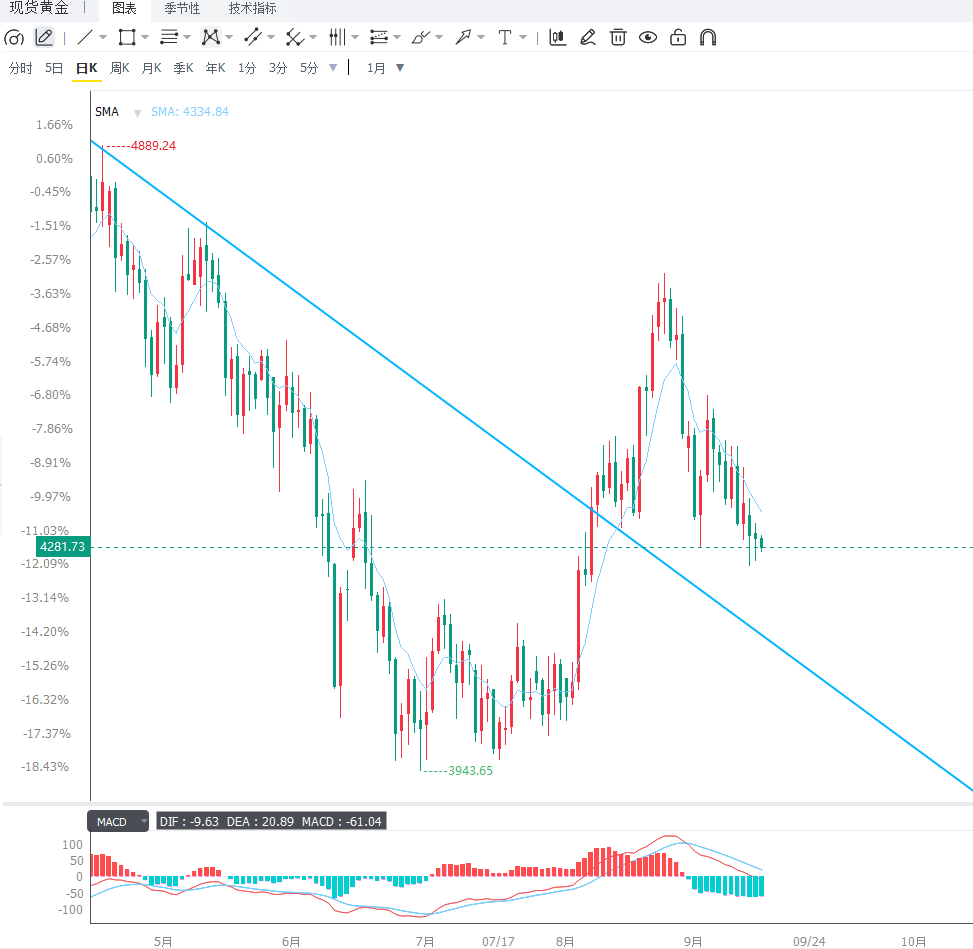 Editor's Summary: The main contradiction in the current gold market has shifted from simple safe-haven trading to the interest rate-suppressing logic of "high oil prices—high inflation—high yields—strong dollar." The US 10-year Treasury yield breaking through 5% and rising expectations of a Fed rate hike have put significant pressure on gold in the short term, while persistently high energy prices make it difficult for inflation risks to dissipate quickly. In the short term, $4300 and $4330 are key areas to determine whether gold prices can rebound, while the key support level to watch is $4225. The future market direction will heavily depend on Fed policy guidance and changes in US Treasury yields. If high yields persist, the downward pressure on gold may continue; if yields and the dollar fall after the rate hike, gold may see a window of opportunity for a phased rebound.
The core variable driving this round of gold price adjustments stems from the US Treasury market. The yield on the 10-year US Treasury note touched 5.041% on Tuesday, its highest level since 2007, before retreating and currently hovering around 5%. The market is simultaneously influenced by rising energy prices, renewed inflation expectations, and pressure on US fiscal financing, thus putting continued pressure on long-term US Treasury yields. For gold, rising yields mean a higher opportunity cost of holding non-interest-bearing assets, making it easier for funds to reallocate to dollar assets that offer interest income. The rapid rise in oil prices further reinforces this logic. Recent increases in energy supply risks, with WTI crude oil prices climbing back above $100 and even briefly breaking $105, have fueled market concerns about renewed inflationary pressures. The combination of rising oil prices and high US inflation data has increased investor expectations for continued high interest rates. While traditional safe-haven demand for gold remains, if safe-haven funds simultaneously face higher dollar yields, fund flows may diverge significantly. The market is currently highly focused on the Federal Reserve's interest rate decision on Wednesday. According to the CME FedWatch tool, the market had previously priced in a 92.4% probability of a 25 basis point rate hike, and the latest market survey shows this expectation is now closer to 95%. If the market expects the Federal Reserve to raise the benchmark interest rate by 25 basis points to the 3.75%-4.00% range, this will be a significant turning point for renewed monetary policy tightening. However, for gold, the real determinant of its short-term direction may not be the rate hike itself, but rather the policy signals following the rate decision. Since the market has largely priced in the rate hike, if Fed Chairman Warsh and the policy statement continue to emphasize inflation risks or signal further tightening, US Treasury yields and the US dollar may continue to receive support, increasing downward pressure on gold. Conversely, if the policy guidance is more moderate than market expectations, some of the already priced-in rate hike expectations may be reversed, and gold prices could see a technical rebound. The rise of US Treasury yields to 5% also signifies a change in the valuation environment of the financial markets. Analysts at Concordia Bank pointed out that the US 10-year yield recently briefly broke through 5%, and if it continues to remain above this level, it may indicate further tightening of financial conditions. This not only affects gold but also impacts multiple markets, including risk assets, real estate, and corporate investment, through higher financing costs. With long-term interest rates remaining high, market attention will further increase regarding the relationship between future economic growth and inflation. The US dollar is also a significant factor suppressing gold's short-term price movement. The US dollar index rose to around 99.60 on Tuesday, mainly driven by rising US Treasury yields and increased expectations of interest rate hikes. A relatively clear transmission chain has formed in the market: rising oil prices fuel inflation concerns, inflationary pressures push US Treasury yields higher, increased expectations of a Fed rate hike support the dollar, and ultimately suppress gold through the dollar's pricing mechanism and holding costs. However, gold's safe-haven attributes have not completely disappeared. Attacks on energy infrastructure, disruptions to the oil supply chain, and volatility in the global bond market all indicate that macroeconomic risks remain high. Therefore, gold is currently closer to finding a new balance between "safe-haven demand" and "high interest rate pressure." Once US Treasury yields stop rising, or the dollar experiences a "buy the rumor, sell the fact" adjustment due to the realization of interest rate hike expectations, gold may quickly attract technical buying. From a funding perspective, the current continuous decline in gold prices has released some short-term overbought pressure, but the market still lacks clear trend reversal signals. Investors should focus on the Fed's interest rate decision, economic forecasts, the dot plot, and Warsh's speech, while also observing whether the 10-year US Treasury yield can stabilize below 5%. If the yield falls back below 5%, the pressure on gold may ease temporarily; if the yield breaks upwards further and forms a sustained trend, gold may continue to test previous lows. From a daily chart perspective, XAU/USD is currently still trading below the 100-day simple moving average and is being suppressed by the Bollinger Band's middle line, indicating an overall weak trend. The 100-day moving average is currently around $4330, a key resistance level that gold prices need to reclaim for a short-term rebound; further upside is the Bollinger Band's middle line around $4455. Only if gold prices can regain a foothold above $4455 will the daily chart's weak structure be expected to improve significantly. The first support level to watch is the lower Bollinger Band around $4225, which is also a crucial dynamic support level. A break below $4225 could open up further downside potential towards $4200 or even lower. The RSI (14) is currently around 44, in a weak zone, indicating that the market still has downward momentum but has not yet entered an extremely oversold state. From the 4-hour chart, gold has maintained a short-term downward trend after breaking below $4300, with relatively limited rebound strength. Short-term momentum indicators remain weak, and the market has not yet formed a clear bottom reversal signal. The area around $4285 is an important area to observe for the current price movement. If it can quickly recover $4300 and further break through $4330, a short-term corrective rebound may occur, with the target pointing back to the $4380-$4400 area. If the rebound is consistently blocked in the $4300-$4330 range, and the price breaks below $4280 again, then the area around $4225 will become the next important test area. Before and after the Fed's decision is announced, volatility on the 4-hour timeframe may increase significantly. Therefore, a valid breakout of the technical level still needs to be confirmed by changes in the US dollar and US Treasury yields. Editor's Summary: The main contradiction in the current gold market has shifted from simple safe-haven trading to the interest rate-suppressing logic of "high oil prices—high inflation—high yields—strong dollar." The US 10-year Treasury yield breaking through 5% and rising expectations of a Fed rate hike have put significant pressure on gold in the short term, while persistently high energy prices make it difficult for inflation risks to dissipate quickly. In the short term, $4300 and $4330 are key areas to determine whether gold prices can rebound, while the key support level to watch is $4225. The future market direction will heavily depend on Fed policy guidance and changes in US Treasury yields. If high yields persist, the downward pressure on gold may continue; if yields and the dollar fall after the rate hike, gold may see a window of opportunity for a phased rebound.
- Risk Warning and Disclaimer
- The market involves risk, and trading may not be suitable for all investors. This article is for reference only and does not constitute personal investment advice, nor does it take into account certain users’ specific investment objectives, financial situation, or other needs. Any investment decisions made based on this information are at your own risk.