Crude oil trading alert: Ahead of the Fed's interest rate decision, US crude oil prices remained volatile at high levels.
2026-09-16 09:46:08
International oil prices remained range-bound at high levels during Asian trading hours on Wednesday, with WTI crude currently trading around $105 per barrel. After a previous surge and a brief break above $105, the market is showing clear signs of caution, with prices temporarily halting further gains. The market is currently digesting the impact of disruptions to Middle Eastern energy supplies while awaiting the Federal Reserve's interest rate decision. Macroeconomic policy expectations are temporarily limiting the willingness to chase higher prices. Therefore, while WTI remains strong due to supply risks, it is expected to continue its range-bound trading at high levels until the Fed's decision is released.  From a fundamental perspective, the biggest support for the crude oil market currently remains on the supply side. The Saudi East-West Pipeline, which transports crude oil from eastern Saudi oil fields to Yanbu port on the Red Sea coast, was previously shut down due to drone attacks. This pipeline is a crucial alternative shipping route bypassing the Strait of Hormuz. Recent market news indicates that Saudi Arabia has canceled or postponed some September crude oil deliveries to European customers, meaning that supply disruptions are beginning to spread from transportation risks to actual spot supply. The significance of this change lies in the fact that the East-West Pipeline is not merely an ordinary oil transport route; its strategic value lies in providing an alternative export route when Persian Gulf shipping is disrupted. When this facility is not functioning properly, market concerns about Saudi crude oil export capacity and the resilience of the global supply chain will increase. Meanwhile, energy infrastructure in the Middle East still faces the risk of further attacks, keeping the crude oil market at a high risk premium. Transportation risks in the Red Sea and the Bab el-Mandeb Strait are also worth noting. As regional attacks increase again, international shipping companies may face higher security, insurance, and detour costs. If key shipping routes continue to be affected, longer crude oil transport cycles and higher freight rates could further exacerbate regional supply shortages. For the market, even if this risk has not yet fully translated into actual production losses, it is enough to prompt traders to pre-price the supply risk premium. Supply pressure is also spreading to North Africa. Two important oil fields and a pumping station in Libya have suspended operations, affecting crude oil transportation. If these facilities cannot be restored in time, Libyan exports may decline further. Meanwhile, attacks on energy infrastructure between Russia and Ukraine continue to impact regional energy supplies, and disruptions to refineries and refined product facilities may further alter the global refined product market's supply and demand balance. Therefore, the crude oil market currently exhibits a relatively clear "supply risk floor" pattern. The core reason WTI has been able to maintain around $105 is not a sudden and significant improvement in demand, but rather the continued existence of supply chain risks and their increasing market risk premium. As long as key Saudi pipelines have not fully recovered, Middle East shipping risks have not significantly decreased, and disruptions to Libyan and Russian energy facilities persist, a sustained deep correction in crude oil prices is unlikely. However, oil prices had already risen rapidly, and after WTI regained $100 and touched around $105, short-term speculative buying has become more cautious. The current market is not lacking in bullish factors. The real factor limiting the continued rapid rise in oil prices is that supply risks have already been partially priced in, and further increases would require new, larger-scale supply disruptions. In other words, the market is gradually shifting from "escalating trading risks" to "waiting for new catalysts." Macroeconomic factors have become a crucial variable in the current short-term market. The Federal Reserve will announce its interest rate decision on Wednesday, and the market has already largely priced in policy adjustments. Since high oil prices themselves push up energy inflation, if crude oil prices remain above $100 for an extended period, it could further increase inflationary pressures and influence market expectations regarding the future path of interest rates. Therefore, the Fed's policy not only affects the dollar and US Treasury yields but also, in turn, influences the oil market through inflation expectations. Before the Fed's decision is officially announced, funds tend to reduce directional positions, making it easier for oil prices to remain range-bound. If the Fed's policy statement and post-meeting remarks do not significantly exceed market expectations, oil prices may continue to consolidate gains around $105. If the policy signals are clearly hawkish, a stronger dollar and higher US Treasury yields could exert temporary pressure on commodities. Conversely, if the market believes there is no need for further tightening of interest rates, a weaker dollar could improve the performance of risk assets such as crude oil. Current market sentiment is therefore exhibiting a clear mixed picture. On the one hand, continued threats to energy infrastructure and supply risks discourage aggressive short-selling; on the other hand, WTI is already at a relatively high level, and funds are unwilling to chase the price significantly higher before major macroeconomic events. Therefore, before the Fed's interest rate decision, WTI maintaining a high level of fluctuation around $105 is more in line with current market dynamics. Two key areas to watch are: first, the progress of the restoration of Saudi Arabia's east-west oil pipelines and whether new supply disruptions occur in major Middle Eastern shipping routes; second, whether the Fed's interest rate decision and policy guidance change expectations regarding the dollar and inflation. If supply risks continue to escalate, a renewed attempt to break above $105 may occur; if there is no new deterioration on the supply side, and the Federal Reserve releases hawkish signals, profit-taking after the previous rapid rise may increase, and oil prices will face more significant downward pressure. From a daily chart perspective, WTI has entered a high-level consolidation phase after its previous rapid rise, with prices still trading above the $100 mark, and the overall upward structure remains intact. The current $105 level is both a recent high and a crucial area of contention between bulls and bears. If the daily chart can effectively break through the $105-$106 range, further resistance levels to watch are $108 and $110; if prices fail to break through the previous high and a pullback occurs, $100 will become the most important psychological support, with further downside support at the $97-$98 area. The current moving average system remains strong, but the momentum has slowed after the rapid rise, indicating that the market is more inclined to digest the gains over time in the short term. From a 4-hour chart perspective, WTI is currently in a clear high-level consolidation phase, with prices fluctuating around $105. Short-term indicators are gradually cooling down from previous highs, but a clear trend reversal signal has not yet formed. $105-$106 is the current short-term breakout zone. If the price breaks and holds above $106 on the 4-hour chart with significant volume, oil prices may test $108 or even $110 again. Conversely, if prices continue to be suppressed near $105 and break below the $102-$103 support level, a deeper technical correction may occur, with the next target around $100. Overall, the technical structure remains bullish, but the market lacks direction before the Fed's interest rate decision, and WTI is expected to continue consolidating around $105.
 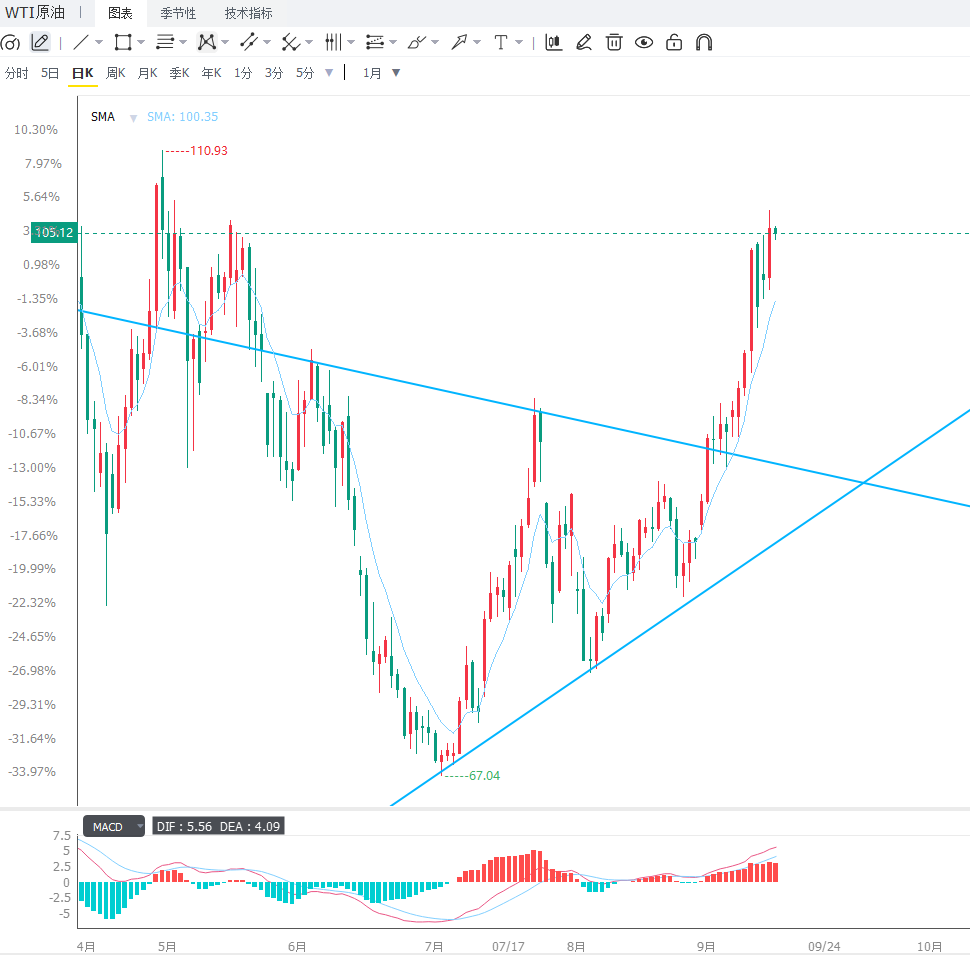 Editor's Summary: The current crude oil market remains in a phase where supply risks and macroeconomic policy expectations are intertwined. The shutdown of key Saudi oil pipelines, the suspension of operations at Libyan oil fields, and risks to Middle Eastern energy facilities and shipping provide fundamental support for WTI to remain above $100. Meanwhile, the market has already priced in some supply risks after the previous rapid rise in oil prices to around $105, reducing the momentum for further short-term gains. Before the Fed's interest rate decision, WTI is expected to maintain high-level fluctuations, with the $105 level continuing to be a key battleground between bulls and bears. If supply disruptions further expand, oil prices may break through $105 and extend to higher levels; if supply risks ease, and the dollar and US Treasury yields strengthen due to the Fed's hawkish signals, oil prices may experience profit-taking. The short-term focus remains on the outcome of policy events, while the medium-term direction depends on the speed of supply facility recovery and the ability of the global energy supply chain to regain stability.
From a fundamental perspective, the biggest support for the crude oil market currently remains on the supply side. The Saudi East-West Pipeline, which transports crude oil from eastern Saudi oil fields to Yanbu port on the Red Sea coast, was previously shut down due to drone attacks. This pipeline is a crucial alternative shipping route bypassing the Strait of Hormuz. Recent market news indicates that Saudi Arabia has canceled or postponed some September crude oil deliveries to European customers, meaning that supply disruptions are beginning to spread from transportation risks to actual spot supply. The significance of this change lies in the fact that the East-West Pipeline is not merely an ordinary oil transport route; its strategic value lies in providing an alternative export route when Persian Gulf shipping is disrupted. When this facility is not functioning properly, market concerns about Saudi crude oil export capacity and the resilience of the global supply chain will increase. Meanwhile, energy infrastructure in the Middle East still faces the risk of further attacks, keeping the crude oil market at a high risk premium. Transportation risks in the Red Sea and the Bab el-Mandeb Strait are also worth noting. As regional attacks increase again, international shipping companies may face higher security, insurance, and detour costs. If key shipping routes continue to be affected, longer crude oil transport cycles and higher freight rates could further exacerbate regional supply shortages. For the market, even if this risk has not yet fully translated into actual production losses, it is enough to prompt traders to pre-price the supply risk premium. Supply pressure is also spreading to North Africa. Two important oil fields and a pumping station in Libya have suspended operations, affecting crude oil transportation. If these facilities cannot be restored in time, Libyan exports may decline further. Meanwhile, attacks on energy infrastructure between Russia and Ukraine continue to impact regional energy supplies, and disruptions to refineries and refined product facilities may further alter the global refined product market's supply and demand balance. Therefore, the crude oil market currently exhibits a relatively clear "supply risk floor" pattern. The core reason WTI has been able to maintain around $105 is not a sudden and significant improvement in demand, but rather the continued existence of supply chain risks and their increasing market risk premium. As long as key Saudi pipelines have not fully recovered, Middle East shipping risks have not significantly decreased, and disruptions to Libyan and Russian energy facilities persist, a sustained deep correction in crude oil prices is unlikely. However, oil prices had already risen rapidly, and after WTI regained $100 and touched around $105, short-term speculative buying has become more cautious. The current market is not lacking in bullish factors. The real factor limiting the continued rapid rise in oil prices is that supply risks have already been partially priced in, and further increases would require new, larger-scale supply disruptions. In other words, the market is gradually shifting from "escalating trading risks" to "waiting for new catalysts." Macroeconomic factors have become a crucial variable in the current short-term market. The Federal Reserve will announce its interest rate decision on Wednesday, and the market has already largely priced in policy adjustments. Since high oil prices themselves push up energy inflation, if crude oil prices remain above $100 for an extended period, it could further increase inflationary pressures and influence market expectations regarding the future path of interest rates. Therefore, the Fed's policy not only affects the dollar and US Treasury yields but also, in turn, influences the oil market through inflation expectations. Before the Fed's decision is officially announced, funds tend to reduce directional positions, making it easier for oil prices to remain range-bound. If the Fed's policy statement and post-meeting remarks do not significantly exceed market expectations, oil prices may continue to consolidate gains around $105. If the policy signals are clearly hawkish, a stronger dollar and higher US Treasury yields could exert temporary pressure on commodities. Conversely, if the market believes there is no need for further tightening of interest rates, a weaker dollar could improve the performance of risk assets such as crude oil. Current market sentiment is therefore exhibiting a clear mixed picture. On the one hand, continued threats to energy infrastructure and supply risks discourage aggressive short-selling; on the other hand, WTI is already at a relatively high level, and funds are unwilling to chase the price significantly higher before major macroeconomic events. Therefore, before the Fed's interest rate decision, WTI maintaining a high level of fluctuation around $105 is more in line with current market dynamics. Two key areas to watch are: first, the progress of the restoration of Saudi Arabia's east-west oil pipelines and whether new supply disruptions occur in major Middle Eastern shipping routes; second, whether the Fed's interest rate decision and policy guidance change expectations regarding the dollar and inflation. If supply risks continue to escalate, a renewed attempt to break above $105 may occur; if there is no new deterioration on the supply side, and the Federal Reserve releases hawkish signals, profit-taking after the previous rapid rise may increase, and oil prices will face more significant downward pressure. From a daily chart perspective, WTI has entered a high-level consolidation phase after its previous rapid rise, with prices still trading above the $100 mark, and the overall upward structure remains intact. The current $105 level is both a recent high and a crucial area of contention between bulls and bears. If the daily chart can effectively break through the $105-$106 range, further resistance levels to watch are $108 and $110; if prices fail to break through the previous high and a pullback occurs, $100 will become the most important psychological support, with further downside support at the $97-$98 area. The current moving average system remains strong, but the momentum has slowed after the rapid rise, indicating that the market is more inclined to digest the gains over time in the short term. From a 4-hour chart perspective, WTI is currently in a clear high-level consolidation phase, with prices fluctuating around $105. Short-term indicators are gradually cooling down from previous highs, but a clear trend reversal signal has not yet formed. $105-$106 is the current short-term breakout zone. If the price breaks and holds above $106 on the 4-hour chart with significant volume, oil prices may test $108 or even $110 again. Conversely, if prices continue to be suppressed near $105 and break below the $102-$103 support level, a deeper technical correction may occur, with the next target around $100. Overall, the technical structure remains bullish, but the market lacks direction before the Fed's interest rate decision, and WTI is expected to continue consolidating around $105. Editor's Summary: The current crude oil market remains in a phase where supply risks and macroeconomic policy expectations are intertwined. The shutdown of key Saudi oil pipelines, the suspension of operations at Libyan oil fields, and risks to Middle Eastern energy facilities and shipping provide fundamental support for WTI to remain above $100. Meanwhile, the market has already priced in some supply risks after the previous rapid rise in oil prices to around $105, reducing the momentum for further short-term gains. Before the Fed's interest rate decision, WTI is expected to maintain high-level fluctuations, with the $105 level continuing to be a key battleground between bulls and bears. If supply disruptions further expand, oil prices may break through $105 and extend to higher levels; if supply risks ease, and the dollar and US Treasury yields strengthen due to the Fed's hawkish signals, oil prices may experience profit-taking. The short-term focus remains on the outcome of policy events, while the medium-term direction depends on the speed of supply facility recovery and the ability of the global energy supply chain to regain stability.
- Risk Warning and Disclaimer
- The market involves risk, and trading may not be suitable for all investors. This article is for reference only and does not constitute personal investment advice, nor does it take into account certain users’ specific investment objectives, financial situation, or other needs. Any investment decisions made based on this information are at your own risk.