In-depth analysis of US August retail sales data: Asset pricing restructuring driven by strong consumer spending.
2026-09-16 21:08:08
The latest retail and inflation data released in August showed a comprehensive and stronger-than-expected trend, significantly shaking off the sluggish state of July and even showing a V-shaped rebound: Overall retail sales month-on-month: actually recorded a strong growth of 1.2%, far exceeding the market forecast of 0.8%, and achieving an extremely strong explosive V-shaped rebound compared to the sluggish performance of -0.6% in July. Core retail sales month-on-month: actually recorded a better-than-expected growth of 1.4%, significantly higher than the forecast of 0.5%, and a significant turnaround from the negative growth of -0.3% in July, indicating that basic consumption remains extremely strong after excluding automobiles and gas stations. Retail sales year-on-year: recorded a high growth of 6.01%, a significant acceleration from the previous value of 5.01%, demonstrating the extremely strong resilience of US household consumption. 
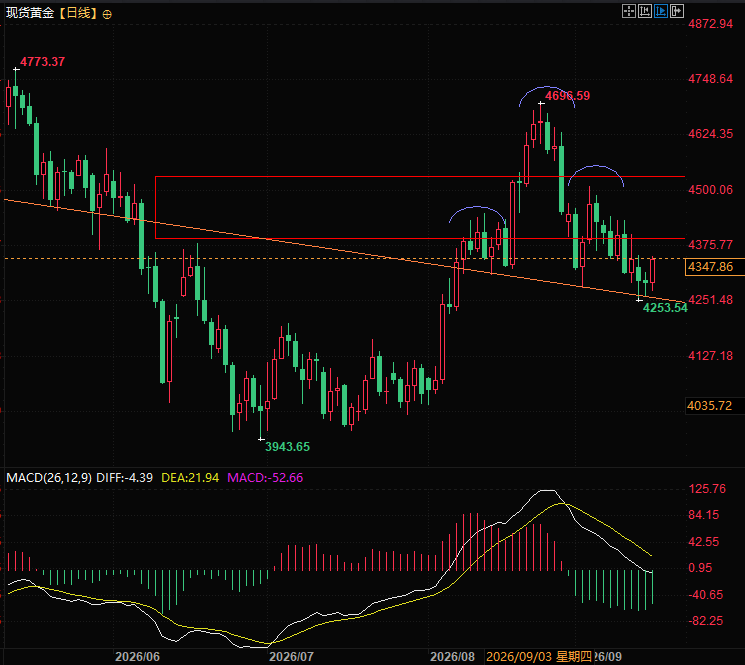 (Spot gold daily chart, source: EasyTrade) At 21:02 Beijing time, spot gold is currently trading at $4346 per ounce.
Structural Analysis: The Real "Quantitative Increase" After Removing Inflation
The comprehensive recovery in both major and basic consumption, with a significant increase in both overall (1.2% growth) and core (1.4% growth) data, indicates a full-scale release of consumption in August, whether in commodities like automobiles suppressed by high interest rates or in non-durable goods such as daily retail and catering. Meanwhile, real purchasing power after adjusting for inflation shows actual overall consumption growth: calculated as nominal overall growth of 1.2% minus CPI of 0.4%, resulting in an actual growth of approximately 0.8%. Real core consumption also saw growth: calculated as nominal core growth of 1.4% minus CPI of 0.4%, resulting in an actual growth of approximately 1.0%. This breakdown directly proves that the surge in consumption in August was not simply propped up by inflation, but rather that American residents were genuinely buying more goods and services. Personal consumption expenditure (PCE) in the third quarter GDP received extremely strong underlying support.Cross-asset linkage logic: From the "sell-off" of CPI to the "soft landing" pricing for retail.
The asset performance following the release of this retail sales data perfectly mirrored and reinforced the cross-asset evolution logic observed after the previous CPI data release: The "sell the news" effect: Previous CPI data showed that while inflation was rising, the increase was limited, and the market had already fully priced in "interest rate hikes or prolonged high interest rates." With short-term tightening a foregone conclusion, market concerns about uncontrolled long-term inflation significantly decreased, creating a typical "sell the news" environment. Strong economic resilience alleviates valuation pressure: Strong retail sales data further validates the "soft landing" or even "non-landing" trend of the US economy. Strong fundamental growth supports a higher interest rate environment, significantly alleviating market anxiety about an economic recession. Risk appetite not only did not deteriorate due to high interest rates, but was actually repaired by strong expectations for corporate profits, significantly slowing the valuation suppression effect of high interest rates on equity assets. Meanwhile, a major reason for the previous surge in US Treasury bonds was market concerns about the US's debt repayment capacity, requiring higher bond yields to compensate. However, "when consumption and economic data significantly exceeded expectations, market concerns about the tail risks of government fiscal deterioration and debt default were largely eliminated. This rapid narrowing of the sovereign credit risk premium drove investors to reallocate to risk-free assets, thereby depressing the real yield of Treasury bonds." In other words, the fading inflation concerns led to a reduction in the cash-futures premium of real interest rates, while the narrowing of sovereign credit risk also lowered real yields. Therefore, from this perspective, gold experienced a significant recovery in opportunity cost.Summary and Outlook
This combination of retail sales data and previous CPI data presents the market with the best window for speculation regarding a "strong economy, stable inflation, and a distant recession": For the Federal Reserve: Raising interest rates can resolve inflation uncertainty and may even cause Treasury yields to fall. The current long-term Treasury yield equals the expected average future short-term interest rate plus the term premium. The term premium reflects concerns about economic growth and uncertainty about inflation. Interest rate hikes eliminate inflation, while retail sales data eliminates concerns about economic growth, ultimately leading to a significant reduction in the term premium and thus lowering Treasury yields. For the market: The market is shifting from past panic about "high interest rates suppressing valuations" to a rational pricing phase where "strong fundamentals offset high interest rate costs." As a result, equity assets and gold, among other major asset classes, have shown unexpected resilience and rebound strength. (Spot gold daily chart, source: EasyTrade) At 21:02 Beijing time, spot gold is currently trading at $4346 per ounce.
- Risk Warning and Disclaimer
- The market involves risk, and trading may not be suitable for all investors. This article is for reference only and does not constitute personal investment advice, nor does it take into account certain users’ specific investment objectives, financial situation, or other needs. Any investment decisions made based on this information are at your own risk.