Three questions that should be asked of Walshti at the press conference
2026-09-16 22:06:10
 Today (September 16th, early morning of September 17th Beijing time), the Federal Reserve's interest rate meeting is divided into two parts. At 2 PM Eastern Time, the Federal Open Market Committee (FOMC) statement and dot plot will be released. At that time, we will know whether the Fed will raise interest rates by 25 basis points (a rate hike is expected), and whether the dot plot shows one or two more rate hikes this year (one more is expected). A press conference will be held at 2:30 PM Eastern Time, where the real debate will begin. If I were at the press conference, I would ask Warsh the following questions:
 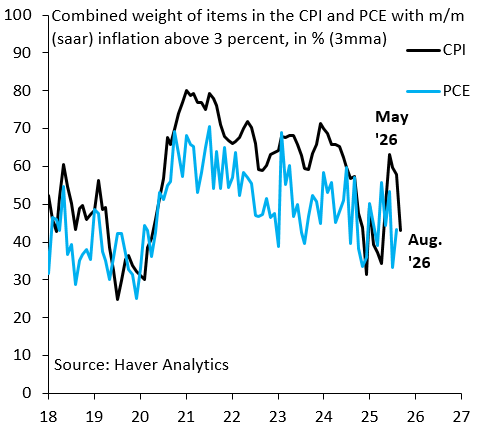 Question 1: Why raise interest rates? In your speech at the Jackson Hole Economic Symposium on August 28th, you mentioned a statistical indicator: the combined percentage of items in the Personal Consumption Expenditures (PCE) price index basket with inflation exceeding 3%. The August data released last Friday showed a significant drop in this indicator; this indicates that the unexpected rise in core inflation was actually driven by only a few specific categories (such as mobile communication services). As shown by the black line in the chart, this indicator peaked in May, when a surge in oil prices brought a brief period of inflation, but this inflationary momentum has now clearly subsided. Since the continuous supply shocks have not caused widespread inflation, why are you still raising interest rates?
 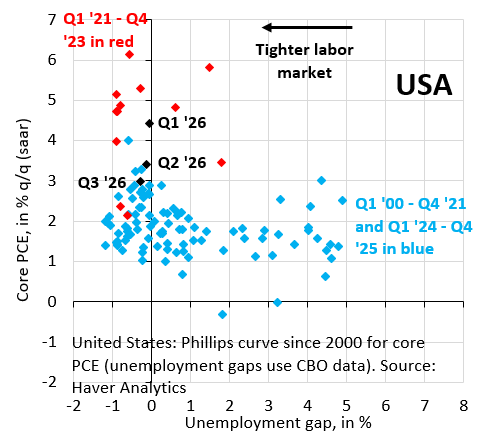 Question 2: What's the point of only raising interest rates once? As shown in the chart, the Phillips curve is extremely flat. This means that multiple large interest rate hikes are needed to suppress inflation more quickly. The market is pricing in a cycle of rate hikes, but you only plan to raise rates once, without committing to a continuous rate hike cycle. What's the point? Raising rates only once seems more like a formality, merely to quell criticism, without truly tightening financial conditions.
 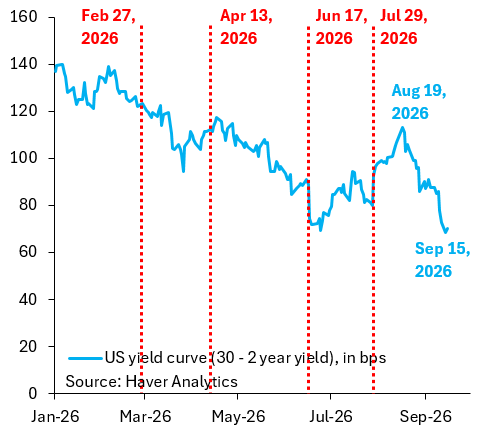 Question 3: Why did you shift to a hawkish stance at the Jackson Hole symposium? At the July 29th press conference, Colby Smith of the *New York Times* asked you whether the Fed kept interest rates unchanged because the main driver of inflation was supply shocks. Your answer at the time implied that these supply shocks had not clearly triggered widespread inflation, hence the lack of a rate hike in July. However, just one month later, at the Jackson Hole symposium on August 28th, you stated that the problem of widespread inflation still existed, thus a rate hike might be necessary. Please explain why your stance underwent such a drastic change without any new key data. Is there reason for the market to believe that this shift was a reaction to the steepening of the yield curve after the July 29th press conference (see above)? If the purpose of this hawkish shift was to anchor long-term yields, then this contradicts the intended effect of a hawkish stance—hawkish policy should push up long-term yields to tighten financial conditions. This policy meeting was a dilemma for Warsh. The logic behind the Fed's rate hikes is flawed; if the Fed truly wants to suppress inflation, it's puzzling that it doesn't commit to starting a rate hike cycle. Warsh's motives for his dramatic shift in stance during Jackson Hole are equally unclear, unless his real aim was to suppress long-term yields, which contradicts the goal of tightening financial conditions through rate hikes. In my view, tomorrow's likely outcome will be: the Fed completes its rate hikes, but long-term bonds continue to be sold off, the dollar weakens, and gold prices rise. This will happen precisely because none of the above questions have been adequately answered.
- Risk Warning and Disclaimer
- The market involves risk, and trading may not be suitable for all investors. This article is for reference only and does not constitute personal investment advice, nor does it take into account certain users’ specific investment objectives, financial situation, or other needs. Any investment decisions made based on this information are at your own risk.