The Federal Reserve's hawkish signals, coupled with a slowdown in oil price gains, pushed the US dollar near 1.4000 against the Canadian dollar, hitting a five-week high.
2026-09-17 14:34:10
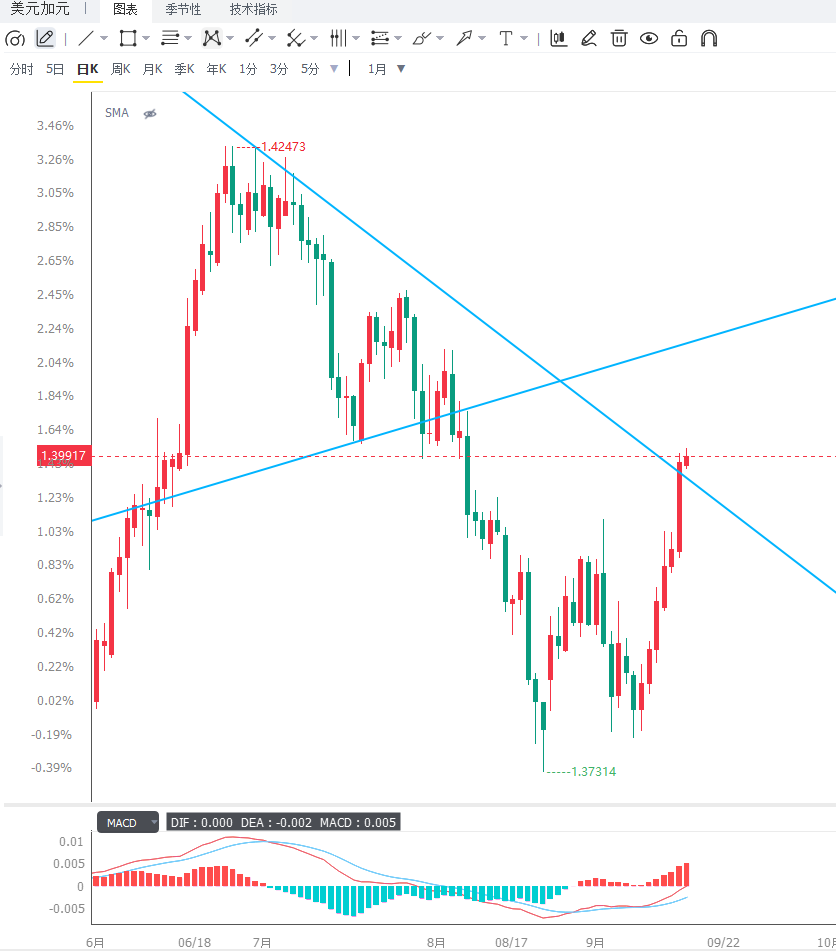
The US dollar continued its upward trend against the Canadian dollar in Asian trading on Thursday, rising to around 1.4000 at one point, a five-week high, and is currently trading around 1.3992. The rise was mainly driven by a broad-based strengthening of the US dollar and a temporary slowdown in the oil price rally. The US dollar index is currently holding near 100.33, in this week's high range, indicating a rapid increase in market demand for dollar assets following the Federal Reserve's policy shift. 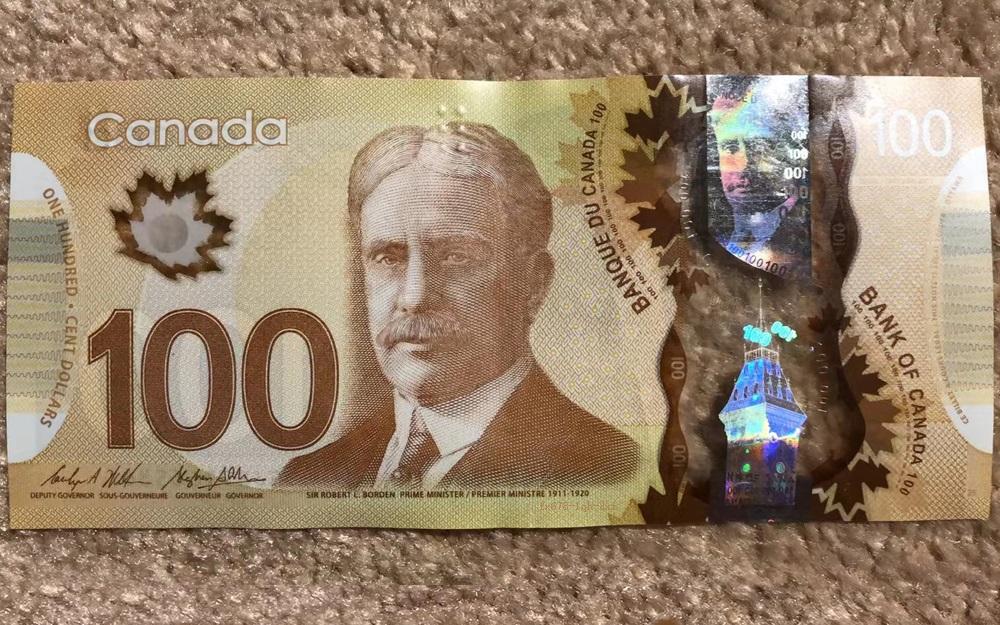 The Federal Reserve raised its benchmark interest rate by 25 basis points to 3.75%-4.00% on Wednesday, in line with market expectations. After holding rates unchanged for five consecutive meetings, the Fed's resumption of rate hikes has prompted the market to reassess the future path of monetary policy. Chairman Kevin Warsh emphasized after the meeting that price pressures may persist for a longer period. While he did not further clarify the timetable for future rate adjustments, his hawkish inflation stance has boosted market expectations for further rate hikes. Market data shows that the probability of at least two more rate hikes by the Fed this year has risen from approximately 79% before the decision to 88.7%. This readjustment of interest rate expectations towards tightening has pushed up short-term yields in the US, while strengthening the dollar's interest rate advantage. The dollar generally rose against major currencies this week, gaining approximately 1.61% against the yen, 1.22% against the euro, 1.17% against the pound, and 0.88% against the Canadian dollar. The general strengthening of the dollar has been a significant driver of the USD/CAD pair's continued move towards 1.40 after breaking through 1.39. Regarding the Canadian dollar, changes in the oil market are weakening its traditional support as a commodity currency. International oil prices recently broke through $100, but the upward momentum weakened as the market reassessed the recovery of Middle Eastern supply and Saudi Arabia's energy export capacity. For net energy exporting economies like Canada, high oil prices typically improve export revenue expectations and support the Canadian dollar; conversely, if oil prices fall from their highs, the commodity price support for the Canadian dollar weakens accordingly. However, oil prices are currently still relatively high, so the rise in USD/CAD is more a combination of a strong US dollar and weakening Canadian dollar support, rather than driven by a single factor. If oil prices break through $100 again and continue to rise, the Canadian dollar may regain some support; if oil prices continue to fall while US yields remain high, USD/CAD may remain relatively strong. From a macroeconomic perspective, the US-Canada interest rate differential remains a significant factor influencing the exchange rate. The Federal Reserve's renewed interest rate hikes mean a further widening of the US interest rate advantage, and the Bank of Canada's subsequent policy direction will be a key focus for the market in the next phase. Meanwhile, oil prices, Canadian economic data, and global risk sentiment will also affect the Canadian dollar's performance through capital flows. Investors should currently focus on US inflation and employment data, speeches by Federal Reserve officials, policy signals from the Bank of Canada, and changes in oil prices. From a daily chart perspective, the USD/CAD pair is currently trading around 1.3992, with the price above the 20-period EMA at 1.3890, maintaining an overall upward short-term trend. After breaking through 1.39, the pair is approaching the 1.40 level, with the RSI around 61.2, indicating relatively strong bullish momentum, but not yet entering extreme overbought territory. On the upside, the first resistance level to watch is the 23.6% Fibonacci retracement level around 1.4082, followed by the previous cycle high around 1.4247; a decisive break above 1.4082 could extend the upside potential. On the downside, the first support level to watch is the 38.2% Fibonacci retracement level around 1.3980, followed by the 50% retracement level at 1.3898 and the 20-period EMA around 1.3890. From a 4-hour chart perspective, the USD/CAD pair maintains an upward trend with short-term moving averages trending upwards, and the price is steadily approaching the 1.4000 level. If the exchange rate breaks through and holds above 1.4000, it may further test the resistance around 1.4080 in the short term. If the bulls fail to break through 1.4000 and profit-taking occurs, the first support level to watch is the 1.3898-1.3900 area. If it falls further below 1.3890, the 4-hour upward structure will be weakened, and the exchange rate may seek the next support around 1.3816.
  Editor's Summary: The USD/CAD pair rose to around 1.4000, primarily driven by a stronger US dollar fueled by expectations of a hawkish Federal Reserve policy, and weakening support for the Canadian dollar due to waning upward momentum in oil prices. In the short term, 1.4000 is a key psychological level, and the direction after a breakout will be a key focus for the market. Going forward, US interest rate expectations, Canadian monetary policy, and oil prices will continue to determine the main direction of the exchange rate. If the US dollar remains strong and oil prices continue to adjust, upward pressure on the USD/CAD pair may persist, while a renewed strengthening of oil prices could alleviate downward pressure on the Canadian dollar.
The Federal Reserve raised its benchmark interest rate by 25 basis points to 3.75%-4.00% on Wednesday, in line with market expectations. After holding rates unchanged for five consecutive meetings, the Fed's resumption of rate hikes has prompted the market to reassess the future path of monetary policy. Chairman Kevin Warsh emphasized after the meeting that price pressures may persist for a longer period. While he did not further clarify the timetable for future rate adjustments, his hawkish inflation stance has boosted market expectations for further rate hikes. Market data shows that the probability of at least two more rate hikes by the Fed this year has risen from approximately 79% before the decision to 88.7%. This readjustment of interest rate expectations towards tightening has pushed up short-term yields in the US, while strengthening the dollar's interest rate advantage. The dollar generally rose against major currencies this week, gaining approximately 1.61% against the yen, 1.22% against the euro, 1.17% against the pound, and 0.88% against the Canadian dollar. The general strengthening of the dollar has been a significant driver of the USD/CAD pair's continued move towards 1.40 after breaking through 1.39. Regarding the Canadian dollar, changes in the oil market are weakening its traditional support as a commodity currency. International oil prices recently broke through $100, but the upward momentum weakened as the market reassessed the recovery of Middle Eastern supply and Saudi Arabia's energy export capacity. For net energy exporting economies like Canada, high oil prices typically improve export revenue expectations and support the Canadian dollar; conversely, if oil prices fall from their highs, the commodity price support for the Canadian dollar weakens accordingly. However, oil prices are currently still relatively high, so the rise in USD/CAD is more a combination of a strong US dollar and weakening Canadian dollar support, rather than driven by a single factor. If oil prices break through $100 again and continue to rise, the Canadian dollar may regain some support; if oil prices continue to fall while US yields remain high, USD/CAD may remain relatively strong. From a macroeconomic perspective, the US-Canada interest rate differential remains a significant factor influencing the exchange rate. The Federal Reserve's renewed interest rate hikes mean a further widening of the US interest rate advantage, and the Bank of Canada's subsequent policy direction will be a key focus for the market in the next phase. Meanwhile, oil prices, Canadian economic data, and global risk sentiment will also affect the Canadian dollar's performance through capital flows. Investors should currently focus on US inflation and employment data, speeches by Federal Reserve officials, policy signals from the Bank of Canada, and changes in oil prices. From a daily chart perspective, the USD/CAD pair is currently trading around 1.3992, with the price above the 20-period EMA at 1.3890, maintaining an overall upward short-term trend. After breaking through 1.39, the pair is approaching the 1.40 level, with the RSI around 61.2, indicating relatively strong bullish momentum, but not yet entering extreme overbought territory. On the upside, the first resistance level to watch is the 23.6% Fibonacci retracement level around 1.4082, followed by the previous cycle high around 1.4247; a decisive break above 1.4082 could extend the upside potential. On the downside, the first support level to watch is the 38.2% Fibonacci retracement level around 1.3980, followed by the 50% retracement level at 1.3898 and the 20-period EMA around 1.3890. From a 4-hour chart perspective, the USD/CAD pair maintains an upward trend with short-term moving averages trending upwards, and the price is steadily approaching the 1.4000 level. If the exchange rate breaks through and holds above 1.4000, it may further test the resistance around 1.4080 in the short term. If the bulls fail to break through 1.4000 and profit-taking occurs, the first support level to watch is the 1.3898-1.3900 area. If it falls further below 1.3890, the 4-hour upward structure will be weakened, and the exchange rate may seek the next support around 1.3816. Editor's Summary: The USD/CAD pair rose to around 1.4000, primarily driven by a stronger US dollar fueled by expectations of a hawkish Federal Reserve policy, and weakening support for the Canadian dollar due to waning upward momentum in oil prices. In the short term, 1.4000 is a key psychological level, and the direction after a breakout will be a key focus for the market. Going forward, US interest rate expectations, Canadian monetary policy, and oil prices will continue to determine the main direction of the exchange rate. If the US dollar remains strong and oil prices continue to adjust, upward pressure on the USD/CAD pair may persist, while a renewed strengthening of oil prices could alleviate downward pressure on the Canadian dollar.
- Risk Warning and Disclaimer
- The market involves risk, and trading may not be suitable for all investors. This article is for reference only and does not constitute personal investment advice, nor does it take into account certain users’ specific investment objectives, financial situation, or other needs. Any investment decisions made based on this information are at your own risk.