In Warsh's first rate hike statement, the repricing was not 25 basis points.
2026-09-17 15:16:09
On Thursday, September 17th, the Federal Reserve raised the target range for the federal funds rate by 25 basis points to 3.75% to 4.00% in the early morning, with a vote of 12-0. This is the first rate hike since July 2023 and the first policy shift since Kevin Warsh became chairman. The official statement addressed the dual mandate in short sentences: economic activity is expanding at a steady pace, employment and labor force growth are roughly in line, the unemployment rate is little changed, and inflation remains high; this action aims to push prices back to the 2% target more quickly. The market reacted simultaneously, with interest rate futures raising the probability of another rate hike this year to nearly 90%. 
 Warsh repeatedly emphasized that credibility isn't about sounding tight, but about ensuring policy will ultimately follow when the committee deems inflation unacceptable. The 25 basis points in this decision are the first verifiable evidence of this logic. Subsequent meetings will depend on whether prices fall at the pace required by the committee, whether financial conditions are reassessed as restrictive, and whether the dot plot will be rewritten again. While Warsh hasn't locked down the path, pricing has already incorporated "inflation first" into the short end of the spectrum.
Information gap between consistent interest rate hikes and dot plot
The resolution text was deliberately condensed. The statement omits conditional statements, only emphasizing high inflation and the Committee's commitment to price stability. The implementation details simultaneously raise the interest rate on excess reserves to 3.90% and the primary lending rate to 4.00%, effective September 17. Operationally, the upper limit of the overnight repo rate and the lower limit of the reverse repo rate have shifted upwards along with the target range, while the banking system maintains an ample reserve framework. Even tougher than the statement is the summary of economic projections. Warsh himself continues to refrain from submitting the dot plot, consistent with his rejection of forward guidance. Among the committee members who submitted projections, the vast majority placed the appropriate interest rate at a higher level by the end of 2026, with a median of approximately 4.1%, and maintained the same level in 2027. The projections also provide a set of comparative figures: real GDP growth of 2.3% this year and 2.4% next year; personal consumption expenditure price index of 3.7% this year, falling back to 2.3% next year; and unemployment rate of approximately 4.1%. The numbers themselves aren't dramatic, but the structure is clear: growth and employment are described as manageable, while the inflation path is described as requiring further policy intervention. The market reads the dot plot, focusing on the distribution rather than the median. Most committee members included at least one more rate hike in their forecasts for the year, a few indicated two, and a very small minority reversed course. This dispersion suggests the committee's expectations for the final outcome are not uniform, but there is a consensus that "one rate hike is insufficient to conclude the discussion."Walsh prioritized the issue of reputation.
At the press conference, Warsh summarized the reasons for the rate hike into three points: economic activity has strengthened since the July meeting, inflation has not slowed as expected, and geopolitical tensions have risen. He then set a definitive standard: "This summer's inflation readings did not tell me that the underlying trend has shown meaningful improvement." "We must be confident that underlying inflation is clearly and quickly returning to the target. Today, the Committee determined that this standard has not yet been met." He also reiterated a more direct assessment: "Inflation is too high, and has been too high for too long." In contrast to the dot plot, he rejected the path. "I will not engage in forward guidance business." "I will not predict any future decisions." He can let the Committee's summary of projections speak for itself, but he refuses to tie himself to a predetermined rate hike path. In the same press conference, his characterization of financial conditions was even more crucial: corporate credit flows were strong, and in the words of the Jackson Hole symposium, it was difficult to describe broad financial conditions as restrictive, therefore the Committee chose to "remove a dose of easing." The market implication of this statement is that 25 basis points were defined as a correction of the easing margin, not that the brakes had been applied to the floor. The White House's response provided external constraints but did not alter the voting result. The US president wrote on social media that US interest rates should be 1% or lower. When asked about his discussions with the president, Warsh simply said, "There's nothing to say." The committee unanimously voted to raise interest rates, but the chairman refused to provide the dot plot or a timeline.Inflation stickiness and the misalignment of financial conditions
The data base for the policy shift is not new, but it's no longer being digested with a "wait and see" approach. The US Personal Consumption Expenditures (PCE) price index rose 3.7% year-on-year in July, with core PCE at 3.3% and both at 0.2% month-on-month. Warsh's immediate projection at the meeting was: combining the published CPI and PPI, the August PCE year-on-year figure would be around 3.6%, core PCE around 3.2%, and the overall CPI around 2.4%. Several categories remained above 3% on both the 6-month and 12-month annualized basis. For the committee, the issue wasn't the month-on-month change in a single month, but rather the extended period of underlying inflation above the target. Energy and Middle East conflicts increased the weight of some supply shocks, but the statement and press conference did not entirely attribute the responsibility to external shocks. Warsh's statement juxtaposed supply and demand: relative price changes can occur, but monetary policy must prevent them from spreading into a broader price process. The employment side was described as "keeping pace with the labor force," not an overheating narrative or a recession narrative. Thus, the policy function presents a structure familiar to traders: inflation is still short of 2%, and financial conditions are not deemed sufficiently tight by the Committee. When both conditions are met, the interest rate path can only tilt towards tightening, until data rewrites one extreme. When the forecast summary pushed back the timeline for the 2% target, Warsh immediately disavowed it: "Those aren't my forecasts." This statement brought the internal modeling disagreements within the Committee into the open. The Chairman wanted immediate action aligned with credibility, not a dot plot that might only approach the target in 2028 or 2029 as a commitment. The market therefore had to process two sets of information simultaneously: the target rate favored by the majority of Committee members, and the Chairman's refusal to accept the target rate.Pricing Shift: Short-Term Interest Rates, the US Dollar Index, and Volatility Structure
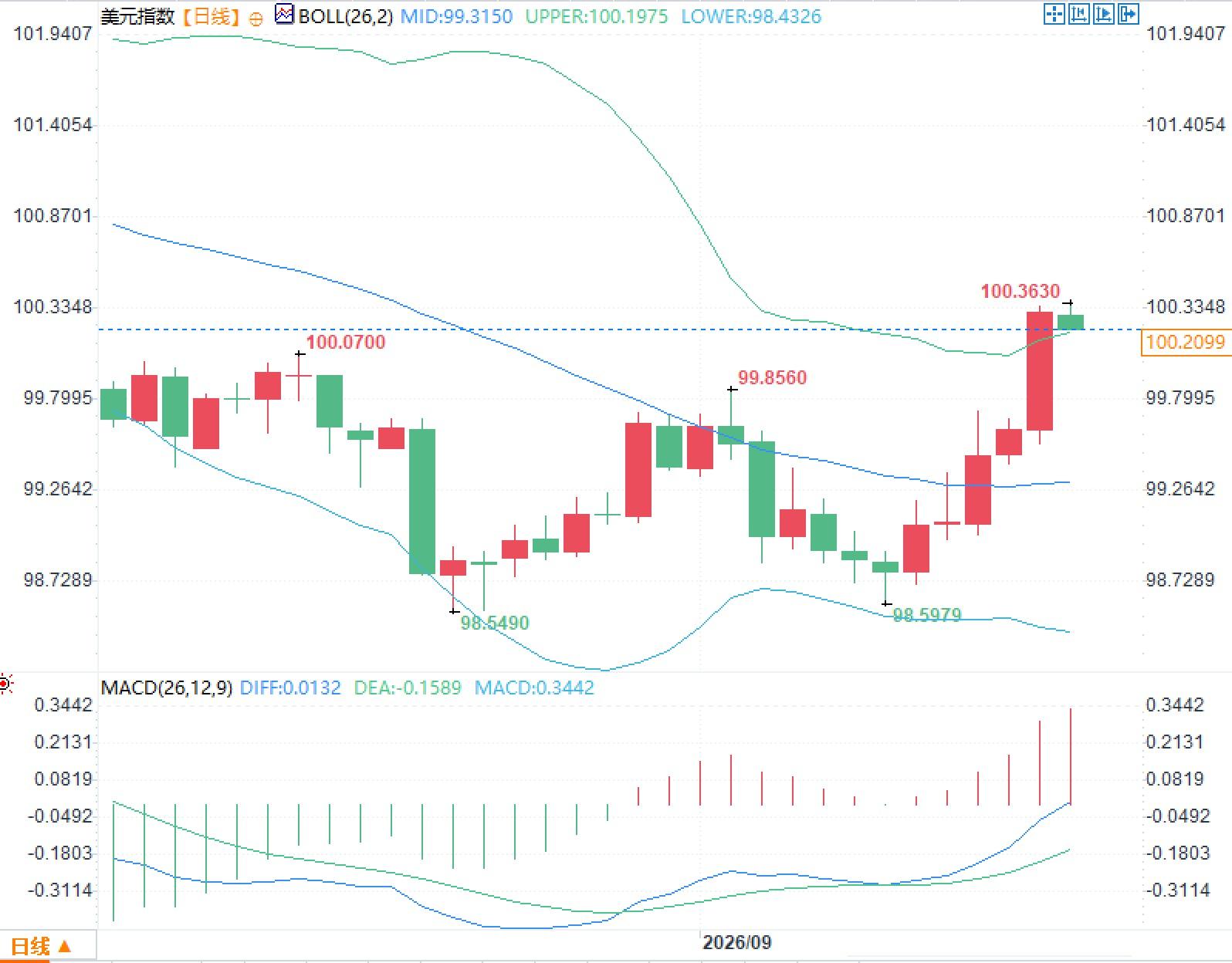
Asset prices underwent a probability reassessment rather than a directional declaration following the Fed's decision. The two-year Treasury yield, most sensitive to policy rate expectations, rose to approximately 4.72% to 4.74% on the day, an increase of about 6 basis points from the previous trading day. The ten-year Treasury yield fluctuated around 5.00%, and the yield curve did not automatically adopt a single slope story due to the jump in the short end. Interest rate futures pushed the probability of another rate hike this year to nearly 90% after the decision, consistent with the majority distribution of "at least one more" in the dot plot. The US dollar index rose from around 99.5 on the day of the decision, with an intraday high above 100. Currently, the Bollinger Band middle line is around 99.32, the upper line around 100.20, and the lower line around 98.43. Prices approached the upper volatility band after the decision, and the bandwidth reopened after the previous contraction. The MACD shows the DIFF at approximately 0.01, the DEA still negative, and the histogram turning positive and expanding. Warsh repeatedly emphasized that credibility isn't about sounding tight, but about ensuring policy will ultimately follow when the committee deems inflation unacceptable. The 25 basis points in this decision are the first verifiable evidence of this logic. Subsequent meetings will depend on whether prices fall at the pace required by the committee, whether financial conditions are reassessed as restrictive, and whether the dot plot will be rewritten again. While Warsh hasn't locked down the path, pricing has already incorporated "inflation first" into the short end of the spectrum.
- Risk Warning and Disclaimer
- The market involves risk, and trading may not be suitable for all investors. This article is for reference only and does not constitute personal investment advice, nor does it take into account certain users’ specific investment objectives, financial situation, or other needs. Any investment decisions made based on this information are at your own risk.