The US dollar fell back after briefly breaking 96 against the Indian rupee, suggesting possible intervention by the Reserve Bank of India.
2026-09-17 15:34:09
The Indian rupee found buying support after a weak opening on Thursday (September 17), with the dollar currently slightly lower against the rupee, trading around 95.88. According to reports from prominent institutions, the Reserve Bank of India (RBI) may have intervened to limit the rupee's decline, with traders saying state-owned banks were selling dollars on behalf of the RBI. 
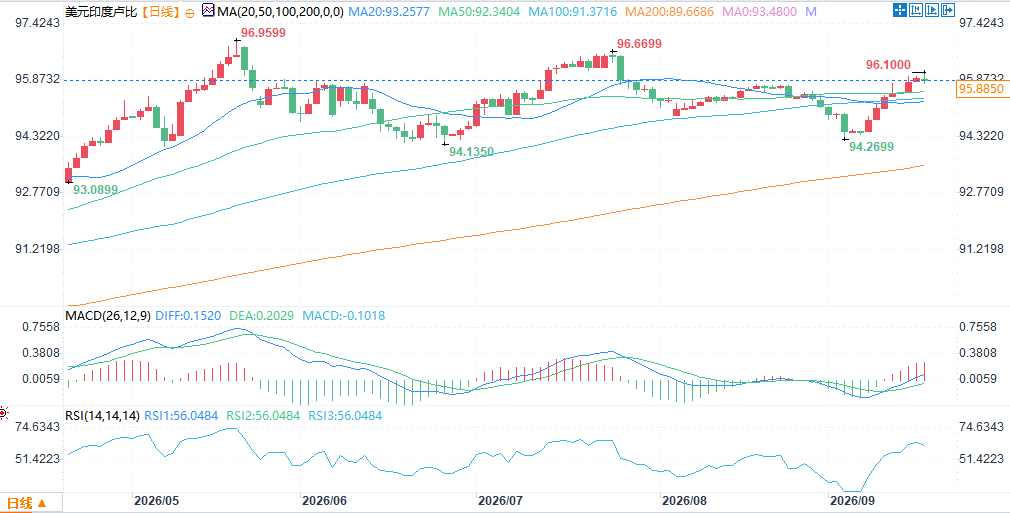 (USD/INR daily chart, source: FX678) At 15:30 Beijing time, the USD/INR exchange rate was 95.88/89.
The rupee rises: Reserve Bank of India intervention limits declines.
According to reports from well-known institutions, the Reserve Bank of India (RBI) may have intervened to limit the rupee's decline, with traders saying state-owned banks were selling dollars on behalf of the RBI. This intervention was highly likely, as the US dollar strengthened significantly following the Federal Reserve's hawkish rate hike on Wednesday, but the dollar did not perform as strongly as expected against the Indian rupee. The rupee initially fell below 96 after opening, the first time in over a month, but subsequently recovered following what appeared to be central bank action, narrowing its losses. High oil prices and importers' demand for foreign currency continue to exert pressure, and the central bank's intervention effectively buffered external shocks, demonstrating the authorities' determination to maintain exchange rate stability. The market expects subsequent fluctuations to remain influenced by the dollar's performance and oil prices.Federal Reserve Decision: 25 basis point rate hike; dot plot points to one more rate hike this year.
The Federal Reserve broke its five-day streak of holding rates steady on Wednesday, raising interest rates by 25 basis points to 3.75%-4.00%. The Fed was widely expected to tighten monetary policy, as the latest consumer price index readings showed sticky inflationary pressures. As expected, Fed Chairman Kevin Warsh did not comment on the outlook for monetary policy but warned of high inflationary pressures. Warsh stated, "Inflation is too high, and it has been going on for too long." However, the dot plot showed that 16 of the 18 policymakers expect at least one more rate hike this year.Institutional View: Higher and Longer Policy Inclination, Terminal Interest Rate at 4.25%
Economists from prominent institutions believe the updated dot plot points to "relatively broad support for a more restrictive monetary policy over a considerable period." In their view, the Fed "won't see a return to the 3.5%-3.75% range until the end of 2029," highlighting a higher and longer policy inclination. The team believes that "the 4.25% upper limit represents the peak of what could be a short-lived tightening cycle," and the timing and size of eventual rate cuts may "depend on the sustainability of the economic expansion (i.e., the AI boom)."Expectations of tightening by the Reserve Bank of India are rising.
Financial markets are beginning to price in a potential shift by the Reserve Bank of India (RBI) to a monetary tightening cycle to combat rising inflationary pressures. India's retail consumer price index (CPI) has accelerated for ten consecutive months, reaching 4.82% year-on-year in August, reinforcing the case for a near-term interest rate hike. Analysts at a prominent institution stated, "The gradual widening of price pressures could keep overall inflation above 5% in the second half of the fiscal year, highlighting the necessity for a more tightening policy stance." The institution added, "Recent developments, including continued rises in oil prices, tightening global financial conditions, robust domestic growth, and signs of widening core pressures, strengthen the case for a modest 50 basis point rate hike in the second half of fiscal year 2027, making the October meeting a 'live meeting'."Summary: The rupee received short-term intervention support, but expectations of tightening by both the Federal Reserve and the Reserve Bank of India are putting pressure on it.
In summary, the Indian rupee rose against the trend after the Fed's hawkish rate hike, mainly due to the intervention of the Reserve Bank of India (RBI). However, the US dollar index remained firm at a six-week high, and the Fed's dot plot pointed to another rate hike this year, with a higher and longer policy stance putting external pressure on the rupee. Domestically, Indian inflation has accelerated for ten consecutive months, and the market is pricing in a possible tightening cycle from the RBI. For the rupee, short-term intervention provides support, but the expectation of tightening from both the Fed and the RBI limits upside potential. Going forward, attention should be paid to the sustainability of the RBI's intervention, the evolution of Fed rate hike expectations in October and December, and whether Indian inflation data can validate the necessity of tightening. (USD/INR daily chart, source: FX678) At 15:30 Beijing time, the USD/INR exchange rate was 95.88/89.- Risk Warning and Disclaimer
- The market involves risk, and trading may not be suitable for all investors. This article is for reference only and does not constitute personal investment advice, nor does it take into account certain users’ specific investment objectives, financial situation, or other needs. Any investment decisions made based on this information are at your own risk.