Oil prices cooled, but bottoming-out inventories and turmoil in the Red Sea provided support for the bullish market.
2026-09-17 16:28:10
On Thursday (September 17), during the Asian and European sessions, international oil prices experienced a slight dip and rebound, falling by 0.68%. WTI crude oil futures traded around 101.6. Multiple signals of supply recovery were released, pushing high oil prices down. However, key variables such as the geopolitical stalemate, regional confrontation risks, and low global inventories have not been completely resolved, and the crude oil market continues to maintain a high-level oscillating trading pattern. 
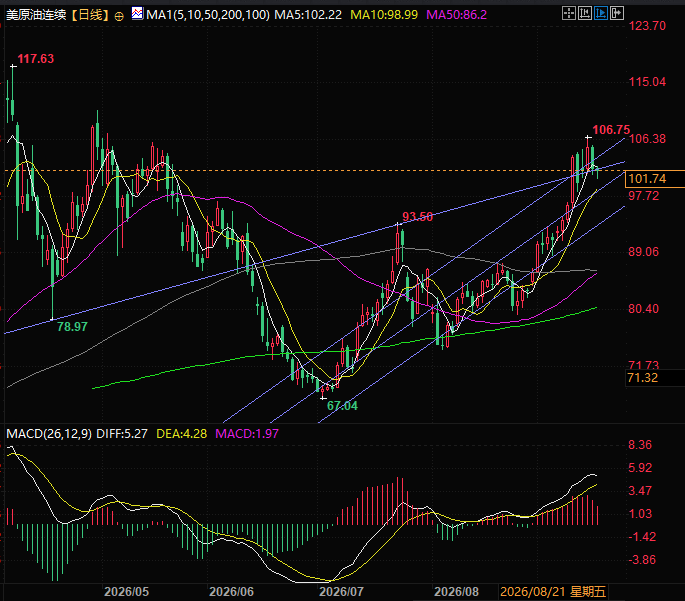 (WTI crude oil futures daily chart, source: EasyTrade) At 16:26 Beijing time, WTI crude oil futures were trading at $101.6 per barrel.
Saudi Arabia's oil and gas transportation routes continue to resume production, easing supply pressure.
The core driver of this round of oil price correction comes from two major positive developments in the Middle Eastern crude oil supply chain, which have completely reversed the market's short-term extreme supply anxiety. Firstly, Saudi Arabia's energy supply chain has seen a crucial recovery. The Saudi East-West crude oil pipeline, previously damaged by drone attacks, is a key land-based alternative route after shipping disruptions in the Strait of Hormuz. Saudi Arabia has initiated an emergency repair plan, and by rerouting around the damaged section, it is expected to restore 50% of the pipeline's capacity within days, and achieve full-capacity operation within six weeks. Simultaneously, Saudi Arabia is actively developing alternative maritime transport routes, utilizing the port of Sohar in Oman for ship-to-ship crude oil transshipment, and increasing crude oil loading capacity at Gulf ports to 4 million barrels per day. This effectively offsets the export gap caused by Red Sea shipping disruptions and significantly alleviates concerns about a global crude oil supply shortage.US signals easing geopolitical tensions and improved supply, oil prices cool down.
On the other hand, the geopolitical tensions between the US and Iran have released signs of easing, further suppressing the risk premium in oil prices. US President Trump publicly released positive signals, stating that the nearly seven-month-long US-Iran conflict "is expected to end soon," and revealing that Iran has proactively sought negotiations and hopes to reach a reconciliation agreement. The US has already made direct contact with Tehran. Although neither side has officially announced a ceasefire agreement or final peace terms, this is the clearest diplomatic easing signal released by the US recently, significantly reducing market panic about a full-scale escalation of conflict in the Middle East. Meanwhile, US Energy Secretary Chris Wright confirmed at a press conference of the International Atomic Energy Agency in Vienna that the current daily shipping volume of crude oil and refined petroleum products through the Strait of Hormuz has reached 10 million barrels, and the volume is expected to continue to climb in the coming weeks. As a core energy route carrying 25% of global crude oil trade and 20% of liquefied natural gas trade, the recovery of shipping through the Strait of Hormuz means that the problem of bottlenecks in Middle Eastern crude oil exports is marginally easing, and the effective supply of crude oil in the market continues to expand, becoming the core fundamental support for the oil price correction. It is worth noting that the United States had previously adjusted its strategy towards Iran, ceasing large-scale military strikes and shifting to economic sanctions and pressure, significantly reducing the probability of high-intensity military conflict in the region. Core Risk Review: The Middle East geopolitical stalemate remains unbroken. Despite multiple positive factors contributing to a sustained decline in international oil prices from their highs, the basis for a unilateral market downturn is not valid. Numerous potential risks continue to support the resilience of crude oil prices at their bottom, and the uncertainty surrounding the future remains extremely high.Iran's continued control over the Strait raises the risk of localized conflict.
On the geopolitical front, the underlying stalemate in the Middle East confrontation remains unbroken. First, Iran maintains a hardline stance, continuing its control over the Strait of Hormuz, requiring passing merchant ships to obtain permits from the Iranian maritime authorities, and planning to establish maritime restricted zones in the Persian Gulf and off the coast of Oman, thus maintaining its grip on global energy shipping routes. Previously, Iran had also launched drone and missile attacks on US-contracted merchant ships, causing injuries, raising the risk of a renewed localized conflict in the Strait.The situation in the Red Sea is out of control, and the Houthi forces are left without effective checks and balances.
Secondly, the situation in the Red Sea is completely out of control, with the Houthi rebels continuing to expand their sphere of influence unchecked. Currently, the Houthis have seized the port of Mocha in Yemen and strategic islands around the Bab el-Mandeb Strait, firmly controlling key shipping nodes in the Red Sea and continuously harassing passing merchant ships, creating a second global energy shipping risk zone. Regional counterbalancing forces have significant weaknesses: Saudi Arabia's air defense missile stockpile is nearing depletion, and it has urgently sought air defense support from countries such as the UK, France, Pakistan, and Egypt, unable to suppress the Houthis alone; simultaneously, the Saudi military's core strategy is homeland defense and air strikes, rarely deploying regular army units to fight in Yemen's mountainous terrain, relying on factional and weak Yemeni proxy forces on the front lines, making it impossible to completely eliminate the Houthi forces. Meanwhile, the US military's main focus is tied up with Iran, preventing it from intervening in the Yemeni situation. The Houthi harassment and expansion will continue for a long time, persistently disrupting global oil shipping and supply.Supported by inventory fundamentals: Global crude oil has extremely limited buffer space.
Fundamental inventory data further solidifies the downside support for crude oil. The latest weekly data from the U.S. EIA shows that U.S. strategic petroleum reserves have hit a new low since November 1982, domestic crude oil production ended a six-week streak of increases and experienced a significant decline, while crude oil exports reached a new high since June of this year. The triple combination of bottoming-out reserves, contracting domestic production, and strong export demand means that global crude oil buffer inventories are extremely scarce. If geopolitical risks in the Middle East erupt again, the market will lack sufficient inventory to offset the supply gap, and oil prices could easily rebound rapidly.Market Outlook Summary: The market is expected to remain range-bound at high levels, with continued battle between bulls and bears.
Overall, the current crude oil market is experiencing a short-term cooling of supply recovery, but the supply gap continues to accumulate. The rapid rise in oil prices necessitates a correction. Simultaneously, driven by the resumption of Saudi pipeline production, the recovery of shipping in the Hormuz, and rising expectations of US-Iran peace talks, oil prices are likely to cool down. However, considering the multiple factors including ongoing Middle East geopolitical tensions, normalized shipping risks, low global crude oil inventories, and the failure of regional military checks and balances, the potential for a deep decline in crude oil prices is limited. The market will continue to trade based on daily emerging clues. What we do know is that as long as oil prices are high, assets such as gold and equities will essentially be stagnant. The US and Saudi Arabia are anxious but lack effective solutions. The Houthis and Iran hold a short-term advantage, but many countries globally are troubled by high oil prices, organizing numerous protests and other activities. Governments worldwide are under pressure from high oil prices, but this pressure cannot accumulate indefinitely. Ultimately, oil prices will return to normal after the war ends, but the ensuing turmoil remains to be seen. We must wait and see, searching for opportunities amidst the complexities of the situation. Technical Analysis: WTI oil prices have fallen back to near the X-line support. If the closing price breaks below the X-line (which is also near the 5-day moving average), there is a possibility of a short-term trend reversal. (WTI crude oil futures daily chart, source: EasyTrade) At 16:26 Beijing time, WTI crude oil futures were trading at $101.6 per barrel.
- Risk Warning and Disclaimer
- The market involves risk, and trading may not be suitable for all investors. This article is for reference only and does not constitute personal investment advice, nor does it take into account certain users’ specific investment objectives, financial situation, or other needs. Any investment decisions made based on this information are at your own risk.