The US and Europe are raising interest rates in tandem, yet the interest rate differential is widening: Why the euro fell below 1.1480.
2026-09-17 16:54:10
On Thursday, September 17th, the euro was trading around 1.1480 against the US dollar, near a seven-week low. The Federal Reserve recently raised the target range for the federal funds rate by 25 basis points to 3.75% to 4.00%, its first rate hike in three years, with all 12 voting members unanimously approving the move. Market pricing has shifted its focus from "whether there will be a rate hike" to "whether there will be another tightening this year." The Bank of England will announce its interest rate decision tonight, with the market widely expecting it to remain unchanged at 3.75%; the Bank of Japan will conclude its two-day meeting on Friday, with the market widely expecting it to raise its policy rate from 1.00% to 1.25%. Crude oil prices fell due to expectations of a partial resumption of Saudi Arabia's East-West pipeline, easing inflation concerns, but this did not change the overall framework of tight monetary policy in major economies. 
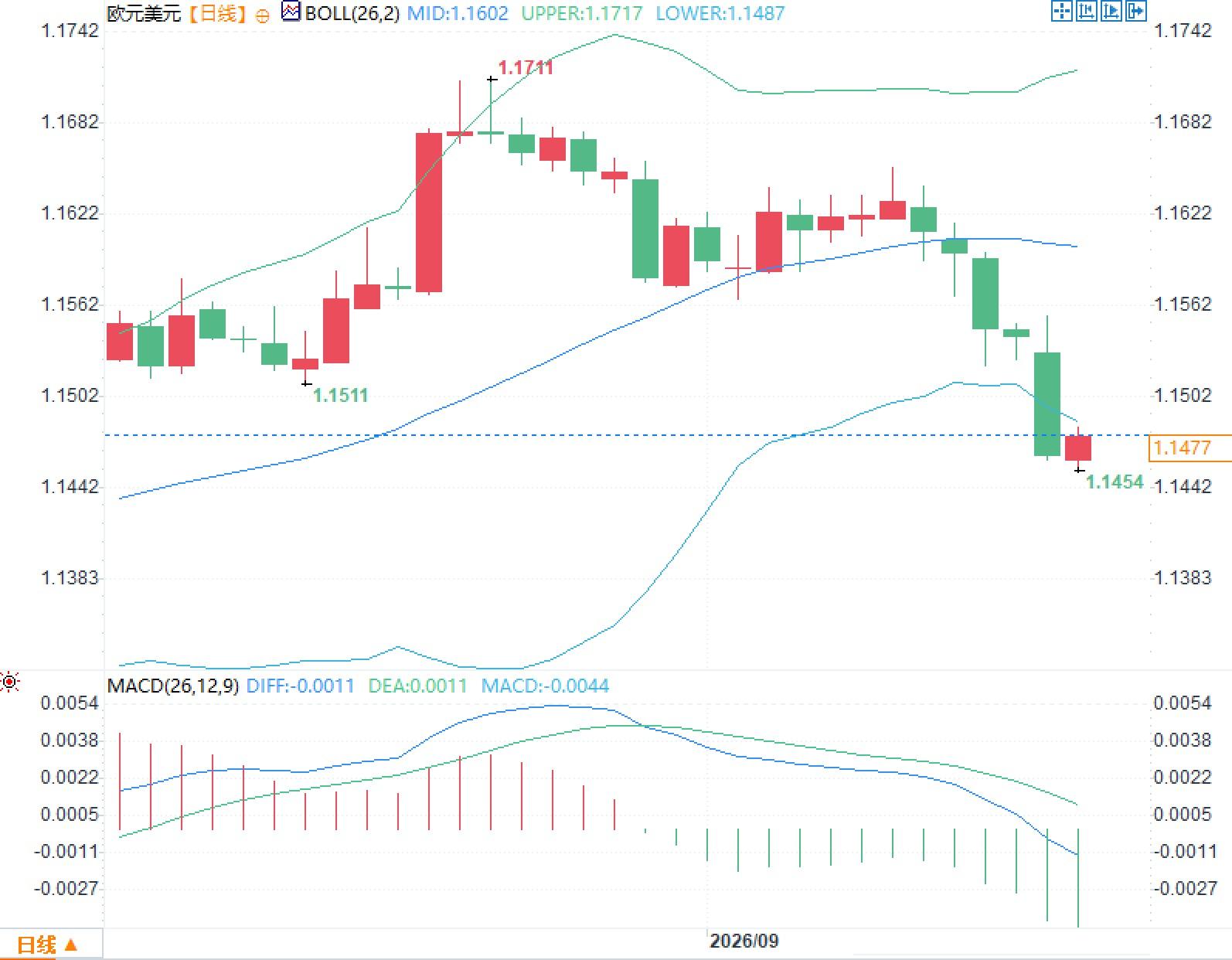 Placing the four central banks on the same interest rate table reveals a clear structure: the Federal Reserve's target range is 3.75% to 4.00%, with a year-end median of 4.1% in its dot plot; the European Central Bank's deposit facility is at 2.50%; the Bank of England is at 3.75% and leans towards holding rates steady; and the Bank of Japan, if it raises rates as expected, will reach 1.25%. The euro-dollar exchange rate reflects the marginal change in the US-EU interest rate differential, not a simple average of the four central banks' rates. Whoever first includes "another rate hike" in credible communication gains an advantage in the interest rate differential.
Exchange rate constraints after policy interest rates re-enter a tightening range
The Fed's rate hike itself was in line with pre-meeting pricing; what truly changed the exchange rate structure was the combination of the statement and the dot plot. The summary of economic projections showed that most members who submitted forecasts set the median federal funds rate at 4.1% at the end of 2026, implying at least one more 25 basis point adjustment this year. Meanwhile, the year-end forecast for the personal consumption expenditures price index was revised upward to 3.7%, and the core forecast to 3.4%. The dot plot did not represent a commitment, but rather the committee's collective judgment on whether the "level of restraint was sufficient." Chairman Kevin Warsh described this operation as "removing a dose of easing" at the post-meeting press conference. He explicitly stated, "I find it difficult to call current financial conditions restrictive." This statement carries a stronger implication than the rate hike itself: the committee does not believe the old range of 3.50% to 3.75% constitutes tightening; therefore, the 25 basis point increase merely pushes interest rates from "relatively loose" to "near neutral," rather than a completed anti-inflationary move. Warsh also listed three changes since the July meeting: economic activity has been more resilient than expected, the decline in inflation is not solid, and the impact of geopolitical conflicts on energy prices has been reassessed. All three conditions must be met for the unanimous vote to pass. In terms of exchange rates, with the dollar interest rate path being revised upwards, the pricing constraint for the euro against the dollar comes from interest rate differentials, rather than unilateral sentiment. The ECB raised its deposit facility rate by 25 basis points to 2.50% and its main refinancing rate to 2.65% on September 10th. Both sides are raising rates, but the Fed's dot plot sets a year-end median of 4.1%, and the ECB has not committed to a subsequent path. The interest rate differential structure is therefore closer to "a shift in the US policy rate center, with the Eurozone moving in tandem but at a more restrained pace." This is the institutional background for the euro's fall to near a seven-week low against the dollar this week, rather than market noise.How Inflation Readings and Warsh's Statements Are Rewriting the Interest Rate Path
The U.S. Consumer Price Index (CPI) rose 3.4% year-on-year in August, and 0.4% month-on-month after seasonal adjustment. The core CPI, excluding food and energy, rose 2.4% year-on-year and 0.3% month-on-month, higher than the pre-meeting consensus forecast of 0.2%. While the year-on-year core reading was slightly lower than July's 2.5%, the month-on-month acceleration was what the committee valued more. Based on this, Warsh estimated that the August personal consumption expenditures (PCE) price index was around 3.6% year-on-year, and the core PCE price index was around 3.2%. His exact words were: "This summer's inflation readings don't tell me that the underlying trend has shown meaningful improvement." "The simple fact is that inflation is still too high, and has been too high for too long." On the Eurozone side, the harmonized index of consumer prices (HICP) rose to 3.3% year-on-year in August, with the energy sub-index rising 14.3% year-on-year, while the core figure fell to 2.4%. ECB staff predict an average overall inflation of 3.0% in 2026 and 2.5% in 2027. While core inflation rates are similar year-on-year on both sides, the US committee characterized financial conditions as "not yet constrained," while the European Central Bank emphasized that the energy shock would keep inflation above target for an extended period. Despite both sides reporting "inflation below target," the asymmetrical assessments of policy function tightness explain why the transatlantic interest rate differential cannot be closed by a single rate hike.The misalignment of policy pace among central banks and the structure of interest rate spreads
This week is a busy window for major central bank policy decisions. The European Central Bank and the Federal Reserve have already raised interest rates, while the Bank of England and the Bank of Japan are still pricing in their rates. The UK's August consumer price index rose to 3.1% year-on-year, the first time it has climbed above 3% since March; the mainstream market expectation for the September 17th decision is to maintain the rate at 3.75%, while delegating more discussion of the next rate hike to the November meeting. The Bank of England faces the constraints of the lagged transmission of energy prices to the retail sector and the easing of the labor market, placing it in a different position from the Federal Reserve's assessment that "conditions are not yet constrained." Regarding the Bank of Japan, the market widely expects it to raise its target for the unsecured overnight call rate from 1.00% to 1.25% on Friday, potentially a new high for policy rates since 1995. Governor Kazuo Ueda has recently reiterated that "overall financial conditions remain relatively loose, and we hope to continue raising policy rates." The yen's role as a low-cost funding currency is being gradually rewritten, but the speed of this rewriting depends on whether the committee is willing to push the frequency of rate hikes further forward from "once every few months." For the euro against the dollar, the direct impact of the Bank of Japan's decision is less than that against the dollar against the yen; the indirect impact is reflected in global real interest rates and the reallocation of safe-haven funds. Placing the four central banks on the same interest rate table reveals a clear structure: the Federal Reserve's target range is 3.75% to 4.00%, with a year-end median of 4.1% in its dot plot; the European Central Bank's deposit facility is at 2.50%; the Bank of England is at 3.75% and leans towards holding rates steady; and the Bank of Japan, if it raises rates as expected, will reach 1.25%. The euro-dollar exchange rate reflects the marginal change in the US-EU interest rate differential, not a simple average of the four central banks' rates. Whoever first includes "another rate hike" in credible communication gains an advantage in the interest rate differential.
- Risk Warning and Disclaimer
- The market involves risk, and trading may not be suitable for all investors. This article is for reference only and does not constitute personal investment advice, nor does it take into account certain users’ specific investment objectives, financial situation, or other needs. Any investment decisions made based on this information are at your own risk.