EUR/USD Trading Signal: Short-term rebound encounters resistance near 1.1487
2026-09-17 18:10:09
On Thursday (September 17), during the European session, the euro/dollar pair traded at 1.474, up 0.09%. The downward trend that had dominated the market for several days showed no significant reversal yesterday, fueled by the Federal Reserve's hawkish stance and rising market expectations of further interest rate hikes in the near term. The euro/dollar pair once again became the focus of the market, with traders watching to see if the euro could recover some of yesterday's losses or if the pair would soon hit new lows.  Fundamental Analysis and Market Sentiment This round of market movement was primarily driven by the US dollar, not the euro, which is quite common in the forex market—approximately 75% of forex trading volume is related to the US dollar. The Federal Reserve raised interest rates by 0.25 percentage points at its September policy meeting on Wednesday, signaling the possibility of further rate hikes in the coming months. Fed Chairman Kevin Warsh pushed for a unanimous vote to raise rates, and the overall hawkish stance of all officials suggests the market is pricing in another rate hike this year. The Fed's hawkish policy stance supported the US dollar, thus putting pressure on major non-US currencies. Warsh's remarks significantly exceeded market expectations of hawkishness; his forward-looking comments on further rate hikes surprised the market, prompting a repricing of monetary policy paths and directly strengthening the US dollar. Last week, the European Central Bank also raised interest rates by 25 basis points, its second rate hike since the outbreak of the Iranian conflict. However, the central bank explicitly stated that it would not pre-commit to further policy actions after this rate hike. The ECB president stated that inflation will remain high for a considerable period, and the market has also noted a significant disconnect between interest rate pricing and inflation reality. Even with the ECB's hawkish signals, current oil prices are significantly higher than two months ago, continuing to weigh on the euro. Market opinions are divided. TD Securities stated that the Fed's 25 basis point rate hike coupled with hawkish forward guidance met market expectations, and the policy committee retains the option to continue raising rates. However, the bank also warned that this round of dollar appreciation is more of a correction, as the Fed's median forecast is not significantly higher than the market's previous pricing; without new external shocks, the Fed has limited room for further monetary tightening, and the economic growth of other global economies remains resilient, suggesting that the dollar's strength is phased and temporary. Warsh emphasized that the US economy has improved, and inflation is the current core issue, hence the implementation of monetary tightening; if the current economic trend continues, there is still room for further policy tightening. The Fed balances its goal of full employment with maintaining price stability, and will not overemphasize single-month data, but rather follow data trends in its decisions; this firm anti-inflation stance is bullish for the dollar. ING analysts stated that the market had initially expected a hawkish Fed to only push the euro down to 1.150 against the dollar, but the more hawkish stance of this meeting exceeded expectations, driving the exchange rate significantly lower. The two-year swap spread widened by 15 basis points, reaching a new high since July; the last time this spread corresponded to a euro/dollar exchange rate below 1.14. Model calculations show the euro's short-term fair value has fallen to 1.150, a 1% decrease compared to a week ago. Further changes in short-term interest rates, oil prices, and global stock markets will quickly depress the euro's fair valuation, and downside risks have not yet been eliminated. Currently, unless there is a significant adjustment in energy prices, there are almost no internal Eurozone drivers capable of reversing the euro/dollar's trend; technically, strong support will only appear in the summer lows of 1.132-1.135. Yesterday's Fed policy meeting provided a strong boost to the dollar, briefly touching a seven-week high. The CME FedWatch Tool shows that the market has priced in a 53% probability of another 25 basis point rate hike in October. The US dollar index has retreated slightly in the past few hours. Although the decline is not significant, it is technically important, as will be explained in the next section. Overall, bullish sentiment towards the dollar is just beginning to emerge. Conversely, the euro's fundamentals and market sentiment are far less clear than the dollar's. The European Central Bank is in a rate hike cycle, but high energy costs and weak European economic confidence data have led to fluctuating market confidence in the euro, supporting a bearish outlook for the euro against the dollar. Technical Analysis
 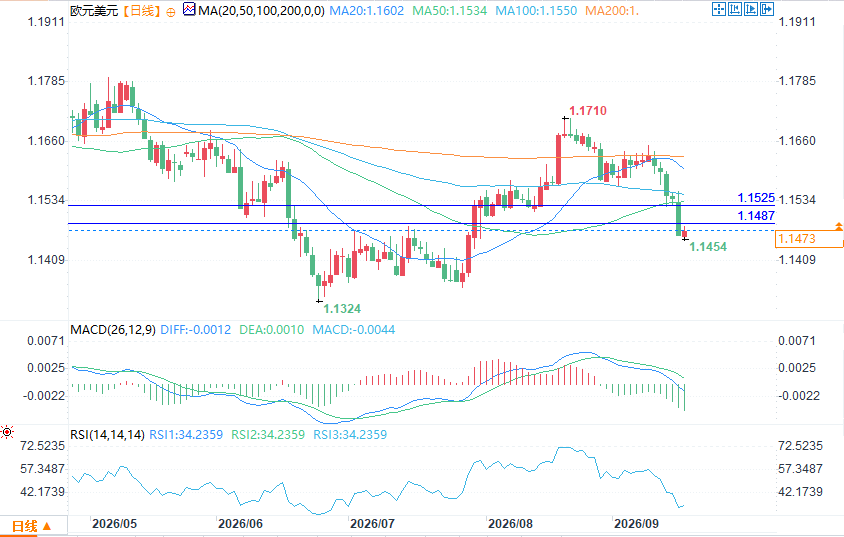 (EUR/USD Daily Chart Source: FX678) Following the Fed meeting, the exchange rate fell sharply yesterday; however, recent price action shows that it found support at 1.1458. This support level is noteworthy, as it coincides with the resistance level of the US Dollar Index at 100.00, where the dollar recently encountered resistance and retreated. These signals are bullish, and the recent U-shaped price pattern suggests a potential upward move. The key test for the bulls is whether they can break through the recent resistance level of 1.1487; the 1.1525 level above that is extremely crucial. Currently, upward resistance is relatively weak, with three closely clustered support levels below the current price. However, if the exchange rate continues to trade below 1.1487 in the coming hours, it indicates that the overall market sentiment remains bearish. The exchange rate is likely to move upwards in the short term, testing 1.1487. This level is highly probable, leading to further gains. However, once the exchange rate touches the psychological level of 1.1500, or the key resistance level of 1.1525 not far above, the original downtrend is likely to regain dominance. If the price clearly encounters resistance and falls back in the aforementioned areas, it would be a relatively safe entry point to short. This upward move could be attempted with short-term scalping long positions. I am more confident in the very short-term bullish outlook because the US dollar index has effectively held up at the 100.00 resistance level – this is both an important psychological level and a key resistance level that has been validated by historical price action.
Fundamental Analysis and Market Sentiment This round of market movement was primarily driven by the US dollar, not the euro, which is quite common in the forex market—approximately 75% of forex trading volume is related to the US dollar. The Federal Reserve raised interest rates by 0.25 percentage points at its September policy meeting on Wednesday, signaling the possibility of further rate hikes in the coming months. Fed Chairman Kevin Warsh pushed for a unanimous vote to raise rates, and the overall hawkish stance of all officials suggests the market is pricing in another rate hike this year. The Fed's hawkish policy stance supported the US dollar, thus putting pressure on major non-US currencies. Warsh's remarks significantly exceeded market expectations of hawkishness; his forward-looking comments on further rate hikes surprised the market, prompting a repricing of monetary policy paths and directly strengthening the US dollar. Last week, the European Central Bank also raised interest rates by 25 basis points, its second rate hike since the outbreak of the Iranian conflict. However, the central bank explicitly stated that it would not pre-commit to further policy actions after this rate hike. The ECB president stated that inflation will remain high for a considerable period, and the market has also noted a significant disconnect between interest rate pricing and inflation reality. Even with the ECB's hawkish signals, current oil prices are significantly higher than two months ago, continuing to weigh on the euro. Market opinions are divided. TD Securities stated that the Fed's 25 basis point rate hike coupled with hawkish forward guidance met market expectations, and the policy committee retains the option to continue raising rates. However, the bank also warned that this round of dollar appreciation is more of a correction, as the Fed's median forecast is not significantly higher than the market's previous pricing; without new external shocks, the Fed has limited room for further monetary tightening, and the economic growth of other global economies remains resilient, suggesting that the dollar's strength is phased and temporary. Warsh emphasized that the US economy has improved, and inflation is the current core issue, hence the implementation of monetary tightening; if the current economic trend continues, there is still room for further policy tightening. The Fed balances its goal of full employment with maintaining price stability, and will not overemphasize single-month data, but rather follow data trends in its decisions; this firm anti-inflation stance is bullish for the dollar. ING analysts stated that the market had initially expected a hawkish Fed to only push the euro down to 1.150 against the dollar, but the more hawkish stance of this meeting exceeded expectations, driving the exchange rate significantly lower. The two-year swap spread widened by 15 basis points, reaching a new high since July; the last time this spread corresponded to a euro/dollar exchange rate below 1.14. Model calculations show the euro's short-term fair value has fallen to 1.150, a 1% decrease compared to a week ago. Further changes in short-term interest rates, oil prices, and global stock markets will quickly depress the euro's fair valuation, and downside risks have not yet been eliminated. Currently, unless there is a significant adjustment in energy prices, there are almost no internal Eurozone drivers capable of reversing the euro/dollar's trend; technically, strong support will only appear in the summer lows of 1.132-1.135. Yesterday's Fed policy meeting provided a strong boost to the dollar, briefly touching a seven-week high. The CME FedWatch Tool shows that the market has priced in a 53% probability of another 25 basis point rate hike in October. The US dollar index has retreated slightly in the past few hours. Although the decline is not significant, it is technically important, as will be explained in the next section. Overall, bullish sentiment towards the dollar is just beginning to emerge. Conversely, the euro's fundamentals and market sentiment are far less clear than the dollar's. The European Central Bank is in a rate hike cycle, but high energy costs and weak European economic confidence data have led to fluctuating market confidence in the euro, supporting a bearish outlook for the euro against the dollar. Technical Analysis (EUR/USD Daily Chart Source: FX678) Following the Fed meeting, the exchange rate fell sharply yesterday; however, recent price action shows that it found support at 1.1458. This support level is noteworthy, as it coincides with the resistance level of the US Dollar Index at 100.00, where the dollar recently encountered resistance and retreated. These signals are bullish, and the recent U-shaped price pattern suggests a potential upward move. The key test for the bulls is whether they can break through the recent resistance level of 1.1487; the 1.1525 level above that is extremely crucial. Currently, upward resistance is relatively weak, with three closely clustered support levels below the current price. However, if the exchange rate continues to trade below 1.1487 in the coming hours, it indicates that the overall market sentiment remains bearish. The exchange rate is likely to move upwards in the short term, testing 1.1487. This level is highly probable, leading to further gains. However, once the exchange rate touches the psychological level of 1.1500, or the key resistance level of 1.1525 not far above, the original downtrend is likely to regain dominance. If the price clearly encounters resistance and falls back in the aforementioned areas, it would be a relatively safe entry point to short. This upward move could be attempted with short-term scalping long positions. I am more confident in the very short-term bullish outlook because the US dollar index has effectively held up at the 100.00 resistance level – this is both an important psychological level and a key resistance level that has been validated by historical price action.
- Risk Warning and Disclaimer
- The market involves risk, and trading may not be suitable for all investors. This article is for reference only and does not constitute personal investment advice, nor does it take into account certain users’ specific investment objectives, financial situation, or other needs. Any investment decisions made based on this information are at your own risk.