The Federal Reserve's interpretation: The rate hike was in line with market expectations, and the policy signaled a more hawkish stance.
2026-09-17 18:42:09
On Thursday (September 16), the Federal Reserve raised interest rates by 25 basis points, increasing the target range for the federal funds rate to 3.75%-4.00%. This rate hike was not merely a one-off response to rising oil prices. The Fed increasingly believes that inflation has become widespread, and that the fundamentals of the U.S. economy are strong enough to justify a tighter monetary policy.  Compared to his economic forecast report, Warsh's statement was arguably more hawkish. He pointed out that the current overall financial environment does not have a tightening effect and hinted at the possibility of further policy tightening in the future. The 10-year Treasury yield is currently around 5%, and has become the most important market indicator. Its subsequent trend will determine the prospects of bonds, stocks, technology sectors, and the US dollar. This is the Fed's first rate hike since 2023, and the market had almost fully priced in this expectation. What is truly noteworthy is the series of accompanying changes: the unanimous decision to raise interest rates, the upward revision of interest rate expectations, the upward revision of economic growth forecasts, the downward revision of unemployment rate forecasts, and Warsh's judgment that the financial environment has not yet had a significant tightening effect. What changes occurred in the policy statement? This Fed policy statement was unusually brief, but several changes were significant. The Fed stated that US economic activity is expanding at a solid pace, emphasizing the resilience of domestic consumption, strong productivity, and strong capital investment, while job growth is in line with the expansion of the labor force. In other words, the Fed does not believe that the current economy needs low interest rates to withstand the impact of rate hikes. The wording regarding inflation was also more hawkish. The Fed stated that inflation remains high and this rate hike will help achieve the 2% inflation target more quickly. The statement concluded with a particularly firm statement: "The Committee will achieve price stability." Perhaps more crucially, there was a reduction in content: the statement in the July statement attributing high inflation to supply shocks was removed in the September statement. This represents a hawkish shift. If inflation is primarily due to supply shocks like oil prices, rate hikes have limited effect on controlling inflation. However, if strong domestic demand allows businesses to pass on rising energy, tariff, and wage costs to consumers, then tightening monetary policy can be more effective. The hawkish signals from the economic projections report are more noteworthy than the rate hike itself. The FOMC Summary of Economic Projections (SEP) is the most important document from this policy meeting.
 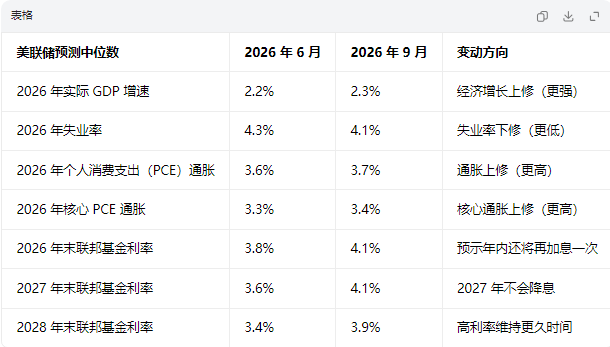 Of the 18 policymakers surveyed, 16 expect at least one more rate hike in 2026. According to the median forecast, PCE inflation won't fall back to the 2% target level until 2029. A striking combination of signals is evident: rising economic growth + declining unemployment + rising inflation + rising interest rates. The Fed believes the US economy is stronger than previously anticipated, and this resilience is one reason why inflation is difficult to fall. Warsh's remarks were more hawkish than the economic forecast report . At the press conference, Warsh stated that inflation has remained high for an extended period, and recent inflation data has not shown any substantial improvement in the underlying trend. This means the Fed no longer intends to simply ignore rising energy prices and passively wait for inflation to fall on its own. He also admitted that "it's difficult to describe the current overall financial environment as having contractionary characteristics," and characterized this rate hike as "retracting some of the easing policy." This is significant. With policy rates near 4%, 10-year Treasury yields around 5%, and mortgage rates approaching 7%, it seems like a contractionary environment. However, the stock market remains high, credit supply is ample, employment is strong, and corporate capital expenditure is booming. From the Fed's perspective, monetary policy has not truly suppressed aggregate demand. If inflation remains stubborn, there is room for further tightening. Trump quickly refuted this on September 16, 2026, posting on the Truth social media platform that US interest rates should "go down to 1% or even lower," urging the Fed to "cut rates immediately and quickly!" The two sides have vastly different positions: Trump: Interest rates should be around 1%. Warsh and the FOMC: Interest rates will most likely need to remain above 4%. Pressure from the political establishment to cut interest rates does not directly equate to a decrease in overall borrowing costs. If the market begins to expect the Fed to ease monetary policy, but inflation, tariffs, fiscal deficits, and capital demand from AI remain high, short-term yields may decline; however, investors will demand higher inflation and fiscal risk premiums before being willing to hold 10-year and 30-year US Treasury bonds. The final possible scenario: the market expects the Fed to cut interest rates, but long-term yields rise instead. Political pressure may therefore steepen the yield curve rather than address the high cost of government borrowing. Has the Fed rebuilt its policy credibility? Despite political pressure, initial market feedback suggests the Fed has strengthened, rather than weakened, its credibility in combating inflation. Following the decision, nominal yields, real yields, and inflation expectations initially declined, with the 10-year breakeven inflation rate falling by more than 3 basis points to approximately 2.35%. Warsh's subsequent hawkish press conference pushed up short-term yields, but did not trigger a disorderly surge in long-term Treasury yields. The yield curve subsequently flattened: the market priced in an increased probability of further Fed rate hikes, but did not demand a significantly higher risk premium for long-term debt. The dollar strengthened in tandem. This indicates that the market is not trading a dovish shift or a return to cheap currencies, but rather a repricing of the central bank's determination to combat inflation. This is more like a "credibility restoration rally" than a pure "Goldilocks rally" (a perfectly balanced economy). Where will the 10-year Treasury yield go? The current 10-year Treasury yield of around 5% is the most important market signal, with three main scenarios: 1. Yields stabilize near current levels: This indicates the continued effectiveness of the Fed's policy credibility dividend. Even if the Fed raises interest rates again, long-term borrowing costs will not surge further. 2. Yields decline: This requires concrete evidence of a clear cooling of inflation, a decline in oil prices, or a weakening economy. This scenario is favorable for bonds and interest rate-sensitive assets, but an economic slowdown would bring another risk. 3. Yields continue to rise significantly: This indicates the problem is no longer limited to monetary policy. Stubborn inflation, high fiscal deficits, large-scale supply of US Treasury bonds, and capital competition driven by AI will continue to push up investors' required returns on long-term bonds. Our baseline scenario is not a one-sided, continuous rise in yields, but rather long-term US Treasury yields remaining high and fluctuating. If Warsh maintains a strong anti-inflation stance, and the 10-year Treasury yield trend remains orderly, this policy credibility dividend can continue. However, if the Federal Reserve continues to tighten, and the yields on 10-year and 30-year US Treasury bonds continue to soar, the market is signaling risk: the root of the problem has extended beyond the scope of Fed policy, pointing to fiscal supply, inflation risks, and competition for capital. Why did the technology and AI sectors withstand the pressure? The technology sector was supported by two positive signals. First, the Fed's economic forecasts presented a relatively favorable macroeconomic combination: stronger economic growth, lower unemployment, and no explosive upward revision of interest rate hike expectations, which supports the economic outlook and corporate profits. Second, inflation expectations have declined, and the yield on long-term US Treasury bonds has stabilized, reducing the short-term risk of growth stocks facing another valuation shock. The technology sector itself also has fundamental support: large technology companies generally have strong cash flow and can rely on their own funds to complete investments; expenditures related to semiconductors, storage, network equipment, cooling and power supply, and data centers remain substantial. However, this does not mean they can rest easy. Technology companies that can generate cash flow are more resilient than those that need constant external financing. While the demand for AI infrastructure is supported, with the 10-year yield at 5%, company valuations will need to cross a higher threshold. Investment returns will be subject to more rigorous scrutiny. The market will increasingly differentiate between two types of companies: those that invest heavily in AI regardless of cost, and those that have already achieved revenue growth, productivity improvements, or have a clear path to return. The AI boom may also spread. The market focus is shifting from building AI infrastructure to the practical application of AI, with software, finance, healthcare, and industrial companies all expected to benefit. The root cause of rising yields is crucial: if high yields stem from economic growth and robust investment, while inflation expectations remain anchored, profitable technology companies can withstand the pressure; however, if rising yields arise from worsening inflation, increased fiscal risks, or damage to the Federal Reserve's credibility, downward pressure on valuations will be difficult to avoid. What does this mean for major asset classes? US Treasuries: Short-term interest rates remain sensitive to potential further rate hikes; long-term yields are a litmus test for policy credibility. Stable yields are a positive signal; a sharp resurgence points to deeper inflationary or fiscal vulnerabilities. US Dollar: High US interest rates coupled with renewed market trust in the Federal Reserve's anti-inflation commitments are expected to support the dollar. Gold: A stronger dollar and rising real yields pose short-term headwinds; geopolitical uncertainty, fiscal vulnerabilities, and central bank gold purchases provide long-term support. Large-cap stocks: Economic resilience benefits corporate profits, but in a high-interest-rate environment, pricing power, free cash flow, and balance sheet quality become increasingly important. Technology and AI sector: Structural demand remains, but a high-yield environment favors companies with stable profits and internal cash flow generation, while suppressing speculative plays and those highly reliant on external capital. Banking sector: High interest rates can support net interest margins, but continued tightening policies will increase financing costs and credit risk. Small and medium-sized enterprises (SMEs): Economic resilience is beneficial, but refinancing costs and floating-rate debt remain significant vulnerabilities. Real Estate Investment Trusts (REITs) and real estate sector: Highly sensitive to long-term yields, the importance of debt maturity structure, balance sheet strength, and lease quality is further highlighted.
Compared to his economic forecast report, Warsh's statement was arguably more hawkish. He pointed out that the current overall financial environment does not have a tightening effect and hinted at the possibility of further policy tightening in the future. The 10-year Treasury yield is currently around 5%, and has become the most important market indicator. Its subsequent trend will determine the prospects of bonds, stocks, technology sectors, and the US dollar. This is the Fed's first rate hike since 2023, and the market had almost fully priced in this expectation. What is truly noteworthy is the series of accompanying changes: the unanimous decision to raise interest rates, the upward revision of interest rate expectations, the upward revision of economic growth forecasts, the downward revision of unemployment rate forecasts, and Warsh's judgment that the financial environment has not yet had a significant tightening effect. What changes occurred in the policy statement? This Fed policy statement was unusually brief, but several changes were significant. The Fed stated that US economic activity is expanding at a solid pace, emphasizing the resilience of domestic consumption, strong productivity, and strong capital investment, while job growth is in line with the expansion of the labor force. In other words, the Fed does not believe that the current economy needs low interest rates to withstand the impact of rate hikes. The wording regarding inflation was also more hawkish. The Fed stated that inflation remains high and this rate hike will help achieve the 2% inflation target more quickly. The statement concluded with a particularly firm statement: "The Committee will achieve price stability." Perhaps more crucially, there was a reduction in content: the statement in the July statement attributing high inflation to supply shocks was removed in the September statement. This represents a hawkish shift. If inflation is primarily due to supply shocks like oil prices, rate hikes have limited effect on controlling inflation. However, if strong domestic demand allows businesses to pass on rising energy, tariff, and wage costs to consumers, then tightening monetary policy can be more effective. The hawkish signals from the economic projections report are more noteworthy than the rate hike itself. The FOMC Summary of Economic Projections (SEP) is the most important document from this policy meeting. Of the 18 policymakers surveyed, 16 expect at least one more rate hike in 2026. According to the median forecast, PCE inflation won't fall back to the 2% target level until 2029. A striking combination of signals is evident: rising economic growth + declining unemployment + rising inflation + rising interest rates. The Fed believes the US economy is stronger than previously anticipated, and this resilience is one reason why inflation is difficult to fall. Warsh's remarks were more hawkish than the economic forecast report . At the press conference, Warsh stated that inflation has remained high for an extended period, and recent inflation data has not shown any substantial improvement in the underlying trend. This means the Fed no longer intends to simply ignore rising energy prices and passively wait for inflation to fall on its own. He also admitted that "it's difficult to describe the current overall financial environment as having contractionary characteristics," and characterized this rate hike as "retracting some of the easing policy." This is significant. With policy rates near 4%, 10-year Treasury yields around 5%, and mortgage rates approaching 7%, it seems like a contractionary environment. However, the stock market remains high, credit supply is ample, employment is strong, and corporate capital expenditure is booming. From the Fed's perspective, monetary policy has not truly suppressed aggregate demand. If inflation remains stubborn, there is room for further tightening. Trump quickly refuted this on September 16, 2026, posting on the Truth social media platform that US interest rates should "go down to 1% or even lower," urging the Fed to "cut rates immediately and quickly!" The two sides have vastly different positions: Trump: Interest rates should be around 1%. Warsh and the FOMC: Interest rates will most likely need to remain above 4%. Pressure from the political establishment to cut interest rates does not directly equate to a decrease in overall borrowing costs. If the market begins to expect the Fed to ease monetary policy, but inflation, tariffs, fiscal deficits, and capital demand from AI remain high, short-term yields may decline; however, investors will demand higher inflation and fiscal risk premiums before being willing to hold 10-year and 30-year US Treasury bonds. The final possible scenario: the market expects the Fed to cut interest rates, but long-term yields rise instead. Political pressure may therefore steepen the yield curve rather than address the high cost of government borrowing. Has the Fed rebuilt its policy credibility? Despite political pressure, initial market feedback suggests the Fed has strengthened, rather than weakened, its credibility in combating inflation. Following the decision, nominal yields, real yields, and inflation expectations initially declined, with the 10-year breakeven inflation rate falling by more than 3 basis points to approximately 2.35%. Warsh's subsequent hawkish press conference pushed up short-term yields, but did not trigger a disorderly surge in long-term Treasury yields. The yield curve subsequently flattened: the market priced in an increased probability of further Fed rate hikes, but did not demand a significantly higher risk premium for long-term debt. The dollar strengthened in tandem. This indicates that the market is not trading a dovish shift or a return to cheap currencies, but rather a repricing of the central bank's determination to combat inflation. This is more like a "credibility restoration rally" than a pure "Goldilocks rally" (a perfectly balanced economy). Where will the 10-year Treasury yield go? The current 10-year Treasury yield of around 5% is the most important market signal, with three main scenarios: 1. Yields stabilize near current levels: This indicates the continued effectiveness of the Fed's policy credibility dividend. Even if the Fed raises interest rates again, long-term borrowing costs will not surge further. 2. Yields decline: This requires concrete evidence of a clear cooling of inflation, a decline in oil prices, or a weakening economy. This scenario is favorable for bonds and interest rate-sensitive assets, but an economic slowdown would bring another risk. 3. Yields continue to rise significantly: This indicates the problem is no longer limited to monetary policy. Stubborn inflation, high fiscal deficits, large-scale supply of US Treasury bonds, and capital competition driven by AI will continue to push up investors' required returns on long-term bonds. Our baseline scenario is not a one-sided, continuous rise in yields, but rather long-term US Treasury yields remaining high and fluctuating. If Warsh maintains a strong anti-inflation stance, and the 10-year Treasury yield trend remains orderly, this policy credibility dividend can continue. However, if the Federal Reserve continues to tighten, and the yields on 10-year and 30-year US Treasury bonds continue to soar, the market is signaling risk: the root of the problem has extended beyond the scope of Fed policy, pointing to fiscal supply, inflation risks, and competition for capital. Why did the technology and AI sectors withstand the pressure? The technology sector was supported by two positive signals. First, the Fed's economic forecasts presented a relatively favorable macroeconomic combination: stronger economic growth, lower unemployment, and no explosive upward revision of interest rate hike expectations, which supports the economic outlook and corporate profits. Second, inflation expectations have declined, and the yield on long-term US Treasury bonds has stabilized, reducing the short-term risk of growth stocks facing another valuation shock. The technology sector itself also has fundamental support: large technology companies generally have strong cash flow and can rely on their own funds to complete investments; expenditures related to semiconductors, storage, network equipment, cooling and power supply, and data centers remain substantial. However, this does not mean they can rest easy. Technology companies that can generate cash flow are more resilient than those that need constant external financing. While the demand for AI infrastructure is supported, with the 10-year yield at 5%, company valuations will need to cross a higher threshold. Investment returns will be subject to more rigorous scrutiny. The market will increasingly differentiate between two types of companies: those that invest heavily in AI regardless of cost, and those that have already achieved revenue growth, productivity improvements, or have a clear path to return. The AI boom may also spread. The market focus is shifting from building AI infrastructure to the practical application of AI, with software, finance, healthcare, and industrial companies all expected to benefit. The root cause of rising yields is crucial: if high yields stem from economic growth and robust investment, while inflation expectations remain anchored, profitable technology companies can withstand the pressure; however, if rising yields arise from worsening inflation, increased fiscal risks, or damage to the Federal Reserve's credibility, downward pressure on valuations will be difficult to avoid. What does this mean for major asset classes? US Treasuries: Short-term interest rates remain sensitive to potential further rate hikes; long-term yields are a litmus test for policy credibility. Stable yields are a positive signal; a sharp resurgence points to deeper inflationary or fiscal vulnerabilities. US Dollar: High US interest rates coupled with renewed market trust in the Federal Reserve's anti-inflation commitments are expected to support the dollar. Gold: A stronger dollar and rising real yields pose short-term headwinds; geopolitical uncertainty, fiscal vulnerabilities, and central bank gold purchases provide long-term support. Large-cap stocks: Economic resilience benefits corporate profits, but in a high-interest-rate environment, pricing power, free cash flow, and balance sheet quality become increasingly important. Technology and AI sector: Structural demand remains, but a high-yield environment favors companies with stable profits and internal cash flow generation, while suppressing speculative plays and those highly reliant on external capital. Banking sector: High interest rates can support net interest margins, but continued tightening policies will increase financing costs and credit risk. Small and medium-sized enterprises (SMEs): Economic resilience is beneficial, but refinancing costs and floating-rate debt remain significant vulnerabilities. Real Estate Investment Trusts (REITs) and real estate sector: Highly sensitive to long-term yields, the importance of debt maturity structure, balance sheet strength, and lease quality is further highlighted.
- Risk Warning and Disclaimer
- The market involves risk, and trading may not be suitable for all investors. This article is for reference only and does not constitute personal investment advice, nor does it take into account certain users’ specific investment objectives, financial situation, or other needs. Any investment decisions made based on this information are at your own risk.