I misjudged Kevin Walsh
2026-09-18 01:48:09
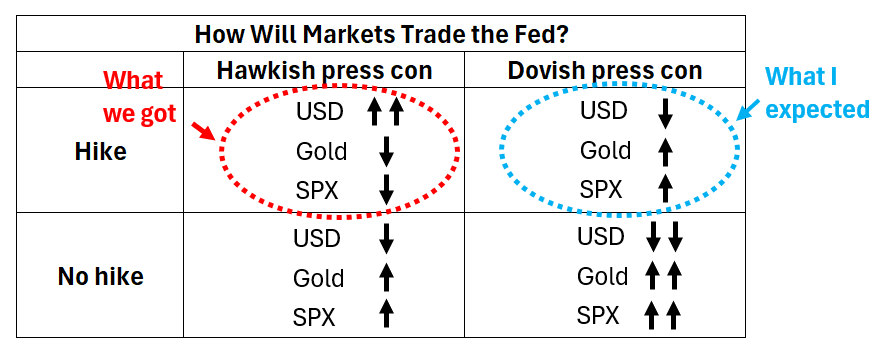
I completely misjudged the Fed's decision yesterday. I had expected a rate hike, but assumed the rest of the statements would be dovish. That wasn't the case. The rate hike was passed unanimously, which was entirely unexpected. I had anticipated at least one or two dissenting votes. The median of the Fed's September dot plot indicates two more rate hikes in 2026; my previous assessment was that "this would be the end after just one hike." Meanwhile, the 2027 dot plot figures almost signaled further policy tightening next year. There were no dovish signals throughout yesterday's meeting. The policy signals suggest that the rate hike cycle may continue for another two quarters, with 25 basis points raised each quarter. In other words, this round of rate hikes almost completely offset the three rate cuts during Powell's tenure as chairman last year.  As a forecaster, it's crucial to honestly admit mistakes when they occur. In the chart below, my initial expectation was the scenario depicted in the upper right corner—a hawkish rate hike coupled with a dovish stance—but the actual outcome was the scenario shown in the upper left corner. After a misjudgment, the most important thing is to clarify the underlying reasons and avoid repeating the same mistake. Here are some conclusions I've drawn so far.
  The current Federal Reserve operates on narrative logic rather than a rigorous analytical framework. At the press conference, a reporter asked Chairman Warsh a key question I had previously focused on: He had released dovish signals on July 29th; what changes have occurred since then? His response was that economic growth was strengthening, inflation showed no signs of a rapid decline, and geopolitical conflicts had escalated again. The arguments for this narrative are actually quite weak. Last Friday's Consumer Price Index (CPI) was affected by rising prices; after removing these factors, inflation actually declined rapidly. Regarding the geopolitical situation, oil prices had already surged before the July 29th policy meeting, so this cannot be used as a clear dividing line between policy shifts. The purpose of a press conference is to allow reporters to question the Fed's statements, but yesterday's press conference lacked such a confrontation. A tweet from veteran Fed watcher Howard Schneider also confirms that the entire press conference was meticulously rehearsed. When policy relies on narrative rather than an analytical framework, the entire logic becomes very fragile, and the authorities naturally do not want to face a large number of pointed questions. Interestingly, this logic also resonates with the broader environment: the Trump administration is similarly reluctant to accept external scrutiny and criticism. Lacking an analytical framework, policy stances fluctuate repeatedly: Warsh faced heavy criticism after the July 29th press conference, but we must remember that core CPI was flat two weeks prior to that meeting, so his dovish inflation stance at the time was entirely justified. What's truly inexplicable is the sudden reversal of his position afterward. In my view, the only reasonable explanation is that the surge in long-term Treasury yields after July 29th made it impossible for him to maintain a dovish stance. Therefore, the shift in narrative was merely a means to an end—stabilizing Treasury yields. This also means that the narrative can be abruptly rewritten as the situation changes. The Federal Reserve today has completely transformed.
 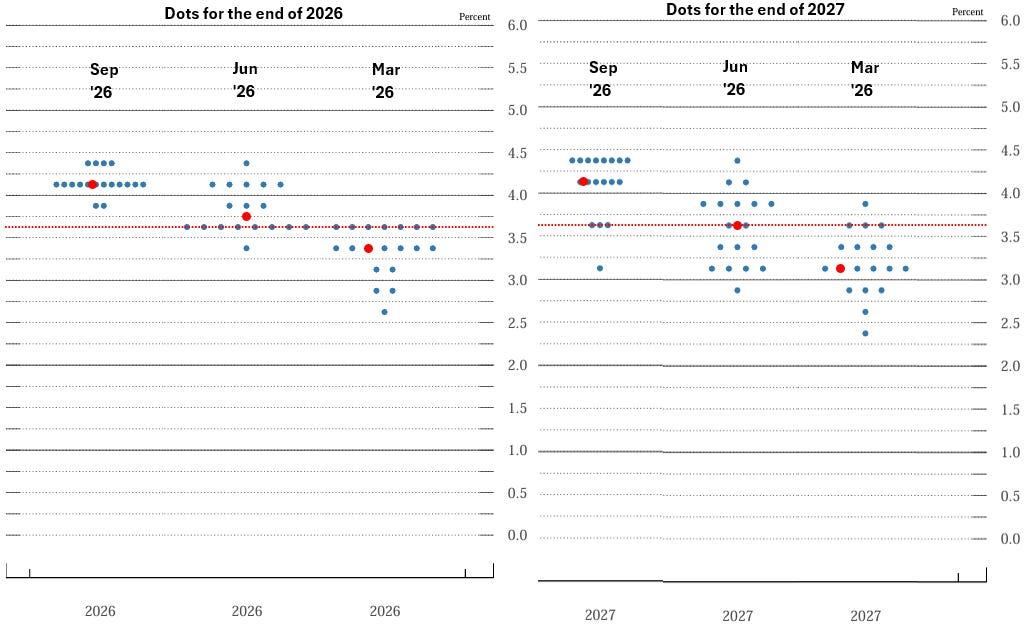 Don't overinterpret the unanimous vote signal: Much market discussion has focused on the unanimous approval of this rate hike decision and the overall upward shift of the dot plot. The chart above shows the changes in the dot plot from March, June, and this meeting, with the left side representing 2026 and the right side representing 2027. However, I believe this is a distracting signal . I can almost certainly conclude that if Jay Powell were still Fed Chairman, many of the members who voted hawkish would maintain their dovish stance and oppose the rate hike. The current situation is partly directed at Trump, and perhaps partly at Warsh himself. For me, the most important lesson is: don't overinterpret this Fed administration using conventional logic. Warsh already indicated a hawkish bias at the Jackson Hole meeting, and the market saw that. I originally assumed he would scrutinize the details of last Friday's CPI data, which was precisely my fundamental misjudgment. As Warsh said yesterday, he doesn't place excessive emphasis on single-month economic data.
As a forecaster, it's crucial to honestly admit mistakes when they occur. In the chart below, my initial expectation was the scenario depicted in the upper right corner—a hawkish rate hike coupled with a dovish stance—but the actual outcome was the scenario shown in the upper left corner. After a misjudgment, the most important thing is to clarify the underlying reasons and avoid repeating the same mistake. Here are some conclusions I've drawn so far. The current Federal Reserve operates on narrative logic rather than a rigorous analytical framework. At the press conference, a reporter asked Chairman Warsh a key question I had previously focused on: He had released dovish signals on July 29th; what changes have occurred since then? His response was that economic growth was strengthening, inflation showed no signs of a rapid decline, and geopolitical conflicts had escalated again. The arguments for this narrative are actually quite weak. Last Friday's Consumer Price Index (CPI) was affected by rising prices; after removing these factors, inflation actually declined rapidly. Regarding the geopolitical situation, oil prices had already surged before the July 29th policy meeting, so this cannot be used as a clear dividing line between policy shifts. The purpose of a press conference is to allow reporters to question the Fed's statements, but yesterday's press conference lacked such a confrontation. A tweet from veteran Fed watcher Howard Schneider also confirms that the entire press conference was meticulously rehearsed. When policy relies on narrative rather than an analytical framework, the entire logic becomes very fragile, and the authorities naturally do not want to face a large number of pointed questions. Interestingly, this logic also resonates with the broader environment: the Trump administration is similarly reluctant to accept external scrutiny and criticism. Lacking an analytical framework, policy stances fluctuate repeatedly: Warsh faced heavy criticism after the July 29th press conference, but we must remember that core CPI was flat two weeks prior to that meeting, so his dovish inflation stance at the time was entirely justified. What's truly inexplicable is the sudden reversal of his position afterward. In my view, the only reasonable explanation is that the surge in long-term Treasury yields after July 29th made it impossible for him to maintain a dovish stance. Therefore, the shift in narrative was merely a means to an end—stabilizing Treasury yields. This also means that the narrative can be abruptly rewritten as the situation changes. The Federal Reserve today has completely transformed. Don't overinterpret the unanimous vote signal: Much market discussion has focused on the unanimous approval of this rate hike decision and the overall upward shift of the dot plot. The chart above shows the changes in the dot plot from March, June, and this meeting, with the left side representing 2026 and the right side representing 2027. However, I believe this is a distracting signal . I can almost certainly conclude that if Jay Powell were still Fed Chairman, many of the members who voted hawkish would maintain their dovish stance and oppose the rate hike. The current situation is partly directed at Trump, and perhaps partly at Warsh himself. For me, the most important lesson is: don't overinterpret this Fed administration using conventional logic. Warsh already indicated a hawkish bias at the Jackson Hole meeting, and the market saw that. I originally assumed he would scrutinize the details of last Friday's CPI data, which was precisely my fundamental misjudgment. As Warsh said yesterday, he doesn't place excessive emphasis on single-month economic data.
- Risk Warning and Disclaimer
- The market involves risk, and trading may not be suitable for all investors. This article is for reference only and does not constitute personal investment advice, nor does it take into account certain users’ specific investment objectives, financial situation, or other needs. Any investment decisions made based on this information are at your own risk.