Interest rate hikes are still priced in, but hawks are disappointed: Japan's CPI fell short of expectations, and the dollar rose slightly against the yen.
2026-09-18 08:22:09
Japan's nationwide CPI data for August, released on Friday (September 18), fell short of expectations across the board, leading to market doubts about whether the Bank of Japan would adopt a hawkish stance as expected on the day of its interest rate hike. The yen subsequently weakened, and the USD/JPY pair rose slightly, currently trading around 156.15. 
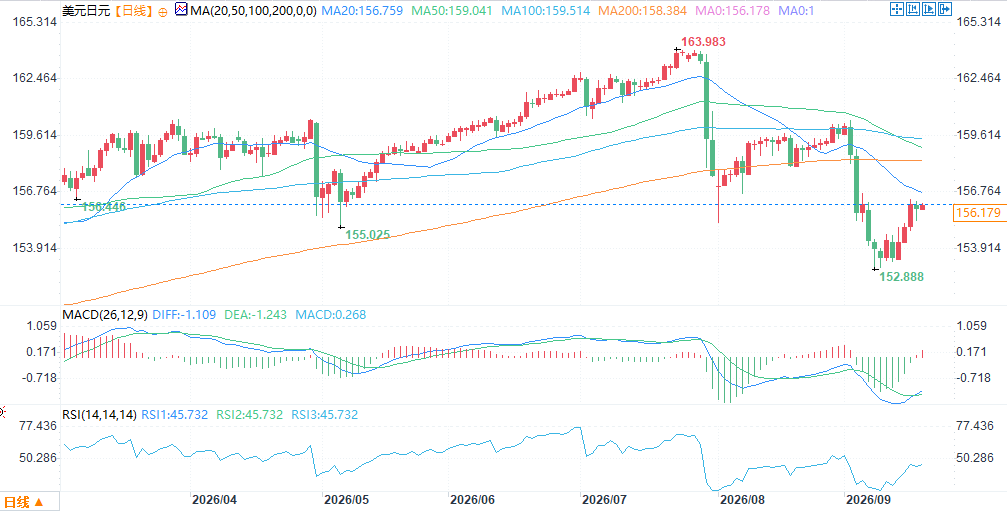 (USD/JPY daily chart, source: FX678) At 8:17 Beijing time, USD/JPY was trading at 156.16/17.
Japanese inflation data: All indicators fell short of expectations, with the biggest gaps in core indicators.
Japan's August consumer price index (CPI) data was officially released shortly after the Asian market opened, with results across the board weaker than all major indicators previously monitored by the market, prompting a reassessment of the weakening upward momentum in Japanese prices. The overall CPI rose 1.9% year-on-year, lower than the expected 2.0% and unchanged from July, indicating that overall inflationary pressures did not intensify as expected. The core CPI, excluding fresh food, rose 1.7% year-on-year, also below the expected 1.8% and lower than July's 1.8%, reflecting a slowdown in the rate of increase in underlying prices after excluding volatile fresh food. Of particular note is the core core CPI, excluding fresh food and energy—the Bank of Japan's most closely watched indicator of potential inflation trends—which recorded only 1.7%, significantly lower than the market expectation of 2.0% and also lower than July's 1.8%. The gap between the core core indicator and expectations is the most significant, becoming the most prominent signal in this data release, suggesting that the demand-driven inflationary momentum in Japan may be weaker than previously assessed by the market, adding more uncertainty to subsequent monetary policy discussions.Yen reaction: Interest rate hike still priced in, but hawkish expectations dampened.
Despite widespread market expectations that the Bank of Japan (BOJ) will raise policy rates tonight, August inflation data fell short of expectations across the board, particularly the core inflation indicator, which was interpreted as a signal that the BOJ's future path may be more dovish than previously priced in. This interpretation quickly triggered a reaction in the foreign exchange market, with the yen weakening slightly after the data release, even though the rate hike itself was almost entirely priced in by the market. Traders began to reassess the hawkishness of the BOJ's subsequent rate hike pace and magnitude, leading to a slight rise in the USD/JPY exchange rate. Market sentiment indicates that while short-term rate hike expectations have not been significantly shaken, the soft inflation data has reduced the room for continued aggressive tightening by the central bank. Some investors are beginning to adjust their expectations for the normalization path of Japan's monetary policy, believing that future rate hikes may be more cautious and slower-paced.Institutional Views
Standard Chartered strategists Chong Hoon Park and Nicholas Chia predict that the Bank of Japan will raise its policy rate by 25 basis points to 1.25% at its September 17-18 meeting, but will avoid sending overly hawkish signals, maintaining a gradual normalization path overall. They believe that a simple rate hike by the Bank of Japan is unlikely to drive a significant appreciation of the yen, as recent positive factors supporting the yen (including rate hike expectations and rumors of capital repatriation) have already been fully priced in by the market. Therefore, the threshold for further yen appreciation is high, and the market is more likely to react negatively to policy or liquidity issues falling short of expectations. Based on this, Standard Chartered expects the USD/JPY exchange rate to return to the upper half of the 155-160 range in the fourth quarter, with limited downside potential in the short term, and the exchange rate movement will still be dominated by the USD/JPY interest rate differential and risk sentiment. Morgan Stanley's strategy team recently assessed that the yen is likely to fall back to levels seen in July. They point out that traders are rebuilding yen carry trades, while fundamentals still favor a weaker yen. The team therefore recommends a new trading strategy, targeting a rise in USD/JPY to the 163 level. This level was reached after the rare coordinated intervention by Japan and the US to purchase yen at the end of July. Morgan Stanley emphasizes that despite the expectation of intervention and interest rate hikes, the rebuilding of carry trades and interest rate advantages will continue to put pressure on the yen, and the upside risk outweighs the downside risk in the short term. (USD/JPY daily chart, source: FX678) At 8:17 Beijing time, USD/JPY was trading at 156.16/17.
- Risk Warning and Disclaimer
- The market involves risk, and trading may not be suitable for all investors. This article is for reference only and does not constitute personal investment advice, nor does it take into account certain users’ specific investment objectives, financial situation, or other needs. Any investment decisions made based on this information are at your own risk.