Reserve Bank of Australia Governor adopts hawkish stance: Upside inflation risks have moved from possibility to reality, and the door to interest rate hikes remains open.
2026-09-18 08:14:10
The Australian dollar edged higher against the US dollar during Asian trading hours on Friday (September 18), currently trading around 0.7115. This modest rebound reflects a repricing of market expectations for further interest rate hikes by the Reserve Bank of Australia (RBA). RBA Governor Michelle Bullock told the House of Representatives Standing Committee on Economics on Thursday (September 17) that the upside inflation risks highlighted in the August monetary policy statement are materializing, driven by factors including Middle East oil prices, the AI boom, and extreme weather, even with slowing growth and unemployment remaining at 4.5%. Bullock's acknowledgment that the upside inflation risks are "materializing" rather than merely a possibility leans towards a hawkish stance, just over a week before the board meeting. She explicitly linked rising Middle East oil prices to direct and indirect inflation transmission, providing the market with a clearer understanding that further rate hikes remain a possibility. The Australian dollar may find some support from this hawkish tone. 
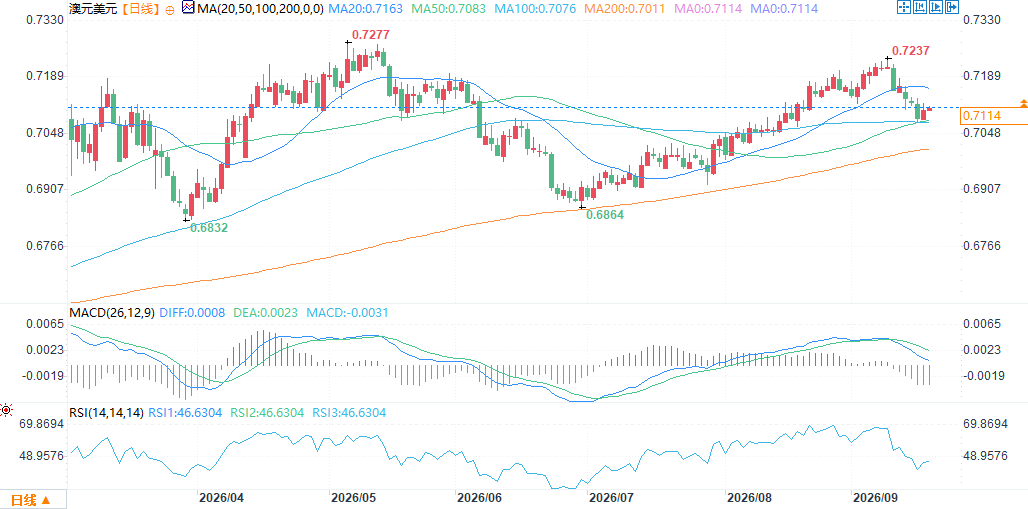 (Australian dollar against US dollar daily chart, source: EasyForex) At 8:01 Beijing time, the Australian dollar was trading at 0.7115/16 against the US dollar.
Inflation assessment: Upside risks marked in August are materializing.
Block stated that inflation has been above target since its rebound in the second half of 2025, with both overall and underlying indicators hovering around or slightly above 3.5% over the past year. She indicated that the upside inflation risks highlighted in the August monetary policy statement are now materializing, citing the Middle East conflict, the AI boom, and extreme weather pushing up energy, agricultural, and technology-related prices. Oil prices have risen sharply again, directly increasing inflation through gasoline prices and indirectly through businesses passing on higher input costs; Block noted that other advanced economy central banks are also responding to this dynamic. She told the committee, “Inflation is too high,” and the board is focused on ensuring it does not embed itself in price and wage setting behavior.Labor market: Near full employment, but slightly tight.
Block stated that labor market conditions remain close to full employment, but slightly tight. The unemployment rate remains at 4.5%, which is low by historical standards, and the employed population as a percentage of the total population is near record highs. This labor market backdrop provides support for the Reserve Bank of Australia to maintain a restrictive policy stance, despite slowing growth.Outlook Assessment: Rising global cost pressures and widespread cost pass-through by companies
Block stated that the Reserve Bank of Australia's (RBA) August monetary policy statement assessed its inflation forecast with risks skewed to the upside, predicting that inflation would not return to the midpoint of the target range until the end of 2027. She noted that subsequent developments indicate some of these upside risks are materializing. Increased global cost pressures, including the Middle East conflict, the AI boom, and extreme weather events, are putting upward pressure on energy, agricultural, and technology-related prices. Oil and related prices have risen sharply again, and the RBA's Business Liaison Program has received widespread reports from businesses passing on higher costs. Block stated that this trend needs to be kept under control, rather than embedded in ongoing price and wage decisions. She pointed out that several other developed economies' central banks are responding to the same global inflationary shock by raising interest rates or signaling that rate hikes may be necessary.Domestic activity: Demand growth slows, but corporate investment remains strong.
Block stated that demand growth in the first half of 2026 slowed broadly as expected, and the full effects of this year's cumulative 75 basis point rate hikes have not yet been fully transmitted due to the typical lag in monetary policy. The impact of the Middle East conflict on activity has been relatively mild so far, although confidence has weakened, household spending growth has gradually slowed, and business investment has risen strongly due to spending on data centers and renewable energy. Block stated that persistently weak productivity growth means the economy cannot grow strongly without increasing inflationary pressures, calling this a fundamental challenge for the coming years. She indicated that the Monetary Policy Board meeting in a little over a week will assess whether the tightening measures implemented so far have been sufficient to bring inflation back to target within a reasonable timeframe.Market Impact: Hawkish sentiment supports the Australian dollar, but the extent is limited.
Block acknowledged that upside inflation risks are materializing rather than merely a possibility, leaning towards a hawkish stance ahead of the board meeting. She explicitly linked rising Middle East oil prices to direct and indirect inflation transmission, providing the market with a clearer understanding that further rate hikes remain a possibility. The Australian dollar may have gained some support from the hawkish tone, especially since she mentioned that other developed economies' central banks are also responding to the same global inflation shock, but her acknowledgment of a softening housing market and a gradually easing labor market limited the magnitude of repricing. Overall, the testimony was consistent with the market's already priced-in 70% to 75% probability of a rate hike at the September 28-29 meeting, rather than a clear escalation.Summary: Upside risks have been priced in, and the probability of an interest rate hike at the September meeting remains high.
In summary, Bullock's testimony confirmed that the upside inflation risks identified by the RBA in August are materializing, with Middle East oil prices, the AI boom, and extreme weather being the core drivers, and businesses broadly passing on costs. The labor market is near full employment but slightly tight, domestic demand is slowing, business investment is strong, and weak productivity is the fundamental challenge. For the Australian dollar, the hawkish tone provides some support, but softening signals in the housing and labor markets limit the extent of repricing. The market has priced in a 70% to 75% probability of a rate hike at the September 28-29 meeting. Going forward, attention should be paid to the actual voting split at the September meeting, whether inflation data can confirm further tightening, and the continued transmission of Middle East tensions and oil prices to Australian inflation. (Australian dollar against US dollar daily chart, source: EasyForex) At 8:01 Beijing time, the Australian dollar was trading at 0.7115/16 against the US dollar.
- Risk Warning and Disclaimer
- The market involves risk, and trading may not be suitable for all investors. This article is for reference only and does not constitute personal investment advice, nor does it take into account certain users’ specific investment objectives, financial situation, or other needs. Any investment decisions made based on this information are at your own risk.