Crude oil trading alert: Supply concerns ease, WTI oil prices remain under pressure near $96 for the third consecutive day.
2026-09-18 09:46:13
WTI crude oil continued its weakness in Asian trading on Friday, hovering around $96.40 per barrel, marking the third consecutive trading day of downward pressure. The recent pullback in oil prices from their highs was not primarily due to a sudden deterioration in global oil demand, but rather to easing market concerns about disruptions to Middle Eastern energy supplies. With more signs of supply recovery emerging, coupled with renewed market focus on whether diplomatic channels can facilitate a gradual resumption of energy transportation, the previously accumulated supply risk premium in crude oil prices has begun to ease.  The most pressing market focus is on the progress of repairs to Saudi Arabia's energy infrastructure. Market estimates suggest that Saudi Arabia is striving to restore approximately half of the East-West Pipeline's capacity within days and expects full operation to resume in about six weeks. This pipeline is crucial for Saudi Arabia's crude oil exports, bypassing the Strait of Hormuz; therefore, its repair progress directly impacts market assessments of global supply stability. Before the infrastructure is fully restored, Saudi Arabia is adjusting its crude oil export routes, maintaining some supply through the Strait of Hormuz. Specifically, Saudi Arabia uses shuttle ships to transport crude oil across the strait, where it is received and transported by tankers anchored outside the strait, thus reducing the prolonged exposure of large export vessels to potential security risks. This transportation arrangement indicates that Saudi Arabia is not entirely reliant on the East-West Pipeline's restoration before resuming normal exports, but rather is seeking alternative transportation options during infrastructure repairs. These supply-side changes are reducing the previously tight premium in the crude oil market. Due to the impact on Middle Eastern energy facilities, the market had previously worried that actual supply losses could continue to widen, and this risk was reflected in oil prices in advance. As Saudi Arabia begins repairing pipelines and rescheduling export transportation, market concerns about a persistent supply gap have eased, leading to a price correction. New pressures are also emerging on the demand side. The Federal Reserve previously raised interest rates by 25 basis points, increasing the policy rate to 3.75% to 4.00%, while maintaining the possibility of further rate hikes. Higher interest rates mean that financing costs remain high and may somewhat inhibit economic activity and energy consumption. For crude oil, the simultaneous easing of supply risks and weakening demand growth expectations has temporarily left the market bulls without new driving factors. The performance of the US Treasury market also reflects this change. Strategists at Societe Generale pointed out that after the Fed's rate hike and upward revision of the policy path, the bond market initially faced significant selling pressure, but lower oil and natural gas prices subsequently provided some buffer. The yield on the 10-year US Treasury note fell to 4.94% at one point, before rising again to approximately 5.02% during the Asian session. There is a certain macroeconomic transmission relationship between crude oil prices and bond yields. Lower energy prices can alleviate inflationary pressures, thereby reducing market concerns about further interest rate increases; however, if the Fed continues to send hawkish signals and yields rise again, it may increase the risk of an economic slowdown and put pressure on crude oil demand expectations. The core issue facing WTI crude oil has shifted from whether supply will be disrupted to whether supply recovery will be faster than demand pressure. Market sentiment is shifting, with investors gradually reducing some of the risk premium they had previously priced in for extreme supply disruptions, but not entirely abandoning a defensive stance. The $96 level remains high, indicating that while oil prices have retreated from previous highs, the market remains highly sensitive to the Middle East situation. If key energy infrastructure is again impacted, or supply recovery falls short of expectations, oil prices could quickly re-induce supply risks. Therefore, the market needs to focus on the actual progress of the Saudi East-West pipeline's restoration, the situation of oil transportation in the Strait of Hormuz, and whether regional diplomatic communication can achieve substantial progress. Meanwhile, US interest rates and Treasury yields cannot be ignored. If oil and gas prices continue to decline and cool inflation expectations, yields may see some relief; conversely, if the Federal Reserve further strengthens its high-interest-rate stance, demand concerns may continue to suppress oil prices. WTI around $96 has entered a critical area for the rebalancing of fundamental bullish and bearish forces. News of supply recovery may limit further price increases, while geopolitical uncertainty means there is still room for downside support. Future oil prices are more likely to be repriced around supply recovery, transportation security, and US demand expectations. From a daily chart perspective, WTI crude oil has weakened for three consecutive trading days, with prices falling back to around $96.40 per barrel, but overall it remains in a high-level consolidation phase after its previous rapid rise. Although the current price has clearly cooled, as long as it hasn't broken below the important support area of the previous upward structure, the daily chart cannot be directly considered a complete trend reversal. Short-term market momentum has weakened significantly compared to before, and investors need to pay attention to whether the price can regain its footing above key psychological levels. The first resistance level to watch is around $100, which is both a significant psychological level and an important area that oil prices need to break through after regaining strength. If WTI regains and stabilizes above $100, the market may retest the previous high area; if it fails to recover $100, selling pressure at higher levels may still limit the rebound. On the downside, the first support level to watch is around $95, which is an important defensive position for the current price. A further breach of this level could lead to oil prices seeking new support in the $92-$93 area. From a 4-hour chart perspective, WTI crude oil has shifted from its previous strong upward trend to a pullback, with momentum weakening after continuous price pressure. The area around $96 is a renewed battleground between bulls and bears. If the price can stabilize above $95 and break through $98 again, a short-term rebound may form on the 4-hour chart. Conversely, if $95 is effectively broken, the short-term correction may widen further, potentially moving towards the $92-$93 range. Indicators need to focus on whether short-term momentum shows signs of bottoming out. Given the continued decline in supply risk premium, the sustainability of the technical rebound still depends on fundamental support. Overall, WTI is currently at the intersection of a high-level pullback and lingering supply risks. $100 is a key resistance level, $95 is a significant short-term support level, and the $92-$93 range is a key area to watch for further pullback. If supply recovery progresses faster than market expectations, downward pressure on the technical side may increase; if supply recovery is hindered or regional risks escalate again, oil prices may quickly recover lost ground.
 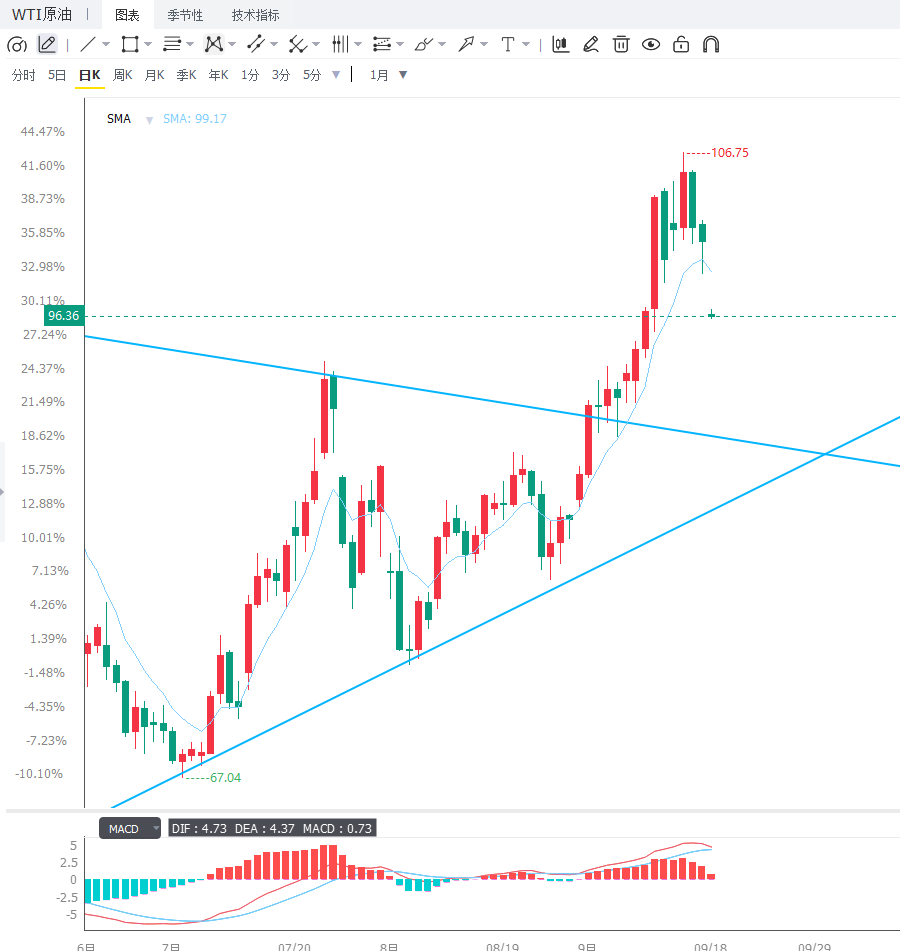 The editor summarizes that WTI oil prices weakened for the third consecutive day, primarily due to a marginal easing of supply disruption risks in the Middle East. Saudi Arabia's progress in repairing the East-West pipeline and its maintenance of some exports through adjustments to transportation routes have reduced market concerns about a persistent supply gap. However, supply risks have not completely disappeared, and oil prices remain vulnerable to changes in energy infrastructure security and transportation routes. Meanwhile, the Federal Reserve maintains a hawkish policy path, and higher interest rates may put pressure on global economic growth and oil demand expectations. In the short term, WTI needs to focus on the $95 support level and the $100 resistance level. Subsequent price movements will depend on the speed of supply recovery, regional developments, and whether demand can withstand a high-interest-rate environment.
The most pressing market focus is on the progress of repairs to Saudi Arabia's energy infrastructure. Market estimates suggest that Saudi Arabia is striving to restore approximately half of the East-West Pipeline's capacity within days and expects full operation to resume in about six weeks. This pipeline is crucial for Saudi Arabia's crude oil exports, bypassing the Strait of Hormuz; therefore, its repair progress directly impacts market assessments of global supply stability. Before the infrastructure is fully restored, Saudi Arabia is adjusting its crude oil export routes, maintaining some supply through the Strait of Hormuz. Specifically, Saudi Arabia uses shuttle ships to transport crude oil across the strait, where it is received and transported by tankers anchored outside the strait, thus reducing the prolonged exposure of large export vessels to potential security risks. This transportation arrangement indicates that Saudi Arabia is not entirely reliant on the East-West Pipeline's restoration before resuming normal exports, but rather is seeking alternative transportation options during infrastructure repairs. These supply-side changes are reducing the previously tight premium in the crude oil market. Due to the impact on Middle Eastern energy facilities, the market had previously worried that actual supply losses could continue to widen, and this risk was reflected in oil prices in advance. As Saudi Arabia begins repairing pipelines and rescheduling export transportation, market concerns about a persistent supply gap have eased, leading to a price correction. New pressures are also emerging on the demand side. The Federal Reserve previously raised interest rates by 25 basis points, increasing the policy rate to 3.75% to 4.00%, while maintaining the possibility of further rate hikes. Higher interest rates mean that financing costs remain high and may somewhat inhibit economic activity and energy consumption. For crude oil, the simultaneous easing of supply risks and weakening demand growth expectations has temporarily left the market bulls without new driving factors. The performance of the US Treasury market also reflects this change. Strategists at Societe Generale pointed out that after the Fed's rate hike and upward revision of the policy path, the bond market initially faced significant selling pressure, but lower oil and natural gas prices subsequently provided some buffer. The yield on the 10-year US Treasury note fell to 4.94% at one point, before rising again to approximately 5.02% during the Asian session. There is a certain macroeconomic transmission relationship between crude oil prices and bond yields. Lower energy prices can alleviate inflationary pressures, thereby reducing market concerns about further interest rate increases; however, if the Fed continues to send hawkish signals and yields rise again, it may increase the risk of an economic slowdown and put pressure on crude oil demand expectations. The core issue facing WTI crude oil has shifted from whether supply will be disrupted to whether supply recovery will be faster than demand pressure. Market sentiment is shifting, with investors gradually reducing some of the risk premium they had previously priced in for extreme supply disruptions, but not entirely abandoning a defensive stance. The $96 level remains high, indicating that while oil prices have retreated from previous highs, the market remains highly sensitive to the Middle East situation. If key energy infrastructure is again impacted, or supply recovery falls short of expectations, oil prices could quickly re-induce supply risks. Therefore, the market needs to focus on the actual progress of the Saudi East-West pipeline's restoration, the situation of oil transportation in the Strait of Hormuz, and whether regional diplomatic communication can achieve substantial progress. Meanwhile, US interest rates and Treasury yields cannot be ignored. If oil and gas prices continue to decline and cool inflation expectations, yields may see some relief; conversely, if the Federal Reserve further strengthens its high-interest-rate stance, demand concerns may continue to suppress oil prices. WTI around $96 has entered a critical area for the rebalancing of fundamental bullish and bearish forces. News of supply recovery may limit further price increases, while geopolitical uncertainty means there is still room for downside support. Future oil prices are more likely to be repriced around supply recovery, transportation security, and US demand expectations. From a daily chart perspective, WTI crude oil has weakened for three consecutive trading days, with prices falling back to around $96.40 per barrel, but overall it remains in a high-level consolidation phase after its previous rapid rise. Although the current price has clearly cooled, as long as it hasn't broken below the important support area of the previous upward structure, the daily chart cannot be directly considered a complete trend reversal. Short-term market momentum has weakened significantly compared to before, and investors need to pay attention to whether the price can regain its footing above key psychological levels. The first resistance level to watch is around $100, which is both a significant psychological level and an important area that oil prices need to break through after regaining strength. If WTI regains and stabilizes above $100, the market may retest the previous high area; if it fails to recover $100, selling pressure at higher levels may still limit the rebound. On the downside, the first support level to watch is around $95, which is an important defensive position for the current price. A further breach of this level could lead to oil prices seeking new support in the $92-$93 area. From a 4-hour chart perspective, WTI crude oil has shifted from its previous strong upward trend to a pullback, with momentum weakening after continuous price pressure. The area around $96 is a renewed battleground between bulls and bears. If the price can stabilize above $95 and break through $98 again, a short-term rebound may form on the 4-hour chart. Conversely, if $95 is effectively broken, the short-term correction may widen further, potentially moving towards the $92-$93 range. Indicators need to focus on whether short-term momentum shows signs of bottoming out. Given the continued decline in supply risk premium, the sustainability of the technical rebound still depends on fundamental support. Overall, WTI is currently at the intersection of a high-level pullback and lingering supply risks. $100 is a key resistance level, $95 is a significant short-term support level, and the $92-$93 range is a key area to watch for further pullback. If supply recovery progresses faster than market expectations, downward pressure on the technical side may increase; if supply recovery is hindered or regional risks escalate again, oil prices may quickly recover lost ground. The editor summarizes that WTI oil prices weakened for the third consecutive day, primarily due to a marginal easing of supply disruption risks in the Middle East. Saudi Arabia's progress in repairing the East-West pipeline and its maintenance of some exports through adjustments to transportation routes have reduced market concerns about a persistent supply gap. However, supply risks have not completely disappeared, and oil prices remain vulnerable to changes in energy infrastructure security and transportation routes. Meanwhile, the Federal Reserve maintains a hawkish policy path, and higher interest rates may put pressure on global economic growth and oil demand expectations. In the short term, WTI needs to focus on the $95 support level and the $100 resistance level. Subsequent price movements will depend on the speed of supply recovery, regional developments, and whether demand can withstand a high-interest-rate environment.
- Risk Warning and Disclaimer
- The market involves risk, and trading may not be suitable for all investors. This article is for reference only and does not constitute personal investment advice, nor does it take into account certain users’ specific investment objectives, financial situation, or other needs. Any investment decisions made based on this information are at your own risk.