While interest rates are rising globally, the Bank of England remains on hold: the pound's interest rate advantage is disappearing.
2026-09-18 10:00:10
On Friday (September 18) during the Asian session, the British pound traded in a narrow range against the US dollar, currently hovering around 1.3360, almost unchanged for the day, and the exchange rate remains near its lowest level since the end of July. The reason for the slow rebound lies in the discrepancy between the Bank of England's stance and the global tightening trend. The Iranian conflict has pushed up global oil prices and borrowing costs; the European Central Bank has raised interest rates twice, the Federal Reserve raised rates on Wednesday, while the Bank of England kept its interest rate unchanged at 3.75% on Thursday, becoming an outlier in global interest rates. UK inflation is 3.1%, above the target but below pre-conflict levels; the unemployment rate is 4.9%, with weak growth. Six of the nine committee members voted to maintain the interest rate, but as the conflict spreads, the UK's unique factors are unlikely to prevent further rate hikes for much longer. 
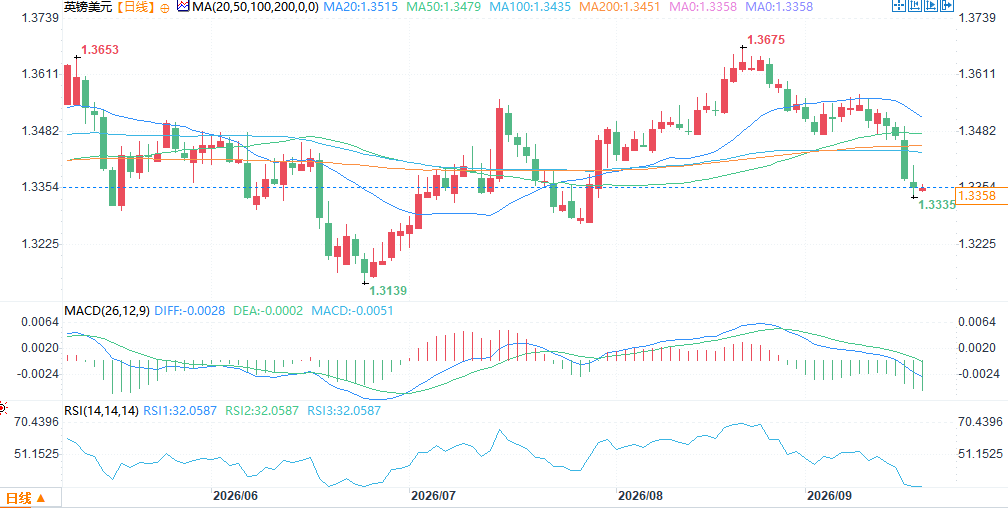 (GBP/USD daily chart, source: FX678) At 9:59 Beijing time, GBP/USD was trading at 1.3362/63.
What makes Britain different: lower inflation than before the conflict, weak employment, and sluggish growth.
The Bank of England does not automatically follow the decisions of Frankfurt or Washington; policymakers have the authority to set monetary policy based on the UK's circumstances. The UK situation differs from that of the US or the Eurozone. UK inflation is 3.1%, above the 2% target, but price increases remain slower than pre-conflict levels in February, while inflation in other Western economies is accelerating. The UK labor market is relatively weak, with an unemployment rate of 4.9%, well above the near-record low of 3.6% in 2022. In contrast, the Eurozone unemployment rate is 6.4%, near a historic low, and the US unemployment rate has steadily declined to 4.1% this year. The UK's growth outlook remains significantly lackluster, at least until recently.The Bank of England's core concern is preventing the spread of cost shocks, not preventing oil prices from rising.
Following the outbreak of the conflict with Iran, imported energy costs have risen sharply. The Monetary Policy Committee's primary concern is not whether to prevent inflation from rising, as higher interest rates would not help restore oil flows from the Persian Gulf. Instead, its goal is to prevent the surge in costs from spreading throughout the economy via worker wage demands and widespread price increases by businesses. So far, there has been little evidence of this. Bank of England Governor Bailey stated, "The evidence regarding the emerging second-party effects remains very limited, although it is too early to say. Domestic inflationary pressures continue to ease." Therefore, six of the nine members of the Monetary Policy Committee voted on Thursday to keep interest rates unchanged.Conflict Spreads: Houthi rebels threaten the Red Sea, oil prices briefly rise to $109, and the Bank of England's "adverse scenario" is materializing.
As the conflict escalates, unique factors in the UK are unlikely to hold back interest rate hikes for much longer. Until recently, a disruption in the Strait of Hormuz was manageable, as the possibility of peace talks between Washington and Tehran dampened oil prices. Inflation has risen to 3.1% so far, which is quite well-controlled for such a large global market shock. Now, the Iranian-backed Houthi rebels in Yemen, fighting against Saudi Arabia, are threatening Red Sea oil pipelines and shipping. Oil prices recently rose to $109 a barrel, pushing up petrol and diesel prices. Households expect a significant increase in their January energy bills. This appears to be the “adverse scenario” presented in the Bank of England’s July economic forecasts: a prolonged conflict could push oil prices above $100, increasing prices and suppressing growth. In these forecasts, officials indicated that inflation would peak at around 4.5% next year, more than double the Bank of England’s 2% target. At this level, the dreaded “second-hand effect”—such as higher wages followed by higher prices—becomes a greater threat. The forecasts also suggest that this worst-case scenario could prompt the Monetary Policy Committee to raise the benchmark interest rate to 4.25%, requiring two rate hikes and then maintaining it for several years.Within the Monetary Policy Committee: Four members expressed concerns about the future, and reasons for raising interest rates are accumulating.
The rationale for raising interest rates is not only rising inflation, but also the possibility that the short-term pain of rising petrol prices and energy bills could embed inflation into the entire economy. Raising the benchmark interest rate won't make petrol cheaper, but it could theoretically prevent a wage-price spiral. Currently, the Bank of England's "adverse scenario" appears to be materializing. Policymakers now believe inflation will rise above 4% next year. Hopes for a reversal, a declaration of peace, and a resumption of oil flows are fading. Of the six members of the Monetary Policy Committee who voted to keep the rate at 3.75%, four expressed concerns about the coming months. Bailey warned that the Gulf "seems to have lost its urgency in finding a solution." He stated, "If the Middle East conflict continues as it appears, and the risk of secondary effects increases, policy may have to be tightened." His two deputies echoed this view. A third deputy stated that although the situation could change, "the longer the conflict continues, the stronger the case for raising rates becomes." For now, everyone seems to be suggesting they might support a rate hike to 4% at the November meeting.Other risks: food prices, economic growth, and the job market.
It's not just the oil market causing the problem. Food price inflation has been unexpectedly low in recent months, but this may not be sustainable given the summer heatwave, El Niño, and conflict-induced fertilizer price increases. One of the three voters who supported raising interest rates said that higher energy prices, along with food prices, could trigger another surge in inflation. The economy also performed slightly better than expected over the summer, and the labor market appears to be stabilizing, potentially giving workers more leverage to demand pay rises—all factors that could drive inflation. As Bailey wrote in his letter to the Chancellor explaining why inflation was well above target, the Monetary Policy Committee is "ready to act if necessary" to bring price increases back to the target. Britain may not remain an outlier for long.The Bank of England holding rates steady and the pound against the dollar: its anomaly suggests that the pound's interest rate differential is eroding.
The Bank of England's decision to keep interest rates unchanged at 3.75% makes it an outlier in global interest rates, creating structural pressure rather than support for the pound against the dollar. The logic is simple: the European Central Bank has already raised rates twice, the Federal Reserve raised rates on Wednesday and signaled another rate hike this year, and the Bank of England's inaction means the interest rate differential between the pound and the dollar/euro is narrowing or even reversing. With the dollar strengthening across the board due to the hawkish Fed, the pound lacks equivalent interest rate support. However, this situation may not last long. Three members of the Bank of England have voted to raise rates, and four of the six members who maintained the rate have expressed concerns about the future. Market pricing in a 4% rate hike in November is heating up. If a rate hike does occur in November, the pound will regain interest rate support, and the synchronized tightening between the Bank of England and the Fed will partially correct the previous gap. Therefore, the core contradiction for the pound against the dollar lies in: short-term pressure from a strong dollar, and medium-term uncertainty depending on whether the Bank of England can keep pace with global tightening in November. (GBP/USD daily chart, source: FX678) At 9:59 Beijing time, GBP/USD was trading at 1.3362/63.
- Risk Warning and Disclaimer
- The market involves risk, and trading may not be suitable for all investors. This article is for reference only and does not constitute personal investment advice, nor does it take into account certain users’ specific investment objectives, financial situation, or other needs. Any investment decisions made based on this information are at your own risk.