The Bank of Japan raised interest rates to 1.25% as expected, but the dollar rose against the yen instead of falling: Why didn't the market buy it?
2026-09-18 12:06:09
The Bank of Japan (BOJ) raised its policy rate by 25 basis points to approximately 1.25% on Friday (September 18) by a 7-2 vote, the highest level since 1993. The new guidance will take effect on September 24. Two board members voted against the rate hike, arguing that current economic and price developments have not yet accelerated significantly, making a rate hike inappropriate at this time. The BOJ statement explicitly included forward guidance, stating that it will continue to raise rates and adjust the degree of easing, signaling that this is not a one-off adjustment. The BOJ expects core CPI to accelerate significantly above 2% in the second half of fiscal year 2026, before falling back to around 2% in the latter part of the forecast period. The Middle East situation, AI-related demand, and exchange rates were flagged as two-way risks. The BOJ believes that even after the rate hike, financial conditions will remain accommodative, and the near-term path is gradual tightening rather than aggressive tightening. The USD/JPY pair briefly surged nearly 70 points to 156.84 before continuing its upward trend, reaching a near two-week high of 157.14. Following the interest rate decision, it has risen nearly 100 points, or about 0.76%, indicating that the market is not buying into the Bank of Japan's hawkish stance. This aligns with the market's expectation that the rate hike has been fully priced in, and the 25 basis point hike itself has virtually no unexpected value. 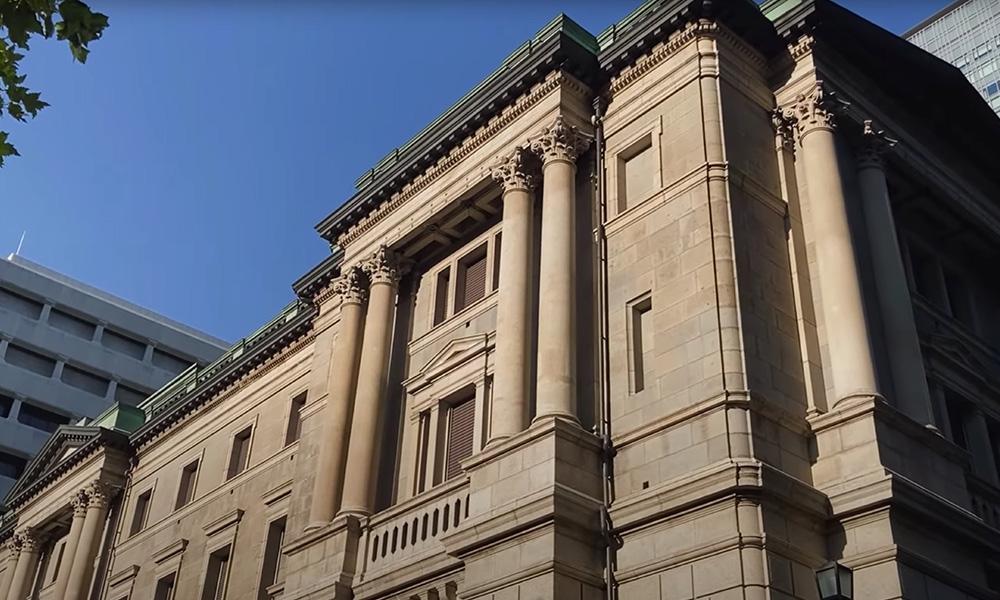
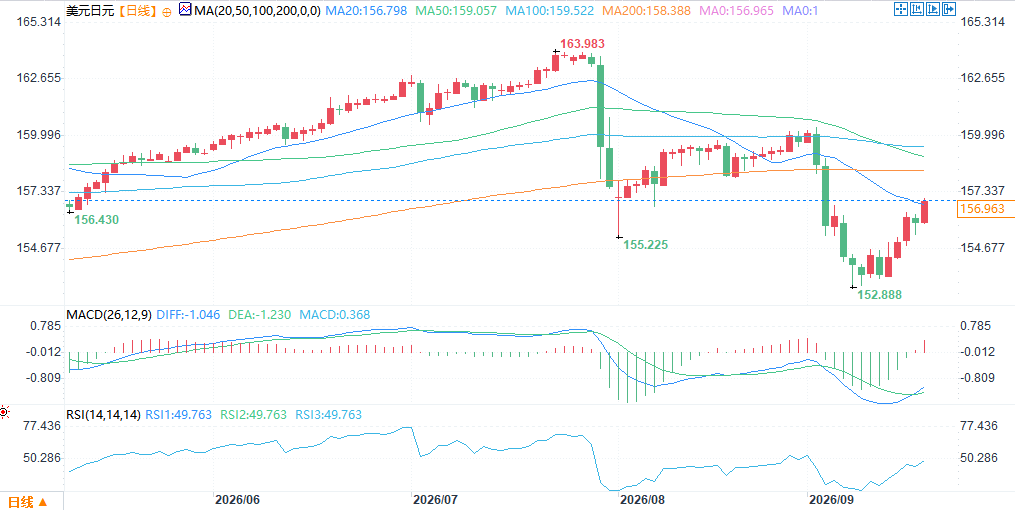 (USD/JPY daily chart, source: FX678) At 12:03 Beijing time, USD/JPY was trading at 157.02/03.
Key points of the resolution: A 7-2 vote to raise interest rates to 1.25%, the highest since 1993.
The Bank of Japan raised its policy rate by 25 basis points to about 1.25% on Friday, the highest level since 1993, with the decision passed 7-2. The new guidelines will take effect on September 24, with the supplementary deposit facility rate also at 1.25% and the base lending rate at 1.5%. Board members Toshiro Asada and Ayano Sato voted against the rate hike. Asada argued that the CPI excluding fresh food was still below 2%, and the economic situation could not necessarily be described as strong; Sato believed that current economic and price developments did not appear to be accelerating significantly, and that raising rates now was inappropriate. The 7-2 split confirms that there are still real differences within the board, rather than a unified decision, which may dampen market pricing for aggressive tightening measures after today.Economic Assessment: Moderate Recovery, with Some Weakness Due to Middle East Circumstances
The Bank of Japan described the Japanese economy as experiencing a modest recovery, but with some weaknesses, partly reflecting the situation in the Middle East. Looking ahead, growth is expected to continue moderately, supported by government measures and increased global AI-related demand, even though the Middle East situation is expected to weigh on activity. Regarding prices, the Bank of Japan stated that producer price inflation remained high year-on-year, reflecting AI-related demand, high oil prices, and the depreciation of the yen, while underlying CPI inflation rose moderately as inter-firm price pressures were passed on to consumer prices, with firms continuing to pass on wage increases.Inflation Path: Accelerating to significantly above 2% in the second half of fiscal year 2026.
The central bank's accompanying economic assessment provides a more detailed path: the CPI excluding fresh food may accelerate significantly above 2% from the second half of fiscal year 2026, driven by factors including the transmission of past oil price increases, rising semiconductor and AI-related prices, and the impact of the yen's depreciation on durable goods prices. Subsequently, in the latter part of the forecast period covered by the July 2026 economic and price outlook, the increase is expected to fall back to around 2% as the impact of high oil prices subsides. The central bank stated that medium- to long-term inflation expectations continue to rise, with underlying inflation expected to reach a level broadly consistent with the 2% target between the second half of fiscal year 2026 and fiscal year 2027, and remain thereafter. The central bank flagged this outlook as having real two-way risks, stating that particular attention needs to be paid to the impact of the Middle East situation, the expansion of AI-related demand, and exchange rate developments on activity and prices. Specifically, it noted that given companies' shift towards wage and price increases and rising inflation expectations, underlying CPI inflation may deviate upward from the 2% target. Committee members Hajime Takada and Naoki Tamura both objected to the description of the price outlook in the annex, both believing that CPI increases, including the underlying indicator, have already largely reached the price stability target.Financial conditions: Remain loose; interest rate hikes will continue.
The central bank stated that financial conditions remain accommodative, with low real interest rates, increased corporate funding demand, and a proactive lending attitude from financial institutions. Conditions for issuing commercial paper and corporate bonds are favorable. The central bank indicated that even after this interest rate adjustment, accommodative financial conditions are expected to persist, continuing to strongly support economic activity. Looking ahead, the central bank stated that given the underlying CPI inflation rate is approaching 2% and financial conditions remain accommodative, it will continue to raise policy rates and adjust the degree of monetary easing. The timing and pace of further action will be determined based on developments in activity, prices, and financial conditions, including the situation in the Middle East, AI-related demand, and exchange rate risks.Forward guidance: Clearly indicating continued interest rate hikes, not a one-off adjustment.
The statement's clear forward guidance—that the central bank will continue to raise interest rates based on developments in activity, prices, and financial conditions—provides a clear signal to the market: this is not a one-off adjustment. The central bank acknowledges that the Middle East situation and AI-related demand are two-way risks that could delay or accelerate this path. Given that accommodative financial conditions are clearly expected to continue even after rate hikes, recent interpretations suggest a gradual tightening cycle rather than an aggressive one.Institutional Views
Chidu Narayanan, Chief Strategist for Asia Pacific at Wells Fargo in Singapore, said the two dissenting votes from the Bank of Japan today were not unexpected. These two members are likely to maintain a dovish stance throughout the remainder of the rate hike cycle, and therefore will not have a significant impact on the market. Regarding the yen's exchange rate, he expects three factors—the Bank of Japan's steady hawkish shift, the threat of intervention from the Ministry of Finance, and the potential rebalancing of pension funds—to collectively anchor the USD/JPY exchange rate in the 155-160 range. Narayanan further pointed out that in the current environment of rising global energy prices and a period of modest rate hikes by the Federal Reserve, a significant appreciation of the yen would require far more aggressive action from the Bank of Japan than it is now, but the bank doubts that the Bank of Japan intends to do so.Summary: Interest rate hikes proceeded as expected, but internal disagreements persisted; the path of gradual tightening was confirmed.
In summary, the Bank of Japan raised interest rates by 25 basis points to 1.25% as expected, the highest level since 1993, with the 7-2 vote reflecting genuine internal divisions. The statement clearly indicated continued forward guidance on rate hikes, projecting core CPI to accelerate significantly above 2% in the second half of fiscal year 2026 before declining. The Middle East situation, AI demand, and exchange rates were flagged as two-way risks. The central bank believes financial conditions remain accommodative, with a near-term path of gradual tightening. For the yen, the rate hike is already priced in; the real variables are the internal divisions and the restraint of the gradual pace on further tightening pricing. Going forward, attention should be paid to the voting split at subsequent Bank of Japan meetings, whether core CPI will accelerate as per the attached path, the impact of the Middle East situation and exchange rates on policy timing, and the reaction of Japanese government bond yields to hawkish signals. (USD/JPY daily chart, source: FX678) At 12:03 Beijing time, USD/JPY was trading at 157.02/03.
- Risk Warning and Disclaimer
- The market involves risk, and trading may not be suitable for all investors. This article is for reference only and does not constitute personal investment advice, nor does it take into account certain users’ specific investment objectives, financial situation, or other needs. Any investment decisions made based on this information are at your own risk.