Record high diesel prices in the United States are pushing up overall price levels and exacerbating inflationary concerns.
2026-09-18 12:06:11
Since the outbreak of the US-Iran conflict at the beginning of this year, drivers have been closely monitoring gas station prices. While unleaded gasoline has not yet broken historical records, diesel prices have spiraled out of control, reaching a record high of $6.31 per gallon on Wednesday (September 16) . This price point marks another serious milestone in the continuous rise in diesel prices. Many economists and supply chain experts warn that the transportation industry will be the first to suffer from the impact of high diesel prices, and this cost pressure will eventually be passed on to almost all commodities, pushing up the overall price level of society. Federal Reserve Chairman Kevin Warsh also mentioned refining crack spreads after the interest rate meeting, regarding them as an important factor driving up inflation and prompting the Fed to raise interest rates.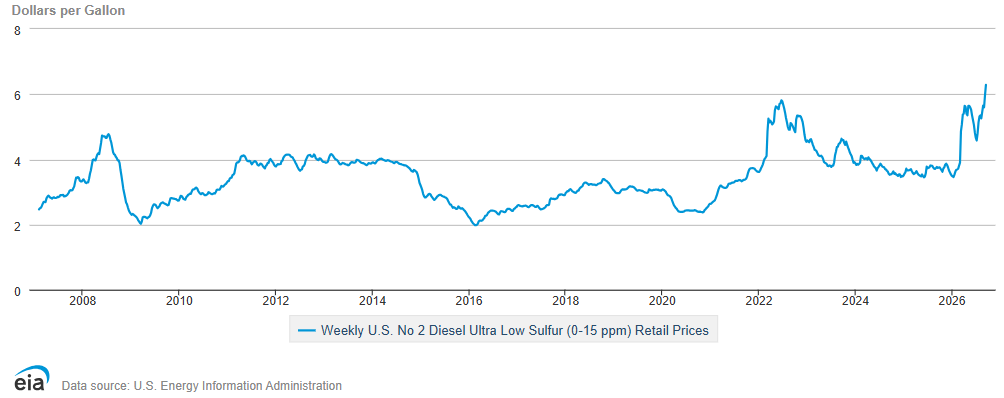 Chart: Weekly Retail Price Chart for Ultra-Low Sulfur Diesel (ULSD) (USD/Gallon) Jeff Lenard, Vice President of Media and Strategic Communications at the Convenience Stores Association, stated that the current surge in oil prices is not solely driven by crude oil; diesel transportation costs are the key factor. The transportation costs incurred in delivering fuel to gas stations continue to drive up retail prices . He said that rising transportation costs will increase the price of fuel by several cents per gallon, and the proportional credit card transaction fees will also increase in tandem with rising oil prices. Currently, retailers mostly absorb the increased costs themselves, compressing their gross profit margin by approximately 15 cents per gallon—a figure roughly equivalent to their original net profit margin. The impact of high diesel prices extends beyond the fuel itself; convenience store snacks, beverages, and other goods rely on diesel trucks for transportation, and rising transportation costs increase the cost of stocking these items . Costco has already implemented purchase limits, restricting the amount of motor oil members can buy. Ship4wd CEO Carmit Glik stated that the impact of diesel fuel often only becomes noticeable to the public after it permeates various goods. Freight rates, agricultural machinery operations, food delivery, and home heating all rely on diesel, and the transmission of price increases is delayed. Consumers will feel the pressure on fresh produce prices and delivery costs several weeks later, which is quite different from the immediate impact of gasoline prices on car owners.
Diesel is a fundamental economic raw material, and its cost pressures permeate to end consumers at every level.
David Russell, global head of market strategy at TradeStation Group, stated that diesel is the most versatile raw material for physical production in the economy. Freight companies are the first to be impacted, and if diesel prices remain historically high, ordinary consumers and various businesses will gradually suffer losses. The chief commercial officer of Norfolk Southern Railway mentioned at a Morgan Stanley conference on Tuesday that diesel prices in California have reached $8 per gallon . Chart: Weekly Retail Price Chart for Ultra-Low Sulfur Diesel (ULSD) (USD/Gallon) Jeff Lenard, Vice President of Media and Strategic Communications at the Convenience Stores Association, stated that the current surge in oil prices is not solely driven by crude oil; diesel transportation costs are the key factor. The transportation costs incurred in delivering fuel to gas stations continue to drive up retail prices . He said that rising transportation costs will increase the price of fuel by several cents per gallon, and the proportional credit card transaction fees will also increase in tandem with rising oil prices. Currently, retailers mostly absorb the increased costs themselves, compressing their gross profit margin by approximately 15 cents per gallon—a figure roughly equivalent to their original net profit margin. The impact of high diesel prices extends beyond the fuel itself; convenience store snacks, beverages, and other goods rely on diesel trucks for transportation, and rising transportation costs increase the cost of stocking these items . Costco has already implemented purchase limits, restricting the amount of motor oil members can buy. Ship4wd CEO Carmit Glik stated that the impact of diesel fuel often only becomes noticeable to the public after it permeates various goods. Freight rates, agricultural machinery operations, food delivery, and home heating all rely on diesel, and the transmission of price increases is delayed. Consumers will feel the pressure on fresh produce prices and delivery costs several weeks later, which is quite different from the immediate impact of gasoline prices on car owners. With multiple industries facing pressure, heating oil prices may rise sharply in winter.
David Russell analyzed that truck drivers are the first group to be affected. Many individual operators struggle to cope with rising costs quickly, and small businesses may be forced out of the market. The contraction in transport capacity will further push up freight rates; the entire transmission process is not a simple linear change. He also stated that aviation kerosene is similar in nature to diesel, meaning winter travelers will face higher airfares, and the costs of various truck transportation services, such as home improvement, will also rise accordingly. Mark Wolfe, executive director of the National Association of Energy Assistance Executives, said that if oil prices remain at current levels, household heating oil costs could rise by 31% this winter. Heating oil and diesel share the same raw material, and their prices are highly correlated . Many families in the northeastern United States rely on heating oil to get through the winter. He said that ordinary families will face triple pressure: heating oil, gasoline, and the additional costs of all goods delivery, significantly increasing the burden on low- and middle-income families. The organization is lobbying Congress to increase heating subsidies, but with Congress in recess until November, the chances of such a proposal being passed are slim. This super El Niño phenomenon is expected to bring above-average temperatures to the Northeast, potentially becoming the only positive factor alleviating the pressure.Supply bottlenecks are driving up diesel prices; refining capacity is the core issue.
Steve Blough, chief supply chain strategist at supply chain software company Infios, stated that multiple factors have contributed to this round of diesel price surges: reduced refining capacity in the Gulf of Mexico, limited Russian crude oil production due to the Russia-Ukraine conflict, and the attack on Saudi oil pipelines, resulting in a convergence of multiple negative factors. Jack Buffington, associate professor of supply chain management at the University of Denver, stated that while crude oil prices have remained relatively stable, the root cause of the diesel price spike is not crude oil, but rather insufficient global refining capacity. While crude oil flows from the Persian Gulf and the Red Sea are disrupted, the impact of damaged refining capacity in Russia and the Middle East is more severe. Globally available refining facilities are operating at almost full capacity, with some capacity undergoing maintenance shutdowns, creating a rigid supply bottleneck. Even if the global conflict were to subside immediately, oil prices would be difficult to fall quickly, and it is expected to take at least a year to return to the $4 per gallon level. Brad Delco, CFO of freight giant JB Hunter, stated that current fuel price volatility is unprecedented, and high diesel prices are causing at least $10 million in operational headwinds, with the company warning of declining profits. Agriculture, construction, public transportation, and food distribution will all be impacted. Agricultural machinery and construction equipment are highly dependent on diesel fuel, and with some contracts having fixed prices, corporate profits will be continuously squeezed. Of course, there are also beneficiaries in the market. The crack spread of oil refineries is widening, and some large transport companies can lock in wholesale diesel fuel and collect surcharges based on retail prices, thus gaining structural benefits.Conclusion
The current diesel crisis hinges on the duration of disturbances in the Strait of Hormuz and the problems at Russian refining facilities. US refinery utilization rates are already nearing capacity, leaving little room to cope with a new round of supply shocks. JPMorgan analysts acknowledge that since the outbreak of the US-Iran conflict, the market has lost its baseline forecasting, making it difficult to establish a complete market projection model, and the possibility of prolonged supply disruptions continues to rise. David Russell believes the current situation leans towards a lose-lose scenario, with inflationary pressures from high diesel prices continuing to plague the US economy and influencing the Federal Reserve's policy choices.- Risk Warning and Disclaimer
- The market involves risk, and trading may not be suitable for all investors. This article is for reference only and does not constitute personal investment advice, nor does it take into account certain users’ specific investment objectives, financial situation, or other needs. Any investment decisions made based on this information are at your own risk.