













UK retail sales unexpectedly rose 0.5%, and the pound held above 1.3360 against the dollar, but hawkish expectations from the Federal Reserve limited the rebound.
2026-09-18 14:42:13
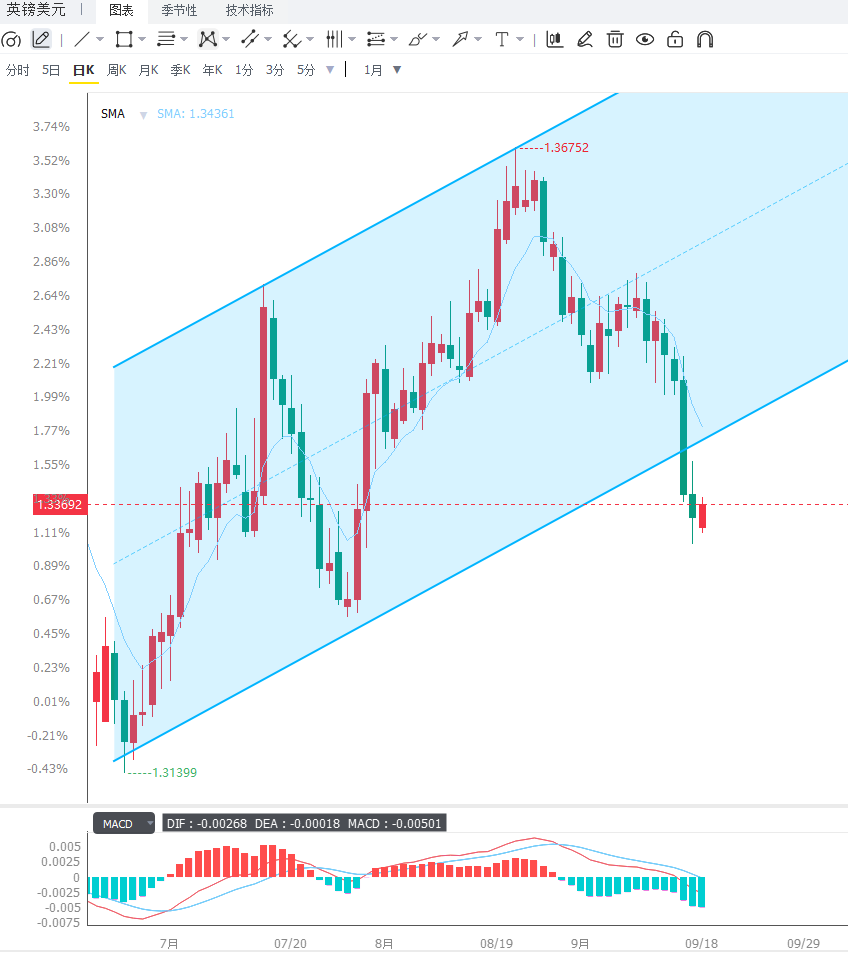
The British pound held steady against the US dollar around 1.3360 in Asian trading on Friday, as the market continued to digest the interest rate decisions made this week by the Bank of England and the Federal Reserve. While the Bank of England kept its interest rate unchanged at 3.75%, the 6-3 vote indicated that some policymakers were inclined to raise rates further. Meanwhile, the Federal Reserve raised rates by 25 basis points this week to 3.75%-4.00%, giving the US dollar a renewed interest rate advantage. Following these changes in the policy paths of the two major central banks, GBP/USD remains in a clearly weak and volatile short-term pattern.  In the UK, August retail sales data provided some support for the pound. Data from the UK Office for National Statistics showed that retail sales rose 0.5% month-on-month in August, significantly better than economists' expectations of a 0.2% decline, compared to a 0.5% decline in July; year-on-year, retail sales increased by 2.4%. The growth mainly came from online sales and department stores, with improvements in clothing and food sales. However, fuel sales fell 1.3% month-on-month, indicating that high energy prices are still squeezing some consumer demand. The improved retail data suggests that UK consumer spending remains relatively resilient for the time being, which is positive for the market's assessment of the UK's economic growth prospects. However, a single month's data is not enough to change the overall policy logic of the UK economy. On Thursday, the Bank of England maintained the interest rate at 3.75% by a 6-3 vote, with three members advocating a 25 basis point increase to 4.00%. The central bank also warned that if rising energy prices further transmit to broader goods and services prices, future interest rate increases may be necessary. UK inflation remains a crucial variable affecting the pound's exchange rate. Rising energy prices may keep UK inflation high in the coming months, and the Bank of England has stated that it needs to closely monitor whether energy costs will create a broader double-dip inflation effect. If this pressure persists, market expectations for a November rate hike could continue to rise, supporting the pound. However, the Bank of England has not committed to a rate hike at its next meeting. Policymakers need to balance controlling inflation with avoiding further suppression of economic activity. The Bank of England has also suspended its government bond sales program for six months and adjusted its long-term reduction in government bond holdings, indicating continued high uncertainty in the current policy environment. In contrast, the Federal Reserve's policy stance is putting more direct pressure on GBP/USD. The Fed raised interest rates by 25 basis points this week to 3.75%-4.00%, its first rate hike since 2023. Fed Chairman Warsh emphasized that US inflation remains high and recent data is insufficient to demonstrate a significant improvement in the underlying inflation trend. This has led to renewed market expectations of further Fed rate hikes. CME FedWatch data shows that the market is now pricing in a probability of another rate hike in October at approximately 53.1%, up from approximately 44% the previous day. If US inflation and employment data remain resilient, expectations of further Fed tightening could strengthen, widening the dollar's interest rate advantage over the pound. Meanwhile, the recent strength of the US dollar has limited the rebound of GBP/USD. The US dollar index previously rose above 100, and although US Treasury yields and oil prices have recently declined, the dollar remains supported by expectations of a hawkish Federal Reserve policy. Therefore, while the Bank of England's signal of an interest rate hike has improved policy expectations for the pound, it is not enough to completely offset the dollar's advantage resulting from changes in the Fed's interest rate path. From an interest rate differential perspective, the current interest rate differential between the UK and the US has changed. The Bank of England's interest rate remains at 3.75%, while the upper limit of the Fed's policy rate range has reached 4.00%, meaning that the dollar has regained interest rate differential support in the short term. However, if the Bank of England ultimately raises interest rates in November, and the Fed's subsequent policy becomes more cautious, the pound's interest rate differential environment may improve again. Therefore, the future trend of GBP/USD still depends on the relative changes in the two policy paths. For the UK, attention needs to be paid to whether inflation, retail sales, and energy prices continue to drive expectations of interest rate hikes; for the US, attention needs to be paid to inflation, employment, and speeches by Fed officials. If UK data remains resilient and fuels expectations of a November rate hike, while US data begins to cool, the pound may see some room for recovery; conversely, if US data continues to support a hawkish policy, GBP/USD may remain weak. On the daily chart, GBP/USD is currently trading around 1.3360, still in a short-term downtrend. The price is below the 20-day Bollinger Band middle line and is also being pressured by the 100-day moving average, indicating a continued weak medium-term trend. The 14-day RSI is around 31.3, approaching oversold territory, suggesting some accumulation of bearish momentum, but no clear trend reversal signal has yet appeared. The first resistance level to watch is the lower Bollinger Band around 1.3365, which has now become short-term resistance after previously acting as technical support; further resistance is the 100-day moving average around 1.3438, currently the most important medium-term resistance. If the exchange rate regains its footing above 1.3438, the short-term rebound potential may further expand, with the next target being the Bollinger Band middle line around 1.3515, and further up the Bollinger Band upper line around 1.3670. On the downside, watch the psychological level around 1.3300, followed by 1.3250 and 1.3200. If GBP/USD continues to trade below 1.3365 and breaks below 1.3300, it suggests the recent weakness may be widening further; conversely, if the exchange rate holds above 1.3300 and breaks above 1.3438 again, the short-term technical outlook will shift from weak to a consolidation phase. Looking at the 4-hour chart, GBP/USD found some support around 1.3340 and entered a narrow consolidation phase, easing short-term bearish pressure, but the price has not yet broken through the 1.3400 level. The 1.3365 to 1.3400 range forms the first resistance zone. If the price can effectively hold above this level on the 4-hour chart, it may further test 1.3438. If the rebound is again blocked and falls below 1.3340, it may still fall back to around 1.3300 in the short term. Overall, GBP/USD is currently in a technical consolidation phase within a weak structure. 1.3300 is a key support level, while 1.3438 is the crucial resistance level that will determine whether the short-term rebound can extend further.
  Editor's Summary: UK retail sales unexpectedly rose 0.5% in August, indicating continued resilience in consumer spending. Meanwhile, the Bank of England's decision to maintain the 3.75% interest rate by a 6-3 vote and signaled a possible future rate hike provided some policy support for the pound. However, on the US dollar front, the Federal Reserve has already raised interest rates to 3.75%-4.00%, and market expectations for another rate hike in October have risen to approximately 53.1%, putting significant interest rate differential pressure on the pound. In the short term, whether GBP/USD can break through 1.3438 again will depend on whether UK rate hike expectations continue to rise and whether the US dollar experiences further pullback. If UK inflation and consumption data remain resilient, expectations of a November rate hike may further support the pound; if US economic data remains strong and pushes the Federal Reserve to maintain a hawkish stance, GBP/USD may still face downward pressure. The current 1.3300 to 1.3438 range will become a crucial area for short-term bullish and bearish battles.
In the UK, August retail sales data provided some support for the pound. Data from the UK Office for National Statistics showed that retail sales rose 0.5% month-on-month in August, significantly better than economists' expectations of a 0.2% decline, compared to a 0.5% decline in July; year-on-year, retail sales increased by 2.4%. The growth mainly came from online sales and department stores, with improvements in clothing and food sales. However, fuel sales fell 1.3% month-on-month, indicating that high energy prices are still squeezing some consumer demand. The improved retail data suggests that UK consumer spending remains relatively resilient for the time being, which is positive for the market's assessment of the UK's economic growth prospects. However, a single month's data is not enough to change the overall policy logic of the UK economy. On Thursday, the Bank of England maintained the interest rate at 3.75% by a 6-3 vote, with three members advocating a 25 basis point increase to 4.00%. The central bank also warned that if rising energy prices further transmit to broader goods and services prices, future interest rate increases may be necessary. UK inflation remains a crucial variable affecting the pound's exchange rate. Rising energy prices may keep UK inflation high in the coming months, and the Bank of England has stated that it needs to closely monitor whether energy costs will create a broader double-dip inflation effect. If this pressure persists, market expectations for a November rate hike could continue to rise, supporting the pound. However, the Bank of England has not committed to a rate hike at its next meeting. Policymakers need to balance controlling inflation with avoiding further suppression of economic activity. The Bank of England has also suspended its government bond sales program for six months and adjusted its long-term reduction in government bond holdings, indicating continued high uncertainty in the current policy environment. In contrast, the Federal Reserve's policy stance is putting more direct pressure on GBP/USD. The Fed raised interest rates by 25 basis points this week to 3.75%-4.00%, its first rate hike since 2023. Fed Chairman Warsh emphasized that US inflation remains high and recent data is insufficient to demonstrate a significant improvement in the underlying inflation trend. This has led to renewed market expectations of further Fed rate hikes. CME FedWatch data shows that the market is now pricing in a probability of another rate hike in October at approximately 53.1%, up from approximately 44% the previous day. If US inflation and employment data remain resilient, expectations of further Fed tightening could strengthen, widening the dollar's interest rate advantage over the pound. Meanwhile, the recent strength of the US dollar has limited the rebound of GBP/USD. The US dollar index previously rose above 100, and although US Treasury yields and oil prices have recently declined, the dollar remains supported by expectations of a hawkish Federal Reserve policy. Therefore, while the Bank of England's signal of an interest rate hike has improved policy expectations for the pound, it is not enough to completely offset the dollar's advantage resulting from changes in the Fed's interest rate path. From an interest rate differential perspective, the current interest rate differential between the UK and the US has changed. The Bank of England's interest rate remains at 3.75%, while the upper limit of the Fed's policy rate range has reached 4.00%, meaning that the dollar has regained interest rate differential support in the short term. However, if the Bank of England ultimately raises interest rates in November, and the Fed's subsequent policy becomes more cautious, the pound's interest rate differential environment may improve again. Therefore, the future trend of GBP/USD still depends on the relative changes in the two policy paths. For the UK, attention needs to be paid to whether inflation, retail sales, and energy prices continue to drive expectations of interest rate hikes; for the US, attention needs to be paid to inflation, employment, and speeches by Fed officials. If UK data remains resilient and fuels expectations of a November rate hike, while US data begins to cool, the pound may see some room for recovery; conversely, if US data continues to support a hawkish policy, GBP/USD may remain weak. On the daily chart, GBP/USD is currently trading around 1.3360, still in a short-term downtrend. The price is below the 20-day Bollinger Band middle line and is also being pressured by the 100-day moving average, indicating a continued weak medium-term trend. The 14-day RSI is around 31.3, approaching oversold territory, suggesting some accumulation of bearish momentum, but no clear trend reversal signal has yet appeared. The first resistance level to watch is the lower Bollinger Band around 1.3365, which has now become short-term resistance after previously acting as technical support; further resistance is the 100-day moving average around 1.3438, currently the most important medium-term resistance. If the exchange rate regains its footing above 1.3438, the short-term rebound potential may further expand, with the next target being the Bollinger Band middle line around 1.3515, and further up the Bollinger Band upper line around 1.3670. On the downside, watch the psychological level around 1.3300, followed by 1.3250 and 1.3200. If GBP/USD continues to trade below 1.3365 and breaks below 1.3300, it suggests the recent weakness may be widening further; conversely, if the exchange rate holds above 1.3300 and breaks above 1.3438 again, the short-term technical outlook will shift from weak to a consolidation phase. Looking at the 4-hour chart, GBP/USD found some support around 1.3340 and entered a narrow consolidation phase, easing short-term bearish pressure, but the price has not yet broken through the 1.3400 level. The 1.3365 to 1.3400 range forms the first resistance zone. If the price can effectively hold above this level on the 4-hour chart, it may further test 1.3438. If the rebound is again blocked and falls below 1.3340, it may still fall back to around 1.3300 in the short term. Overall, GBP/USD is currently in a technical consolidation phase within a weak structure. 1.3300 is a key support level, while 1.3438 is the crucial resistance level that will determine whether the short-term rebound can extend further. Editor's Summary: UK retail sales unexpectedly rose 0.5% in August, indicating continued resilience in consumer spending. Meanwhile, the Bank of England's decision to maintain the 3.75% interest rate by a 6-3 vote and signaled a possible future rate hike provided some policy support for the pound. However, on the US dollar front, the Federal Reserve has already raised interest rates to 3.75%-4.00%, and market expectations for another rate hike in October have risen to approximately 53.1%, putting significant interest rate differential pressure on the pound. In the short term, whether GBP/USD can break through 1.3438 again will depend on whether UK rate hike expectations continue to rise and whether the US dollar experiences further pullback. If UK inflation and consumption data remain resilient, expectations of a November rate hike may further support the pound; if US economic data remains strong and pushes the Federal Reserve to maintain a hawkish stance, GBP/USD may still face downward pressure. The current 1.3300 to 1.3438 range will become a crucial area for short-term bullish and bearish battles.
- Risk Warning and Disclaimer
- The market involves risk, and trading may not be suitable for all investors. This article is for reference only and does not constitute personal investment advice, nor does it take into account certain users’ specific investment objectives, financial situation, or other needs. Any investment decisions made based on this information are at your own risk.

