













Hawkish signals from the Federal Reserve pushed the dollar index above the 100 mark, and rising expectations of further interest rate hikes kept the dollar at a six-week high.
2026-09-18 14:56:11
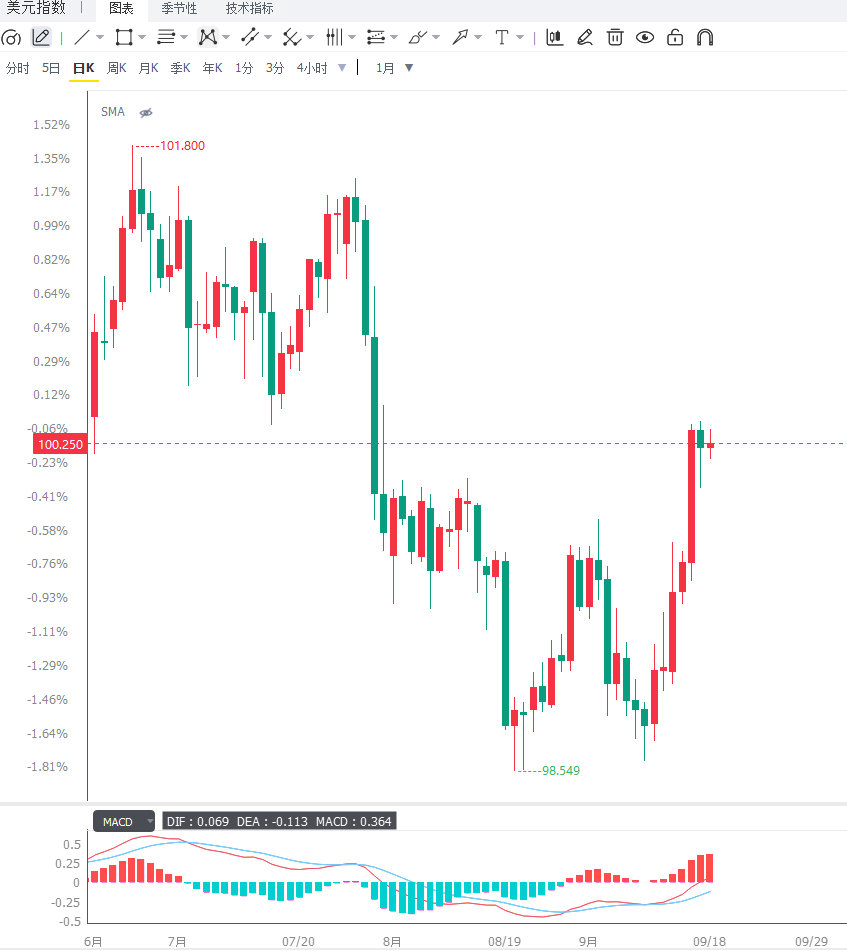
The US dollar remained strong this week, with the dollar index consolidating narrowly around 100.27 during Friday's Asian session, continuing to hover near its six-week high. The market's repricing of the Federal Reserve's monetary policy path is the core factor driving this round of dollar strength. The Fed raised the federal funds rate by 25 basis points this week to a range of 3.75%-4.00%, while also signaling the possibility of further policy tightening this year, giving the dollar support from its interest rate differential advantage.  Looking at the performance of major currencies this week, the US dollar saw the most significant increase against the Japanese yen, rising approximately 2.28% against the yen; it also rose about 1.20% against the British pound, 0.99% against the euro, and 0.95% against the Swiss franc. This reflects that the strengthening of the US dollar is not a single currency pair's performance, but rather is broadly driven by changes in US interest rate expectations. Meanwhile, the Bank of Japan also raised its policy rate to 1.25% this week, but the yen did not receive sustained support as a result, with the US dollar/yen pair rising above 157 at one point, indicating that expectations of the US-Japan interest rate differential still have a significant impact on the exchange rate. The change in the Federal Reserve's policy path is key to the current renewed upward momentum of the US dollar. According to data from CME FedWatch, market expectations for at least one more rate hike this year have risen to approximately 88%, significantly higher than 66.3% a week ago. At the same time, the Fed's dot plot shows that 16 out of 18 officials expect at least one more rate hike this year. The shift in policy expectations from previous easing to a more hawkish stance has provided new support for US Treasury yields and the US dollar. Inflation risks remain an important reason for the Fed's hawkish attitude. Federal Reserve Chairman Warsh emphasized after the meeting that inflation remains high and that price pressures have persisted for an extended period. For the market, this means that even after the Fed has completed its current rate hike cycle, policymakers may still use further rate hikes to suppress inflation rather than quickly switching to rate cuts. This shift in interest rate expectations has directly driven the dollar's renewed strength. However, the dollar's continued rise still faces validation from economic growth data. The market has already largely priced in further rate hikes; if future US economic data shows a significant slowdown, the dollar's interest rate advantage may be challenged again. Therefore, the preliminary reading of the US S&P Global Purchasing Managers' Index for September, to be released next week, will be a crucial observation window. The current market expectation is for a manufacturing PMI of approximately 53.9, a composite PMI of approximately 56.0, and a services PMI of approximately 56.5. From an asset correlation perspective, the dollar's return to the 100 mark also means that gold, non-US currencies, and some commodities face greater valuation pressure. Gold, in particular, is likely to see its upside potential limited by a stronger dollar and high US Treasury yields; while major currencies such as the euro and pound sterling will need to rely on changes in their own central bank policy expectations to offset the dollar's interest rate advantage. Meanwhile, the market still needs to pay attention to the impact of energy prices on US inflation expectations. Recently, international oil prices have fallen, alleviating some supply risks and reducing short-term inflationary pressures to some extent. If oil prices continue to decline, US inflation expectations may cool further, thus weakening the necessity for the Federal Reserve to continue raising interest rates; conversely, if energy prices rebound rapidly again, it may strengthen market expectations for high interest rates to be maintained for a longer period. Therefore, the core logic of the US dollar has gradually shifted from "whether to cut interest rates" to "whether to continue raising interest rates this year and how long high interest rates can be maintained." In this process, US inflation, employment, PMI, and Treasury yields will jointly determine whether the US dollar index can transform the 100 level from resistance into new trend support. The US dollar index is currently trading around 100.26 on the daily chart, with the price rising back above the 20-day exponential moving average of 99.56, indicating a shift in the short-term trend from oscillation to a slightly stronger bias. The 14-day RSI is around 62, in a relatively strong area but not yet in a clearly overbought zone, indicating that the bulls still hold the short-term initiative. If the US dollar index can effectively hold above 100.26, the market may further test the previous high area; if it fails to break through effectively, profit-taking may still occur near the 100 level. The first support level to watch is the 20-day EMA around 99.56, which currently constitutes an important short-term trend support for the US dollar index. If the price falls back but can hold 99.56, the overall bullish structure remains intact; if it falls below this level, it means that the upward momentum of this round is beginning to weaken, and it may re-enter a range-bound trading pattern. Looking at the 4-hour chart, the US dollar index has entered a period of consolidation after its previous continuous rise, and the short-term bullish momentum has slowed somewhat, but the price is still trading above important moving average support. 100.26 is the key breakout area to watch. If the 4-hour chart continues to close above this level, it will be conducive to the continuation of the short-term upward structure; conversely, if it fails to break through 100.26 after multiple attempts and the price falls below 99.56, a technical correction in the US dollar should be anticipated.
  Editor's Summary: The Federal Reserve's 25 basis point rate hike and hawkish policy signals have led the market to re-price further rate hikes this year, pushing the dollar index back above 100 and near a six-week high. In the short term, interest rate expectations remain a key support for the dollar, but the market has already priced in many hawkish factors, and further upside potential will require supportive US economic data. Next week's US September PMI will be a crucial indicator for assessing economic resilience and monetary policy expectations. If economic activity remains strong, the dollar may continue to hold its highs; if economic data shows a significant slowdown, expectations for further rate hikes may cool again, putting temporary pressure on the dollar. Meanwhile, US Treasury yields, energy prices, and policy changes by non-US central banks will continue to determine the future direction of the dollar index.
Looking at the performance of major currencies this week, the US dollar saw the most significant increase against the Japanese yen, rising approximately 2.28% against the yen; it also rose about 1.20% against the British pound, 0.99% against the euro, and 0.95% against the Swiss franc. This reflects that the strengthening of the US dollar is not a single currency pair's performance, but rather is broadly driven by changes in US interest rate expectations. Meanwhile, the Bank of Japan also raised its policy rate to 1.25% this week, but the yen did not receive sustained support as a result, with the US dollar/yen pair rising above 157 at one point, indicating that expectations of the US-Japan interest rate differential still have a significant impact on the exchange rate. The change in the Federal Reserve's policy path is key to the current renewed upward momentum of the US dollar. According to data from CME FedWatch, market expectations for at least one more rate hike this year have risen to approximately 88%, significantly higher than 66.3% a week ago. At the same time, the Fed's dot plot shows that 16 out of 18 officials expect at least one more rate hike this year. The shift in policy expectations from previous easing to a more hawkish stance has provided new support for US Treasury yields and the US dollar. Inflation risks remain an important reason for the Fed's hawkish attitude. Federal Reserve Chairman Warsh emphasized after the meeting that inflation remains high and that price pressures have persisted for an extended period. For the market, this means that even after the Fed has completed its current rate hike cycle, policymakers may still use further rate hikes to suppress inflation rather than quickly switching to rate cuts. This shift in interest rate expectations has directly driven the dollar's renewed strength. However, the dollar's continued rise still faces validation from economic growth data. The market has already largely priced in further rate hikes; if future US economic data shows a significant slowdown, the dollar's interest rate advantage may be challenged again. Therefore, the preliminary reading of the US S&P Global Purchasing Managers' Index for September, to be released next week, will be a crucial observation window. The current market expectation is for a manufacturing PMI of approximately 53.9, a composite PMI of approximately 56.0, and a services PMI of approximately 56.5. From an asset correlation perspective, the dollar's return to the 100 mark also means that gold, non-US currencies, and some commodities face greater valuation pressure. Gold, in particular, is likely to see its upside potential limited by a stronger dollar and high US Treasury yields; while major currencies such as the euro and pound sterling will need to rely on changes in their own central bank policy expectations to offset the dollar's interest rate advantage. Meanwhile, the market still needs to pay attention to the impact of energy prices on US inflation expectations. Recently, international oil prices have fallen, alleviating some supply risks and reducing short-term inflationary pressures to some extent. If oil prices continue to decline, US inflation expectations may cool further, thus weakening the necessity for the Federal Reserve to continue raising interest rates; conversely, if energy prices rebound rapidly again, it may strengthen market expectations for high interest rates to be maintained for a longer period. Therefore, the core logic of the US dollar has gradually shifted from "whether to cut interest rates" to "whether to continue raising interest rates this year and how long high interest rates can be maintained." In this process, US inflation, employment, PMI, and Treasury yields will jointly determine whether the US dollar index can transform the 100 level from resistance into new trend support. The US dollar index is currently trading around 100.26 on the daily chart, with the price rising back above the 20-day exponential moving average of 99.56, indicating a shift in the short-term trend from oscillation to a slightly stronger bias. The 14-day RSI is around 62, in a relatively strong area but not yet in a clearly overbought zone, indicating that the bulls still hold the short-term initiative. If the US dollar index can effectively hold above 100.26, the market may further test the previous high area; if it fails to break through effectively, profit-taking may still occur near the 100 level. The first support level to watch is the 20-day EMA around 99.56, which currently constitutes an important short-term trend support for the US dollar index. If the price falls back but can hold 99.56, the overall bullish structure remains intact; if it falls below this level, it means that the upward momentum of this round is beginning to weaken, and it may re-enter a range-bound trading pattern. Looking at the 4-hour chart, the US dollar index has entered a period of consolidation after its previous continuous rise, and the short-term bullish momentum has slowed somewhat, but the price is still trading above important moving average support. 100.26 is the key breakout area to watch. If the 4-hour chart continues to close above this level, it will be conducive to the continuation of the short-term upward structure; conversely, if it fails to break through 100.26 after multiple attempts and the price falls below 99.56, a technical correction in the US dollar should be anticipated. Editor's Summary: The Federal Reserve's 25 basis point rate hike and hawkish policy signals have led the market to re-price further rate hikes this year, pushing the dollar index back above 100 and near a six-week high. In the short term, interest rate expectations remain a key support for the dollar, but the market has already priced in many hawkish factors, and further upside potential will require supportive US economic data. Next week's US September PMI will be a crucial indicator for assessing economic resilience and monetary policy expectations. If economic activity remains strong, the dollar may continue to hold its highs; if economic data shows a significant slowdown, expectations for further rate hikes may cool again, putting temporary pressure on the dollar. Meanwhile, US Treasury yields, energy prices, and policy changes by non-US central banks will continue to determine the future direction of the dollar index.
- Risk Warning and Disclaimer
- The market involves risk, and trading may not be suitable for all investors. This article is for reference only and does not constitute personal investment advice, nor does it take into account certain users’ specific investment objectives, financial situation, or other needs. Any investment decisions made based on this information are at your own risk.

