Gold stuck below the $4400 mark: Who is repricing the discount rate after the Fed's rate hike?
2026-09-18 21:24:10
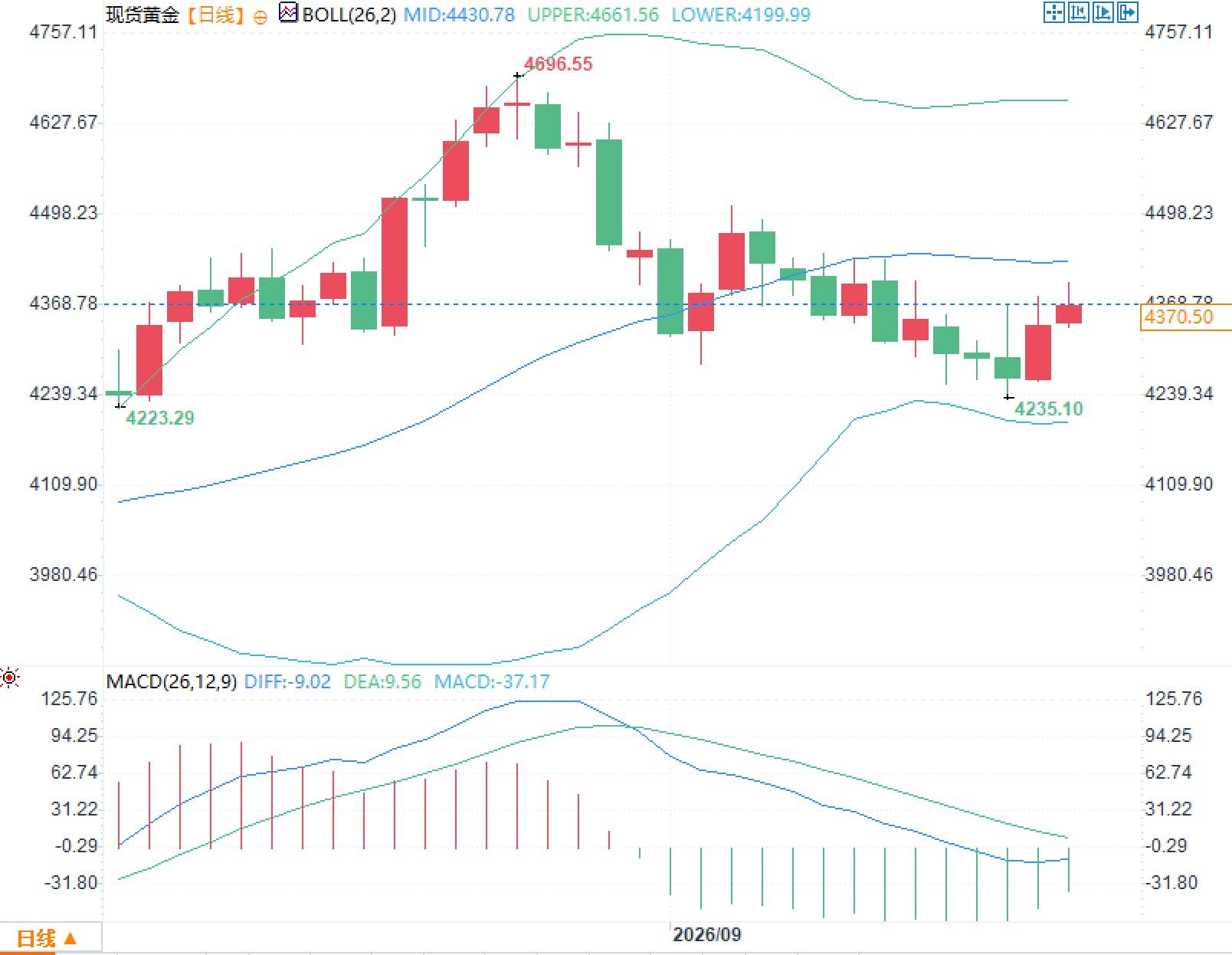
On Friday, September 18th, spot gold traded amidst a volatile session following the Federal Reserve's first rate hike in three years, currently fluctuating around $4370, up about 0.6% on the day, still some distance from the $4400 mark. The yield on the 10-year US Treasury note remained near 4.96%, having reached a weekly high of 5.04%. US crude oil retreated from its highs and is currently trading around $97. The simultaneous reshaping of interest rate paths, energy premiums, and the cost of holding non-interest-bearing assets within the same week constitutes the core contradiction in the current gold price. 
 The decline remains limited. Navigation in the Strait of Hormuz has not returned to normal, with the number of transit vessels significantly lower than recent averages, meaning energy-related inflation risks have not been removed from the pricing equation. As long as crude oil remains in a high range, inflation expectations are unlikely to be systematically revised downwards, and long-term US Treasury bonds lack the conditions for a sustained decline. This rebound in gold is more like a correction of the overreaction following the interest rate hike, coupled with a breather in yields due to oil price pullbacks, rather than a removal of holding cost constraints. Geopolitical events will continue to influence energy premiums next week. During the UN General Assembly, the US President is expected to meet with leaders or foreign ministers of Gulf Cooperation Council member states on September 22 to discuss the aftermath of the Middle East conflict. The US President recently stated that Iran is willing to engage. Such statements themselves do not change inventory and shipping capacity, but they will rewrite the slope of the crude oil risk premium, which will then be transmitted to gold through inflation expectations and real interest rates. Only if diplomatic de-escalation is accompanied by a deeper decline in oil prices will yields have the opportunity to move away from their high levels; if there are setbacks in strait access and pipeline repairs, energy premiums will again raise long-term interest rates.
The median policy target following the Fed's rate hike is more hawkish than the decision itself.
The Federal Open Market Committee (FOMC) recently voted 12-0 to raise the target range for the federal funds rate by 25 basis points to 3.75% to 4.00%, marking the first rate hike since 2023. While the decision itself largely aligned with market expectations, the real change to the yield curve was the summary of economic projections. The dot plot shows that 16 of the 18 officials who submitted projections expect at least one more rate hike this year, with the median policy rate at 4.1% at the end of both 2026 and 2027. This means the official path no longer positions 2027 as a year of rate cuts, but rather extends the period for interest rates to remain in a higher range. Fed Chairman Warsh explained the logic clearly at the post-meeting press conference. He stated that inflation is too high and has persisted for too long; and that data this summer has not shown any substantial improvement in the underlying trend. Based on the latest consumer and producer price indexes, the year-on-year growth rate of overall personal consumption expenditures (PCE) in August was approximately 3.6%. The committee forecasts that the overall PCE growth rate for the year will be 3.7%, declining to 2.3% the following year, with the unemployment rate remaining at approximately 4.1%. Real GDP growth is projected at 2.3% this year and 2.4% the following year. Warsh also stated that it is difficult to describe current broad financial conditions as restrictive, therefore this action merely removes a layer of easing. The market subsequently interpreted this as the committee not believing it has pushed policy to a sufficiently tight position. Interest rate futures are pricing in the Fed's October meeting at roughly 50%, with a significantly higher probability of another rate hike in December compared to a single October meeting. For gold, the key is not whether the next meeting will raise rates, but how long the risk-free rate remains above 4%. Gold does not pay dividends, and its holding costs rise in tandem with real and nominal interest rates. The dollar index rising to a seven-week high is merely a reflection of the same pricing mechanism in the foreign exchange market, not an independent story.The pullback in crude oil prices has opened a window for a gold rebound, but the energy premium has not disappeared.
Gold prices rebounded this week from around $4235, not directly triggered by a sudden easing of interest rate expectations, but rather by a decline in oil prices from their highs, which dragged down US Treasury yields from their weekly highs. The Saudi Arabian East-West oil pipeline, which was attacked last week and temporarily shut down, was originally intended to transport crude oil to the Red Sea side, reducing reliance on the Strait of Hormuz. Subsequently, the market learned that repair work was progressing, some exports were diverted, and additional shipments were being delivered to Asian refineries via ship-to-ship transport near Sokha, Oman. As a result, crude oil prices retreated from their highs, and the 10-year US Treasury yield fell from around 5.04% to around 4.96%. The decline remains limited. Navigation in the Strait of Hormuz has not returned to normal, with the number of transit vessels significantly lower than recent averages, meaning energy-related inflation risks have not been removed from the pricing equation. As long as crude oil remains in a high range, inflation expectations are unlikely to be systematically revised downwards, and long-term US Treasury bonds lack the conditions for a sustained decline. This rebound in gold is more like a correction of the overreaction following the interest rate hike, coupled with a breather in yields due to oil price pullbacks, rather than a removal of holding cost constraints. Geopolitical events will continue to influence energy premiums next week. During the UN General Assembly, the US President is expected to meet with leaders or foreign ministers of Gulf Cooperation Council member states on September 22 to discuss the aftermath of the Middle East conflict. The US President recently stated that Iran is willing to engage. Such statements themselves do not change inventory and shipping capacity, but they will rewrite the slope of the crude oil risk premium, which will then be transmitted to gold through inflation expectations and real interest rates. Only if diplomatic de-escalation is accompanied by a deeper decline in oil prices will yields have the opportunity to move away from their high levels; if there are setbacks in strait access and pipeline repairs, energy premiums will again raise long-term interest rates.Holding costs and official demand go hand in hand
The fundamentals present both ends simultaneously. On one hand, there's the cost of holding: the median Federal Reserve policy rate is anchored at 4.1%, the 10-year Treasury yield is close to 5%, and the opportunity cost of non-interest-bearing assets is at a relatively high level in recent years. On the other hand, there's physical and allocation demand. Global official sectors made net purchases of approximately 289 tons of gold in the second quarter, totaling approximately 345 tons in the first half of the year, with central banks such as Poland continuing to increase their holdings. Gold-backed exchange-traded funds (ETFs) saw a concentrated influx of subscriptions in August, with approximately $7.7 billion flowing into North America and approximately $18 billion globally that month. Global ETF assets under management rose to approximately $615 billion, with holdings of approximately 4,189 tons. The pace of official gold purchases and ETF subscriptions and redemptions will fluctuate with price and interest rate changes, but both constitute a medium-term inventory and allocation base, providing a liquidity foundation for gold prices to rebound after interest rate shocks. The Bank of Japan raised its policy rate by 25 basis points to 1.25% today, citing reasons including the risk of upward revisions to inflation due to oil prices. With major economies tightening monetary policy in tandem, the global real interest rate level is rising. The relative attractiveness of gold depends more on whether real interest rates can fall back than on the fluctuations in nominal gold prices alone.Next week's focus will be on official speeches and data revisions.
Next week's US economic schedule is relatively light, with a more concentrated focus on public speeches by Federal Reserve officials. The market needs to discern two things from these speeches: whether an October rate hike is described as the baseline path or as a data-dependent option; and whether the decline in energy prices is acknowledged as easing inflation risks or emphasized as not yet stable. Warsh has set the standard as: there must be confidence that underlying inflation is moving towards 2% at a sufficient pace. If officials reiterate this standard, the probability of an October rate hike in interest rate futures will likely continue to fluctuate around 50%; only if the decline in oil prices is interpreted as improved inflation conditions will yields have room to decline further. Data is equally crucial. Once positions and policy expectations are fully leveraged, even a slight deviation from the data will redistribute the probability distribution of the interest rate path. If subsequent price and demand data are weaker than the committee's forecast of a 3.7% price path, the market will reduce its weight on a second rate hike this year; if the data is close to or even higher than the forecast, the median of 4.1% will move from the dot plot into the futures curve. Gold's reaction to this process is typically reflected first in real interest rates and the dollar index, and then in the volatility of the metal itself. In the medium to long term, official gold purchases, investment demand, and gold fund subscriptions and redemptions provide sufficient inventory and allocation depth. In the short term, the median policy interest rate, US Treasury yields, and the US dollar index determine the discount rate. The simultaneous presence of these two forces explains why gold, despite rebounding this week after the Fed's rate hike, has struggled to firmly break through key psychological levels.- Risk Warning and Disclaimer
- The market involves risk, and trading may not be suitable for all investors. This article is for reference only and does not constitute personal investment advice, nor does it take into account certain users’ specific investment objectives, financial situation, or other needs. Any investment decisions made based on this information are at your own risk.