Why is the yen still so weak despite interest rates reaching a 31-year high?
2026-09-18 21:50:10
On Friday (September 18), the Bank of Japan raised interest rates by 25 basis points as expected, pushing the benchmark rate to 1.25%, a 31-year high and a key step in the normalization of Japan's monetary policy. However, contrary to market expectations, the yen did not appreciate after the rate hike; instead, it continued its depreciation trend. This unusual trend was not due to insufficient monetary policy力度, but rather to the weak fundamentals of the Japanese economy, limited room for further rate hikes by the central bank, and the double impact of the fiscal expansion policies of the Sanae Takashi cabinet. This created a fatal policy mismatch of monetary tightening and fiscal easing, completely reversing the pricing logic of yen-denominated assets and allowing the USD/JPY exchange rate to exhibit independent strength. 
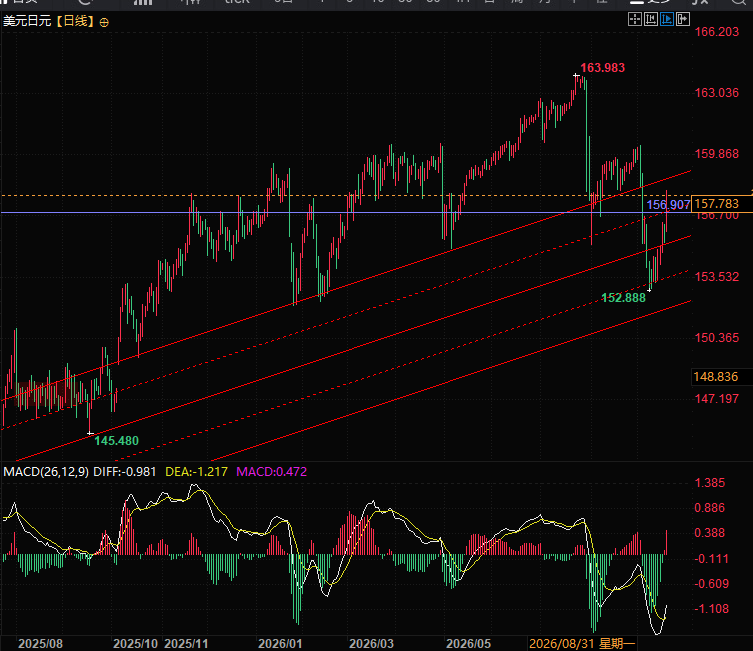 (USD/JPY daily chart, source: FX678) At 21:47 Beijing time, USD/JPY is currently trading at 157.81/82.
Economic fundamentals are deteriorating: interest rate hikes are a reactive measure, and further room for maneuver is severely limited.
From a fundamental perspective, this interest rate hike is entirely a "passive tightening," lacking the economic support for sustained rate increases, directly shattering previous market expectations. The Japanese economy is currently showing clear signs of slowing down, with both domestic inflation and core inflation growth rates falling short of market expectations, and upward pressure on prices continuing to ease. More importantly, Japanese household consumption has declined for eight consecutive months, with weak domestic demand becoming a core pain point for the economy. For the central bank, against the backdrop of continued weakening consumption and sluggish economic recovery, further interest rate hikes will directly suppress corporate investment and household consumption, exacerbating the risk of economic downturn. Therefore, the current interest rate of 1.25% is highly likely a temporary peak.Severe fiscal policy mismatch: Tax cuts coupled with increased military spending severely damage the yen's credit.
If the sluggish economy limiting the scope for interest rate hikes is the superficial reason for the yen's depreciation, then the fiscal policies of the Sanae Takaichi cabinet are the core root cause of the yen's collapse and amplified bond and currency volatility. Recently, Takaichi completed a small-scale cabinet reshuffle, retaining core ministers in finance, foreign affairs, and defense, and continued to push forward two core policies: a reduction in the food consumption tax and a large-scale expansion of military spending. This has created a two-way deterioration pattern of shrinking fiscal revenue and expanding fiscal expenditure. On the tax side, Japan plans to lower the food consumption tax starting next year, coupled with a corresponding revenue-linked cash subsidy policy, which will create a fiscal deficit of approximately 5 trillion yen annually, significantly reducing regular government tax revenue. On the expenditure side, Japan continues to revise its defense strategy document, responding to the US demand for military spending at 3.5% of GDP, with annual military spending expected to exceed 20 trillion yen, resulting in a rigid surge in fiscal expenditure. Under the dual pressure of sharply declining revenue and soaring expenditure, Japan's already high government debt ratio has further climbed, completely exposing its fiscal vulnerability.Japanese bond pricing logic has distorted: soaring debt risk and declining asset attractiveness.
The deterioration of fiscal fundamentals has deepened the pricing logic of the Japanese currency and bonds. Market concerns about the weakening of the Japanese government's debt repayment capacity and rising debt risk have forced Japanese government bond yields to rise passively, with the 30-year yield reaching a 30-year high. This trend is not a positive feedback from an improving economy, but rather a passive pricing mechanism driven by rising debt risk premiums. On one hand, the central bank has exhausted its room for interest rate hikes and is unable to tighten monetary policy; on the other hand, there is disorderly fiscal expansion and soaring debt risk. The national credit foundation of the yen is being continuously weakened, and the attractiveness of domestic currency assets has declined significantly.A negative feedback loop is formed: a vicious cycle of yen depreciation and imported inflation.
Thus, the Japanese market has formed a vicious cycle that is difficult to break: deteriorating fiscal conditions and weakening yen credit drive continuous depreciation of the local currency → yen depreciation pushes up the cost of imported energy and goods, leading to a resurgence of imported inflation → imported inflation cannot be repaired by domestic demand, but instead further suppresses already sluggish consumer spending, exacerbating the risk of stagflation → weak economic data further limits the central bank's room for interest rate hikes → the USD/JPY interest rate differential remains high, and the yen continues to depreciate, creating a vicious cycle that intensifies. In the short term, the correction of the expectation gap after this interest rate hike will drive the USD/JPY exchange rate to continue rising; in the medium term, as long as Japan's fiscal policy of tax cuts and increased spending does not change, domestic consumption remains sluggish, and the central bank cannot restart interest rate hikes, the upward trend of USD/JPY will not end, and the market will continue to maintain a high-level oscillation and a slightly upward trend until a fundamental turning point occurs in Japan's policy mix.The USD/JPY exchange rate has reversed course, rising despite intervention.
Based on the aforementioned economic fundamentals, monetary policy constraints, and the drawbacks of fiscal policy, we can make a phased assessment of the overall USD/JPY exchange rate. The market has clearly entered a core trend phase characterized by structural strength and a tendency to rise rather than fall, meaning that a new wave of yen depreciation is underway. (USD/JPY daily chart, source: FX678) At 21:47 Beijing time, USD/JPY is currently trading at 157.81/82.
- Risk Warning and Disclaimer
- The market involves risk, and trading may not be suitable for all investors. This article is for reference only and does not constitute personal investment advice, nor does it take into account certain users’ specific investment objectives, financial situation, or other needs. Any investment decisions made based on this information are at your own risk.