A chart shows that Capesize freight rates drove the index recovery, while the Baltic Dry Index rose on a single day but closed lower for the week.
2026-09-18 23:52:09
Latest data shows that the Baltic Dry Index (BDI) reached 3370 points on September 18, 2026, a four-day high, up 1.02% month-on-month (compared to the previous value), marking the largest increase since September 4, 2026, and the second consecutive day of increase (including zero growth). Looking at the short-term charts, the recent 11 BDI data points show: 5 positive increases, 6 negative increases, and 0 zero increases. Specifically, the Panamax Freight Index (BPI) was 2251 points, down 1.36% from the previous value; the Capesize Freight Index (BCI) was 5768 points, up 1.98%; and the Supramax Freight Index (BSI) was 1767 points, up 0.28%. For detailed 720-day and 10-year trend charts of the Baltic Dry Index and its three sub-indices, please refer to the charts specially created by FX678. 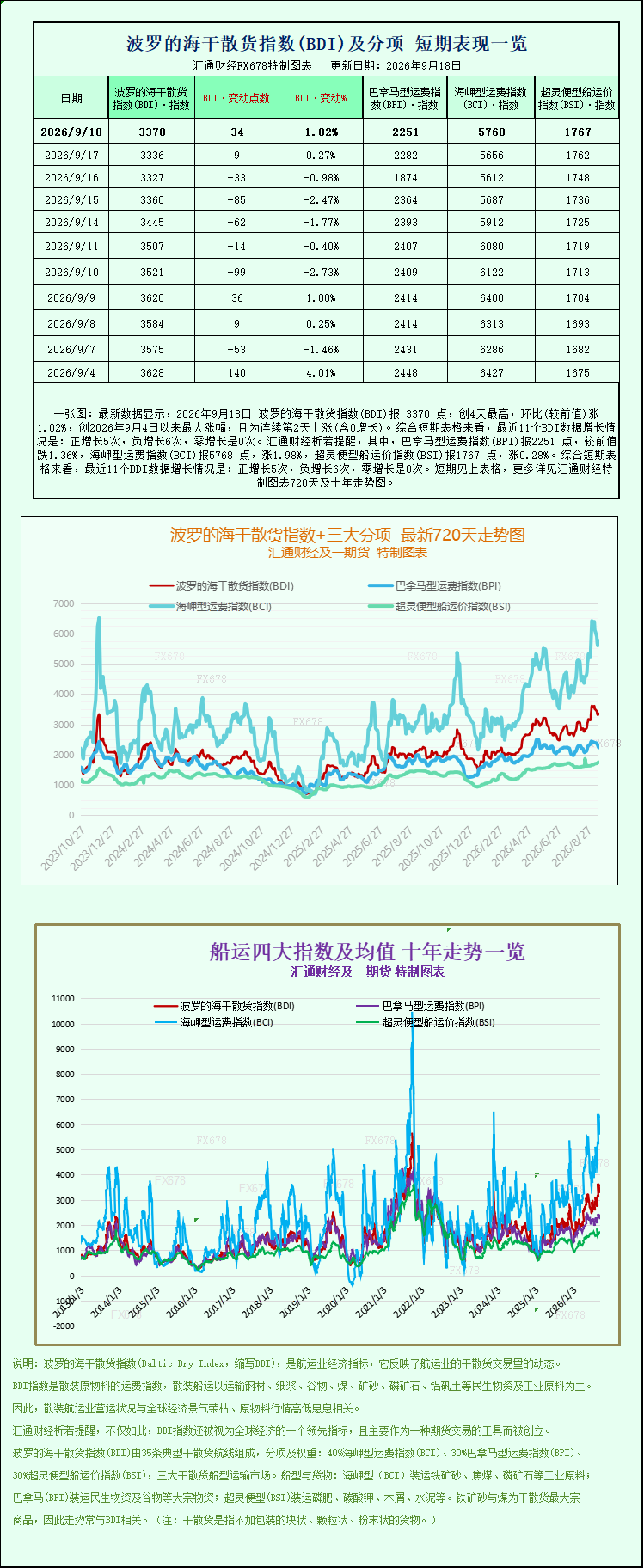 On September 18, 2026, the latest shipping market data showed a clear structural divergence in the international dry bulk shipping market. The Baltic Dry Index (BDI) saw a recovery on the day, mainly benefiting from a strong rebound in Capesize large bulk carrier freight rates. However, dragged down by weaker medium-sized vessel freight rates, the overall index was under pressure this week, ultimately recording a weekly decline. This highlights the uneven performance and intensified competition between bulls and bears in the current global dry bulk shipping market. Data shows that the Baltic Dry Index, which tracks the freight rates of the three major dry bulk carrier types—Capesize, Panamax, and Supramax—rose 34 points, or 1%, to close at 3370 points, ending its previous period of weak fluctuations. However, from a weekly perspective, the market recovery was limited; the index fell nearly 4% this week, failing to reverse the phase of correction and reflecting that the overall situation of weak short-term market demand and ample shipping capacity supply has not fundamentally improved. As a core weighted index for dry bulk shipping, the Capesize bulk carrier market was the only strong sector this week, and the core driver supporting the index's single-day rebound. The Capesize bulk carrier index surged 112 points, a 2% increase, closing at 5768 points, significantly outperforming other vessel types. Correspondingly, market profitability data improved, with 150,000-ton standard Capesize vessels, primarily engaged in transporting iron ore and coal, seeing their average daily revenue increase by $1019 to $48,812, returning to recent highs. This rebound in Capesize freight rates is highly correlated with the recent recovery in the upstream iron ore commodity market. The recent stronger-than-expected production resilience in the global steel industry and the continued rise in hot metal output have driven iron ore spot prices up for the third consecutive trading day, directly boosting demand for ocean-going iron ore procurement. To replenish raw material inventories and meet temporary production demands, domestic steel mills have increased their overseas iron ore import bookings. Shipments from major iron ore exporting countries such as Brazil and Australia have steadily rebounded, driving up cargo volume on large ocean-going dry bulk carriers and raising freight rates. It's worth noting that the iron ore market also exhibits a typical pattern of short-term rebound followed by medium-term pressure. Despite a continued daily price recovery, iron ore prices closed lower overall this week due to multiple negative factors, ending the recent upward trend. Currently, there is significant uncertainty in global steel end-user demand. The recovery pace of downstream construction and manufacturing industries is slowing, coupled with the continuous accumulation of port iron ore inventories and persistently low profit margins for steel sales at steel mills. Overall, the industry's willingness to replenish inventory is cautious, maintaining only essential purchases and making it difficult to form a sustained large-scale stockpiling trend. This also poses a risk to future freight rate increases for Capesize vessels, limiting the sustainability and scope of this rebound. In stark contrast to the recovery in large Capesize vessels, the medium-sized Panamax vessel market continues to weaken, becoming the main negative factor dragging down the weekly index performance. Data shows that the Panamax index fell 31 points, or 1.4%, to close at 2251 points, indicating a clear weakness. The index's decline widened further this week, with a cumulative drop expected to reach 6.5%, significantly underperforming the broader market. Panamax vessels primarily transport 60,000 to 70,000 tons of bulk commodities such as coal and grain. The continued decline in freight rates is mainly due to cooling global demand for energy and food shipping. Currently, global coal trade demand is stabilizing, the European energy restocking cycle is nearing its end, and there is no significant increase in thermal power procurement demand in the Asia-Pacific region. Simultaneously, the pace of global food transportation has slowed, with stable shipments from major grain exporting countries and weak demand from importing countries, leading to a shortage of cargo space for Panamax vessels. Coupled with a relative oversupply of regional shipping capacity, daily charter rates have continued to decline. On that day, the average daily revenue for Panamax vessels decreased by $273 to $20,262, further shrinking industry profit margins. The small vessel market, however, has shown independent resilience, offsetting some of the downward pressure from medium-sized vessels. The Supramax bulk carrier index rose slightly by 5 points, or 0.3%, to close at 1767 points, showing a steady trend. As of today, the index has risen 2.8% this week, making it the only ship type index to achieve a weekly increase. Supramax vessels are mainly used for short-distance, small-volume general cargo, building materials, and small-volume ore transportation. Regional trade activity is relatively stable, and they are less affected by fluctuations in global bulk raw material demand. Therefore, they have shown resilience during the overall market adjustment, exhibiting relatively independent and stable performance. In summary, the structural trend of the Baltic Dry Index this week is essentially a concentrated reflection of the divergence in global commodity trade and the mismatch between upstream and downstream supply chains. Large ore carriers benefited from a rebound due to phased steel mill restocking, but weak end-user demand limited their upside potential; medium-sized energy and grain carriers continued to weaken due to insufficient trade growth; small vessels remained stable based on regional demand. In the short term, the recovery in Capesize vessel freight rates is unlikely to drive a market-wide upward trend. The market as a whole remains in an adjustment period characterized by weak demand recovery and ample supply and demand for shipping capacity. The subsequent market trend will mainly depend on two core variables: first, whether the global steel industry's operating rate can continue to recover, driving a sustained increase in seaborne demand for bulk raw materials such as iron ore and coal, supporting the continued strength of Capesize freight rates; and second, whether global food and energy trade can see increased demand, correcting the weak performance of Panamax vessels. Before a substantial recovery in end-user demand, the dry bulk shipping market is likely to continue its structural differentiation trend, with the overall index likely maintaining a volatile trading pattern.
On September 18, 2026, the latest shipping market data showed a clear structural divergence in the international dry bulk shipping market. The Baltic Dry Index (BDI) saw a recovery on the day, mainly benefiting from a strong rebound in Capesize large bulk carrier freight rates. However, dragged down by weaker medium-sized vessel freight rates, the overall index was under pressure this week, ultimately recording a weekly decline. This highlights the uneven performance and intensified competition between bulls and bears in the current global dry bulk shipping market. Data shows that the Baltic Dry Index, which tracks the freight rates of the three major dry bulk carrier types—Capesize, Panamax, and Supramax—rose 34 points, or 1%, to close at 3370 points, ending its previous period of weak fluctuations. However, from a weekly perspective, the market recovery was limited; the index fell nearly 4% this week, failing to reverse the phase of correction and reflecting that the overall situation of weak short-term market demand and ample shipping capacity supply has not fundamentally improved. As a core weighted index for dry bulk shipping, the Capesize bulk carrier market was the only strong sector this week, and the core driver supporting the index's single-day rebound. The Capesize bulk carrier index surged 112 points, a 2% increase, closing at 5768 points, significantly outperforming other vessel types. Correspondingly, market profitability data improved, with 150,000-ton standard Capesize vessels, primarily engaged in transporting iron ore and coal, seeing their average daily revenue increase by $1019 to $48,812, returning to recent highs. This rebound in Capesize freight rates is highly correlated with the recent recovery in the upstream iron ore commodity market. The recent stronger-than-expected production resilience in the global steel industry and the continued rise in hot metal output have driven iron ore spot prices up for the third consecutive trading day, directly boosting demand for ocean-going iron ore procurement. To replenish raw material inventories and meet temporary production demands, domestic steel mills have increased their overseas iron ore import bookings. Shipments from major iron ore exporting countries such as Brazil and Australia have steadily rebounded, driving up cargo volume on large ocean-going dry bulk carriers and raising freight rates. It's worth noting that the iron ore market also exhibits a typical pattern of short-term rebound followed by medium-term pressure. Despite a continued daily price recovery, iron ore prices closed lower overall this week due to multiple negative factors, ending the recent upward trend. Currently, there is significant uncertainty in global steel end-user demand. The recovery pace of downstream construction and manufacturing industries is slowing, coupled with the continuous accumulation of port iron ore inventories and persistently low profit margins for steel sales at steel mills. Overall, the industry's willingness to replenish inventory is cautious, maintaining only essential purchases and making it difficult to form a sustained large-scale stockpiling trend. This also poses a risk to future freight rate increases for Capesize vessels, limiting the sustainability and scope of this rebound. In stark contrast to the recovery in large Capesize vessels, the medium-sized Panamax vessel market continues to weaken, becoming the main negative factor dragging down the weekly index performance. Data shows that the Panamax index fell 31 points, or 1.4%, to close at 2251 points, indicating a clear weakness. The index's decline widened further this week, with a cumulative drop expected to reach 6.5%, significantly underperforming the broader market. Panamax vessels primarily transport 60,000 to 70,000 tons of bulk commodities such as coal and grain. The continued decline in freight rates is mainly due to cooling global demand for energy and food shipping. Currently, global coal trade demand is stabilizing, the European energy restocking cycle is nearing its end, and there is no significant increase in thermal power procurement demand in the Asia-Pacific region. Simultaneously, the pace of global food transportation has slowed, with stable shipments from major grain exporting countries and weak demand from importing countries, leading to a shortage of cargo space for Panamax vessels. Coupled with a relative oversupply of regional shipping capacity, daily charter rates have continued to decline. On that day, the average daily revenue for Panamax vessels decreased by $273 to $20,262, further shrinking industry profit margins. The small vessel market, however, has shown independent resilience, offsetting some of the downward pressure from medium-sized vessels. The Supramax bulk carrier index rose slightly by 5 points, or 0.3%, to close at 1767 points, showing a steady trend. As of today, the index has risen 2.8% this week, making it the only ship type index to achieve a weekly increase. Supramax vessels are mainly used for short-distance, small-volume general cargo, building materials, and small-volume ore transportation. Regional trade activity is relatively stable, and they are less affected by fluctuations in global bulk raw material demand. Therefore, they have shown resilience during the overall market adjustment, exhibiting relatively independent and stable performance. In summary, the structural trend of the Baltic Dry Index this week is essentially a concentrated reflection of the divergence in global commodity trade and the mismatch between upstream and downstream supply chains. Large ore carriers benefited from a rebound due to phased steel mill restocking, but weak end-user demand limited their upside potential; medium-sized energy and grain carriers continued to weaken due to insufficient trade growth; small vessels remained stable based on regional demand. In the short term, the recovery in Capesize vessel freight rates is unlikely to drive a market-wide upward trend. The market as a whole remains in an adjustment period characterized by weak demand recovery and ample supply and demand for shipping capacity. The subsequent market trend will mainly depend on two core variables: first, whether the global steel industry's operating rate can continue to recover, driving a sustained increase in seaborne demand for bulk raw materials such as iron ore and coal, supporting the continued strength of Capesize freight rates; and second, whether global food and energy trade can see increased demand, correcting the weak performance of Panamax vessels. Before a substantial recovery in end-user demand, the dry bulk shipping market is likely to continue its structural differentiation trend, with the overall index likely maintaining a volatile trading pattern.
- Risk Warning and Disclaimer
- The market involves risk, and trading may not be suitable for all investors. This article is for reference only and does not constitute personal investment advice, nor does it take into account certain users’ specific investment objectives, financial situation, or other needs. Any investment decisions made based on this information are at your own risk.