Brent crude held steady at $104, while diesel surged to a record high! Refining capacity may be reduced again next week; where will oil prices go?
2026-09-19 08:04:09
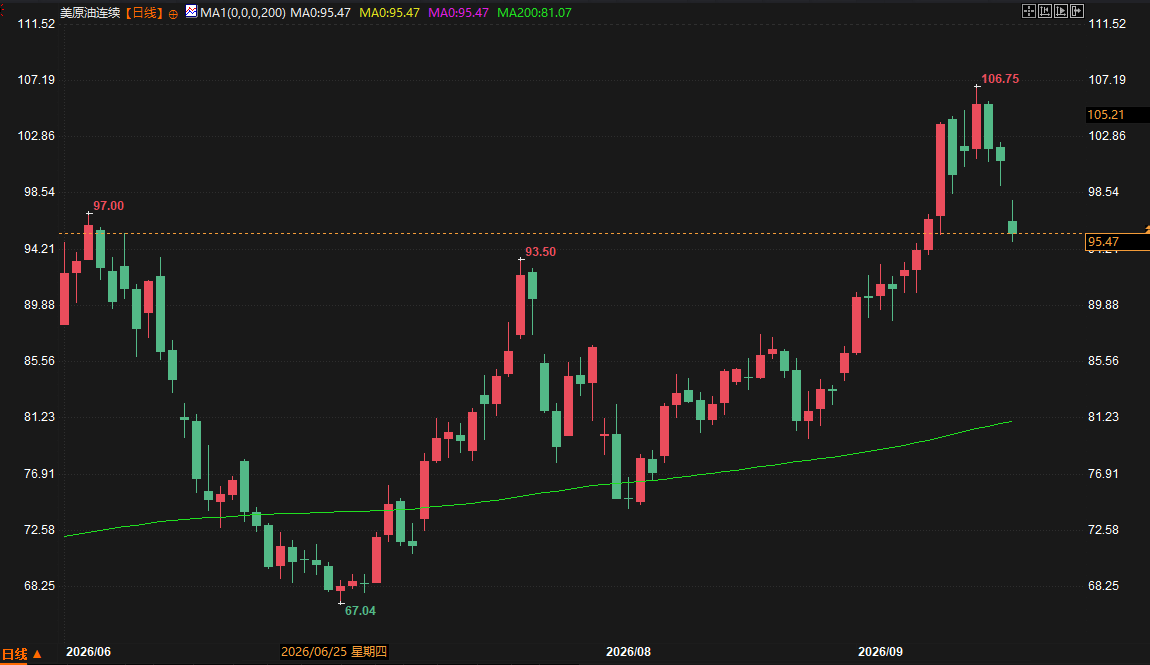
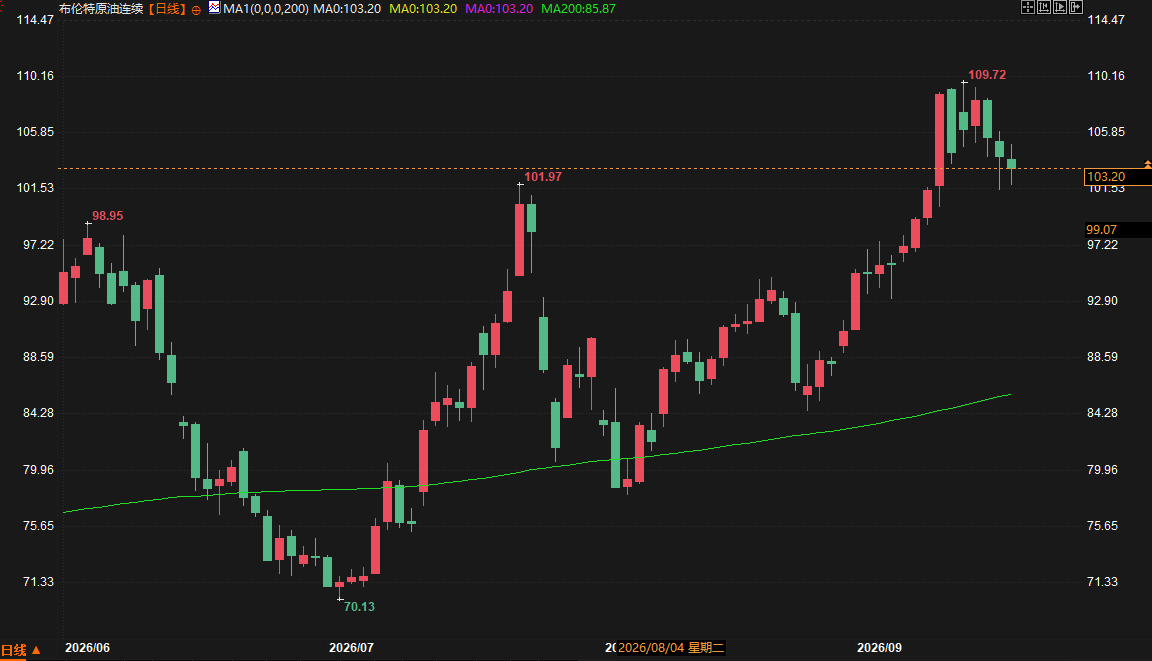
International oil prices rose and then fell this week, with WTI crude down 6.63% and Brent crude down 4.05%, mainly due to China mediating with Saudi Arabia at Saudi Arabia's request to restrict Houthi attacks on Saudi oil facilities, thus easing geopolitical premiums in the short term. However, Brent crude settlement prices remained above $104, as a sharp drop in traffic in the Strait of Hormuz and a contraction in refining capacity left supply and demand concerns unresolved. Gasoline and natural gas bucked the trend and closed higher, while a stronger dollar pressured overseas markets, and precious metals remained resilient amid the interplay of interest rates and debt dynamics. 
 Event-Driven : The core trigger for this round of decline was China's request to Saudi Arabia, demanding that Iran limit Houthi attacks on Saudi oil infrastructure. In the preceding weeks, escalating attacks between the US and Iran, coupled with increased Houthi military activity, had steadily driven up oil prices. Diplomatic efforts eased geopolitical tensions, but substantial supply constraints remain—only four commodity carriers passed through the Strait of Hormuz on Thursday, far below the ten-day average of 16; after attacks on key Saudi east-west oil pipelines, some European refining customers were told they would not receive crude oil next month. US refining capacity is expected to decrease by 371,000 barrels per day next week, and diesel retail prices have reached a record high of $6.45. Institutional Views : Major overseas institutions believe that the core contradiction has shifted from "supply shortages" to "refining bottlenecks," with capacity, rather than crude oil itself, becoming the price constraint. Some investment banks point out that for the first time since the US-Iran conflict, it has been difficult to establish a clear baseline scenario for the oil market, and the outlook for the next few months remains uncertain; short-term sentiment recovery cannot mask structural tensions.
WTI and Brent crude oil
Market Review : The daily charts for both WTI and Brent crude showed a pattern of "large bullish candle – medium bearish candle – small bullish candle – medium bearish candle – large bearish candle," indicating a pullback after a surge, suggesting the short-term downtrend has not yet ended. WTI fell 6.63% for the week, and Brent crude fell 4.05%, but both held above $100, indicating that the decline was a high-level correction rather than a trend reversal. Event-Driven : The core trigger for this round of decline was China's request to Saudi Arabia, demanding that Iran limit Houthi attacks on Saudi oil infrastructure. In the preceding weeks, escalating attacks between the US and Iran, coupled with increased Houthi military activity, had steadily driven up oil prices. Diplomatic efforts eased geopolitical tensions, but substantial supply constraints remain—only four commodity carriers passed through the Strait of Hormuz on Thursday, far below the ten-day average of 16; after attacks on key Saudi east-west oil pipelines, some European refining customers were told they would not receive crude oil next month. US refining capacity is expected to decrease by 371,000 barrels per day next week, and diesel retail prices have reached a record high of $6.45. Institutional Views : Major overseas institutions believe that the core contradiction has shifted from "supply shortages" to "refining bottlenecks," with capacity, rather than crude oil itself, becoming the price constraint. Some investment banks point out that for the first time since the US-Iran conflict, it has been difficult to establish a clear baseline scenario for the oil market, and the outlook for the next few months remains uncertain; short-term sentiment recovery cannot mask structural tensions.Natural gas and gasoline
Natural gas rose 1.08% for the week, while unleaded gasoline rose 3.12%, diverging from crude oil prices. Refining contraction coupled with disruptions to Middle Eastern oil supplies drove refined oil prices higher against the trend, with gasoline retail prices reaching a high of $4.47 per barrel for the same period. This divergence also confirms the market logic that "the problem lies in refining, not crude oil."Related Market Background
The US dollar index rose 1.16% for the week, while the Japanese yen, Swiss franc, and Canadian dollar weakened relatively, with the dollar rebounding most sharply against the yen. Yields on 2-year, 5-year, and 10-year US Treasury bonds all rose, reflecting rising interest rate expectations, consistent with the logic of a stronger dollar. Spot gold rose 1.11% for the week, with a daily chart showing a bottoming out and rebound, indicating unusual resilience in gold prices to the Fed's rate hikes and US Treasury yields near 5%. Institutions attributed this to the long-term hedging demand from sovereign debt levels and fiscal deficits. This week, the energy market tugged between "diplomatic de-escalation" and "hard supply constraints": diplomatic maneuvering suppressed short-term geopolitical premiums, but the decline in air traffic over the Strait of Hormuz, refining capacity gaps, and historically high refined oil prices limited the downside for oil prices. The simultaneous strengthening of the US dollar and interest rates put pressure on overseas commodities, while precious metals countered tightening expectations with structural buying. In the short term, the oil market is more likely to maintain a wide range of fluctuations above $100, with the market closely monitoring the subsequent developments in the Middle East and the pace of refinery recovery.QA module
Q1: What signal does the rise in gasoline and natural gas prices against the trend reveal? The decline in crude oil prices while the rise in refined oil prices is a typical characteristic of the "refining bottleneck." US refining capacity is expected to decrease by 371,000 barrels per day next week, diesel reached a record high of $6.45, and gasoline is at a high level for the same period, all pointing to the constraint being in downstream processing rather than upstream supply. This also explains the current market's differentiated pricing, which prioritizes refined products over crude oil. Q2: Is the 16% weekly drop in SC crude oil a distortion? The decline is significantly larger than that of international markets, clearly deviating from the daily data of -1.81% for WTI crude and -0.83% for Brent crude. It is more likely due to contract rollover or reading errors. It is advisable to cross-verify with the price difference between domestic and international markets and selected quotes, and not to conclude that the fundamentals of the domestic oil market have changed drastically based on this alone. Q3: Why is gold price becoming increasingly "insensitive" to Fed rate hikes? Market pricing is shifting from "interest rate expectations" to "fiscal and debt logic." With over $40 trillion in national debt and over $1 trillion in annual interest payments, high interest rates have become a burden on government finances. Gold thus gains long-term hedging value against sovereign credit risk, and short-term fluctuations cannot mask the structural buying. Q4: How should we view the future direction of the oil market? In the short term, it is likely to maintain a wide range of fluctuations above $100. Downside is constrained by refining shortages and geopolitical disturbances, while upside is suppressed by a stronger dollar and a de-escalation of diplomatic tensions. The market needs to closely monitor three key factors: the evolution of the Middle East situation, the resumption of air traffic over the Strait of Hormuz, and the operating rate of US refineries. Any single variable could trigger a revaluation.- Risk Warning and Disclaimer
- The market involves risk, and trading may not be suitable for all investors. This article is for reference only and does not constitute personal investment advice, nor does it take into account certain users’ specific investment objectives, financial situation, or other needs. Any investment decisions made based on this information are at your own risk.