Crude oil trading alert: Rising geopolitical easing expectations lead to a rapid decline in risk premiums, causing US crude oil prices to fall sharply.
2026-09-21 10:12:10
US crude oil prices continued their decline in Asian trading on Monday, with WTI falling for the fourth consecutive session, trading around $94. The strong rally following its break above $100 is rapidly cooling as the market begins to reassess Middle East supply risks. With more signs of easing diplomatic tensions, investor concerns about further deterioration in energy transportation have lessened, and the substantial geopolitical risk premium previously accumulated in crude oil prices has begun to recede, pushing WTI to continue its downward correction from its highs.  The biggest change in the current market is that the pricing logic for crude oil is gradually shifting from "the risk of escalating supply disruptions" to "the increased likelihood of supply recovery and easing tensions." Recently, the US has signaled a willingness to promote diplomatic engagement, and expectations for related meetings during the UN General Assembly have increased. Meanwhile, Gulf states are also working to stabilize the region. For the crude oil market, this news does not mean that supply risks have been completely eliminated, but it is enough to reduce market pricing for the most extreme supply disruption scenario, thereby directly compressing the risk premium for WTI. At the same time, there are signs of improvement in energy transportation through the Strait of Hormuz. The US Central Command stated that crude oil and liquefied natural gas shipments through the Strait of Hormuz have reached their highest levels in about six months over the past two weeks. The resumption of transportation activity means that actual energy flows have not continued to deteriorate as previously feared, which is one of the important fundamental factors contributing to the recent rapid decline in crude oil prices. Marginal improvements on the supply side are also reflected in the recovery of Saudi energy exports. The latest market information shows that some of Saudi Arabia's export capacity is recovering, and the volume of crude oil transported through the Strait of Hormuz rebounded significantly in September. The market has therefore begun to lower its valuation of a long-term supply gap in the Middle East. Even with lingering regional uncertainties, the extreme risk premium in crude oil prices could further decline as long as actual energy flows continue to recover. After WTI fell below $100, technical factors also began to amplify downward pressure. $100 was not only an important psychological level but also a key price area formed during the geopolitical risk-driven oil price increases. When prices fell below this level again from above $100, the safety margin for long positions decreased significantly, leading some short-term funds to take profits or reduce positions, further pushing prices downward to find a new supply-demand equilibrium. Therefore, the current oil price decline is not solely caused by fundamental changes but is the result of a combination of declining risk premiums and technical selling. US inventory data is also worth noting. The latest data from the US Energy Information Administration shows that for the week ending September 11, US commercial crude oil inventories fell by 640,000 barrels to approximately 423.4 million barrels, marking the third consecutive week of decline, but the decrease was significantly less than the market's previous expectation of approximately 1.6 million barrels. Meanwhile, US crude oil inventories, including those in the Strategic Petroleum Reserve, were approximately 708.4 million barrels. While declining inventories still provide some support for oil prices, the smaller-than-expected drop suggests that the US crude oil market currently lacks a strong destocking signal sufficient to offset the rapid decline in geopolitical risk premiums. Especially after oil prices have clearly retreated from above $100, the market will be more focused on whether subsequent inventory changes can prove that actual demand remains strong. The next EIA inventory data will be released on September 23. If commercial crude oil inventories continue to decline and the decline widens significantly, it may alleviate downward pressure on WTI; conversely, if inventories increase again, or the decline continues to be smaller than market expectations, it may further strengthen bearish sentiment. Besides crude oil inventories, the refined product market is also an important window for judging the strength of demand. Recent US inventory structures show that although crude oil inventories have declined continuously, changes in some refined product inventories do not fully support the judgment of continued strong demand. For the market, this means that oil prices need to find new fundamental support and cannot continue to rely solely on the previous geopolitical risk premiums. From a macroeconomic perspective, the rapid decline in oil prices may also reduce the role of energy costs in pushing up inflation. Economists at RBC Capital Markets previously pointed out that rising energy prices have not yet led to widespread inflationary transmission. Higher fuel costs are squeezing profit margins in corporate supply chains, and companies may absorb these costs through profit compression rather than immediately passing them all on to end consumers. This means that if oil prices fall further, the marginal pressure of energy prices on overall inflation may decrease simultaneously, which would also help the market reassess the future policy paths of major central banks. However, the market cannot simply interpret this as the disappearance of supply risks. Potential disruptions remain to Middle Eastern energy infrastructure and transportation routes. If diplomatic efforts are hampered or key energy facilities are attacked again, the risk premium for crude oil could rise rapidly. Therefore, the current decline in WTI reflects more of a rapid compression of the risk premium than a complete shift in global crude oil fundamentals towards easing. From a daily chart perspective, WTI has undergone a continuous correction after rising above $100, and the price has now fallen back to around $94, indicating a clear weakening short-term trend. $100 has transformed from a significant psychological support level into a key resistance area. If subsequent rebounds fail to regain a foothold above $100, the market may continue to face pressure at higher levels. The first support level to watch is around $93, with the more important support level at the psychological level of $90. If $90 holds, this decline is more likely to be seen as a correction of risk premium in a high-level market, and WTI may still return to the $95-$100 range. If $90 is broken, the bears may open up further downside potential. Looking at the 4-hour chart, WTI has formed a relatively clear short-term downtrend, with bearish momentum strengthening after breaking through the previous consolidation area. Technical indicators are generally weak, but with the rapid price decline, there is also a short-term technical rebound potential. If the decline finds support around $93, WTI may first rebound towards $95, further testing the $98-$100 area; only by regaining a foothold above $100 can the short-term downtrend structure be significantly repaired. Conversely, if the $93 support is breached, the market will further test $90. Whether $90 can provide effective support will be key to determining whether the subsequent market will be range-bound or a trending downtrend.
 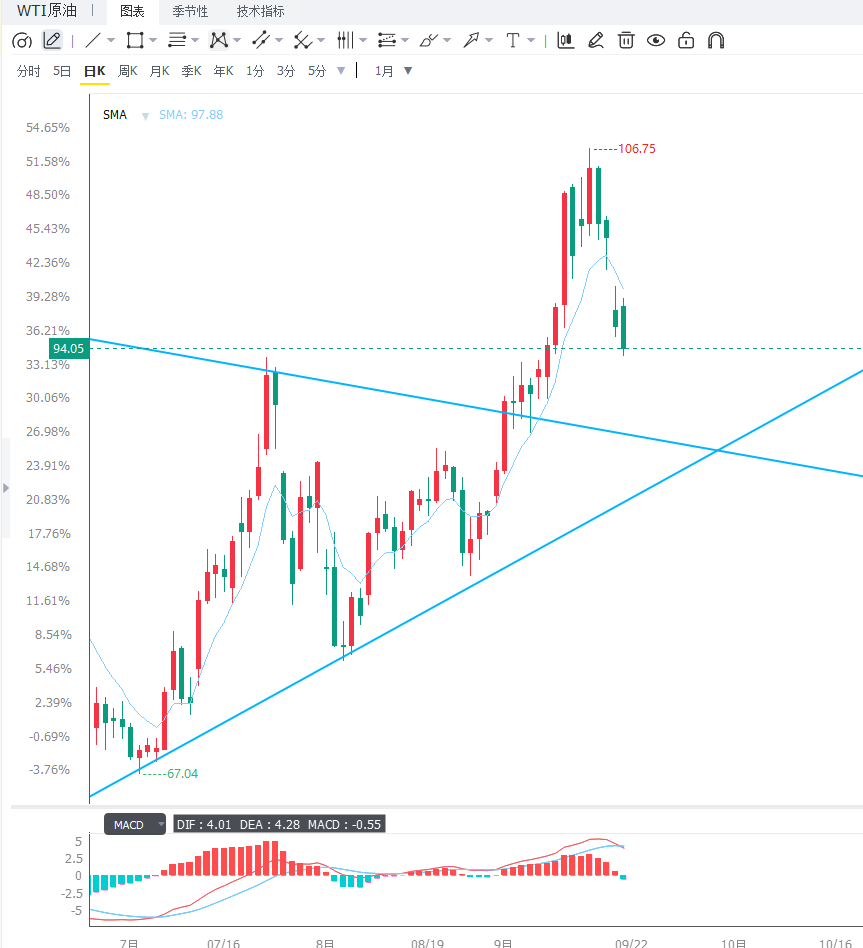 Editor's Summary: The core issue for US crude oil has shifted from concerns about supply disruptions to the decline in geopolitical risk premiums and the repricing of actual supply and demand. Expectations of diplomatic easing, the recovery of energy transportation, and the partial recovery of Saudi Arabia's export capacity have collectively weakened the risk premium that previously supported oil prices breaking through $100. After WTI fell below $100, technical selling further amplified the downward momentum, and it has now fallen back to around $93. In the short term, $100 will be a significant resistance level for WTI's rebound, while $90 is a key support level for determining whether the price can continue to decline. As long as $90 is not effectively broken, oil prices may still re-enter the $90-$100 range. The market should focus on whether geopolitical tensions continue to ease, whether energy transportation through the Strait of Hormuz can maintain its recovery trend, and whether there are significant changes in US EIA inventory data. If geopolitical risks continue to cool and inventory pressure increases, the risk premium may further contract; if the situation escalates again, oil prices may quickly re-incorporate supply risks.
The biggest change in the current market is that the pricing logic for crude oil is gradually shifting from "the risk of escalating supply disruptions" to "the increased likelihood of supply recovery and easing tensions." Recently, the US has signaled a willingness to promote diplomatic engagement, and expectations for related meetings during the UN General Assembly have increased. Meanwhile, Gulf states are also working to stabilize the region. For the crude oil market, this news does not mean that supply risks have been completely eliminated, but it is enough to reduce market pricing for the most extreme supply disruption scenario, thereby directly compressing the risk premium for WTI. At the same time, there are signs of improvement in energy transportation through the Strait of Hormuz. The US Central Command stated that crude oil and liquefied natural gas shipments through the Strait of Hormuz have reached their highest levels in about six months over the past two weeks. The resumption of transportation activity means that actual energy flows have not continued to deteriorate as previously feared, which is one of the important fundamental factors contributing to the recent rapid decline in crude oil prices. Marginal improvements on the supply side are also reflected in the recovery of Saudi energy exports. The latest market information shows that some of Saudi Arabia's export capacity is recovering, and the volume of crude oil transported through the Strait of Hormuz rebounded significantly in September. The market has therefore begun to lower its valuation of a long-term supply gap in the Middle East. Even with lingering regional uncertainties, the extreme risk premium in crude oil prices could further decline as long as actual energy flows continue to recover. After WTI fell below $100, technical factors also began to amplify downward pressure. $100 was not only an important psychological level but also a key price area formed during the geopolitical risk-driven oil price increases. When prices fell below this level again from above $100, the safety margin for long positions decreased significantly, leading some short-term funds to take profits or reduce positions, further pushing prices downward to find a new supply-demand equilibrium. Therefore, the current oil price decline is not solely caused by fundamental changes but is the result of a combination of declining risk premiums and technical selling. US inventory data is also worth noting. The latest data from the US Energy Information Administration shows that for the week ending September 11, US commercial crude oil inventories fell by 640,000 barrels to approximately 423.4 million barrels, marking the third consecutive week of decline, but the decrease was significantly less than the market's previous expectation of approximately 1.6 million barrels. Meanwhile, US crude oil inventories, including those in the Strategic Petroleum Reserve, were approximately 708.4 million barrels. While declining inventories still provide some support for oil prices, the smaller-than-expected drop suggests that the US crude oil market currently lacks a strong destocking signal sufficient to offset the rapid decline in geopolitical risk premiums. Especially after oil prices have clearly retreated from above $100, the market will be more focused on whether subsequent inventory changes can prove that actual demand remains strong. The next EIA inventory data will be released on September 23. If commercial crude oil inventories continue to decline and the decline widens significantly, it may alleviate downward pressure on WTI; conversely, if inventories increase again, or the decline continues to be smaller than market expectations, it may further strengthen bearish sentiment. Besides crude oil inventories, the refined product market is also an important window for judging the strength of demand. Recent US inventory structures show that although crude oil inventories have declined continuously, changes in some refined product inventories do not fully support the judgment of continued strong demand. For the market, this means that oil prices need to find new fundamental support and cannot continue to rely solely on the previous geopolitical risk premiums. From a macroeconomic perspective, the rapid decline in oil prices may also reduce the role of energy costs in pushing up inflation. Economists at RBC Capital Markets previously pointed out that rising energy prices have not yet led to widespread inflationary transmission. Higher fuel costs are squeezing profit margins in corporate supply chains, and companies may absorb these costs through profit compression rather than immediately passing them all on to end consumers. This means that if oil prices fall further, the marginal pressure of energy prices on overall inflation may decrease simultaneously, which would also help the market reassess the future policy paths of major central banks. However, the market cannot simply interpret this as the disappearance of supply risks. Potential disruptions remain to Middle Eastern energy infrastructure and transportation routes. If diplomatic efforts are hampered or key energy facilities are attacked again, the risk premium for crude oil could rise rapidly. Therefore, the current decline in WTI reflects more of a rapid compression of the risk premium than a complete shift in global crude oil fundamentals towards easing. From a daily chart perspective, WTI has undergone a continuous correction after rising above $100, and the price has now fallen back to around $94, indicating a clear weakening short-term trend. $100 has transformed from a significant psychological support level into a key resistance area. If subsequent rebounds fail to regain a foothold above $100, the market may continue to face pressure at higher levels. The first support level to watch is around $93, with the more important support level at the psychological level of $90. If $90 holds, this decline is more likely to be seen as a correction of risk premium in a high-level market, and WTI may still return to the $95-$100 range. If $90 is broken, the bears may open up further downside potential. Looking at the 4-hour chart, WTI has formed a relatively clear short-term downtrend, with bearish momentum strengthening after breaking through the previous consolidation area. Technical indicators are generally weak, but with the rapid price decline, there is also a short-term technical rebound potential. If the decline finds support around $93, WTI may first rebound towards $95, further testing the $98-$100 area; only by regaining a foothold above $100 can the short-term downtrend structure be significantly repaired. Conversely, if the $93 support is breached, the market will further test $90. Whether $90 can provide effective support will be key to determining whether the subsequent market will be range-bound or a trending downtrend. Editor's Summary: The core issue for US crude oil has shifted from concerns about supply disruptions to the decline in geopolitical risk premiums and the repricing of actual supply and demand. Expectations of diplomatic easing, the recovery of energy transportation, and the partial recovery of Saudi Arabia's export capacity have collectively weakened the risk premium that previously supported oil prices breaking through $100. After WTI fell below $100, technical selling further amplified the downward momentum, and it has now fallen back to around $93. In the short term, $100 will be a significant resistance level for WTI's rebound, while $90 is a key support level for determining whether the price can continue to decline. As long as $90 is not effectively broken, oil prices may still re-enter the $90-$100 range. The market should focus on whether geopolitical tensions continue to ease, whether energy transportation through the Strait of Hormuz can maintain its recovery trend, and whether there are significant changes in US EIA inventory data. If geopolitical risks continue to cool and inventory pressure increases, the risk premium may further contract; if the situation escalates again, oil prices may quickly re-incorporate supply risks.
- Risk Warning and Disclaimer
- The market involves risk, and trading may not be suitable for all investors. This article is for reference only and does not constitute personal investment advice, nor does it take into account certain users’ specific investment objectives, financial situation, or other needs. Any investment decisions made based on this information are at your own risk.