Hawkish signals from the Federal Reserve have dampened gold's gains, and gold is maintaining a range-bound trading pattern.
2026-09-21 13:44:10
Spot gold continued its weakness in Asian trading on Monday, with prices falling to around $4,365 at one point. Gold prices had previously fluctuated significantly after the Federal Reserve's interest rate decision, and the market is now refocusing on the path of US interest rates, the dollar's performance, and subsequent speeches by Fed officials. On September 16, the Fed raised the target range for the federal funds rate by 25 basis points to 3.75% to 4.00%, stating that inflation remains high. The latest dot plot shows that most policymakers expect further rate hikes this year.  The Federal Reserve's policy path has shifted back towards tightening, which is the main source of pressure currently facing gold. The market currently expects a 56.5% probability of another rate hike in October, significantly higher than the approximately 42.5% a week ago. Meanwhile, Fed officials have recently continued to emphasize inflation risks, meaning the market is unlikely to quickly establish expectations of rate cuts. For gold, which does not generate interest income, high real interest rates and risk-free rates increase the opportunity cost of holding it. Fed Chairman Kevin Warsh recently stated that US inflation remains too high and has persisted for an extended period; Minneapolis Fed President Neel Kashkari also stated on Sunday that inflationary pressures exist in multiple sectors of the economy, not just energy and food prices. Kashkari also supports a near-term rate hike, believing that policy still needs to push inflation back towards the 2% target. This means the gold market is currently facing a complex macroeconomic environment. The situation in the Middle East remains highly uncertain. Traditional safe-haven demand could theoretically support gold, but if rising energy prices further push up inflation and prompt the Fed to maintain high interest rates for a longer period, then the support for gold from safe-haven funds may be partially offset by the rising dollar and yields. The recent decline in oil prices has further altered the short-term pricing logic for gold. The market saw pressure on crude oil prices following the recovery of Saudi energy supplies and improvements in some key transportation routes, leading to a cooling of inflation trading. Meanwhile, US Treasury yields remain relatively high, and the US dollar index has returned to near the 100 mark, making further upward movement of gold more challenging. On Monday, oil prices fell due to signs of increased supply in the Middle East, while the US bond market remained suppressed by expectations of further interest rate hikes. However, the medium-term logic for gold has not completely changed. With the market already pricing in a significant degree of hawkish policy expectations, if future US economic data cools, especially if employment, consumption, or inflation data are weaker than expected, US Treasury yields and the dollar may decline in tandem, thereby improving the allocation environment for gold. OCBC previously pointed out that high yields and a strong dollar would limit gold's short-term performance, but if weaker US data leads to a renewed decline in yields and the dollar, gold may still find new support. Therefore, the key to the current gold market is not simply geopolitical risk, but rather the rebalancing between "safe-haven demand" and "high interest rate pressure." If Middle East risks escalate further while oil prices strengthen again, gold may receive support from safe-haven flows; however, if energy supplies continue to recover, oil prices decline, and the Federal Reserve maintains a hawkish policy, the dollar and yields may continue to suppress gold prices. From a funding perspective, the recent upward momentum of gold has weakened. The current price is close to $4370, a significant pullback from previous highs, but it has not yet broken the medium-term structure on the daily chart. Investors need to pay close attention this week to speeches by Federal Reserve officials and whether US economic data continues to support the assessment of "high interest rates for longer." If hawkish statements are further strengthened, gold may continue to test key support levels below; if the market lowers its expectations for further rate hikes, there is room for gold prices to recover. Gold is currently still trading above the 100-day SMA on the daily chart, indicating that the medium-term upward structure has not been broken for the time being. The current price is close to $4370, below the Bollinger Band middle line at $4410, and the 14-day RSI is around 51, having returned to near the neutral zone, indicating that the forces of bulls and bears are tending to balance, and the short-term trend is more inclined towards consolidation at high levels than a one-sided market. The first resistance level to watch is the Bollinger Band middle line at $4410. If gold prices can regain this level and form a valid daily breakout, the short-term rebound potential may further expand, with the next resistance level to watch being the upper Bollinger Band near $4615. Therefore, $4410 is a crucial technical watershed for the current renewed strength of gold. On the downside, the first support level to watch is around $4320 near the 100-day SMA. This level is both an important moving average support and a key defensive line in the current daily chart structure. If $4320 holds, gold prices may continue to fluctuate at higher levels and look for rebound opportunities; if it breaks down effectively, the downward pressure may increase significantly, with further attention to the $4300 psychological level and the lower Bollinger Band near $4200. Looking at the 4-hour chart, gold is still in a short-term correction structure, and the stabilization situation around $4370 is worth noting. If it breaks above $4410 again, the short-term correction pressure will be alleviated; if it continues to be capped by $4410 and breaks below $4320, it may open up further downside potential. The current US dollar index remaining near the 100 mark and US yields remaining high are the main external pressures that gold will face in its short-term rebound.
 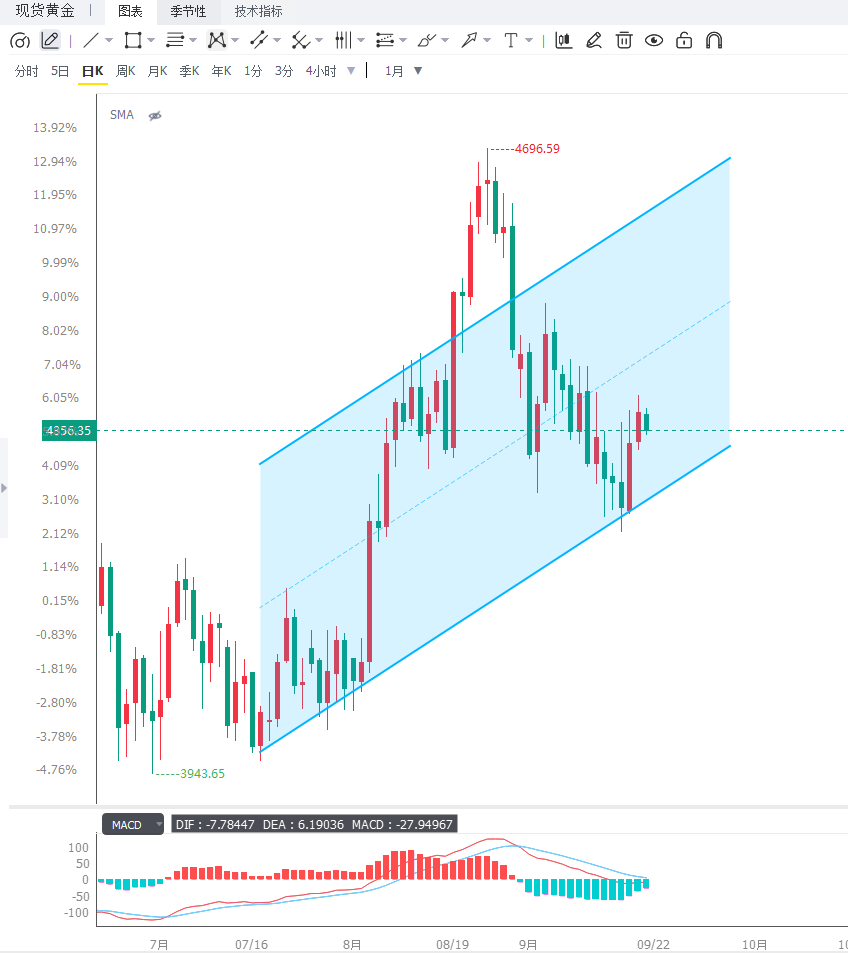 Editor's Summary: Gold is currently caught in a tug-of-war between safe-haven demand and expectations of a hawkish Federal Reserve policy. Geopolitical risks provide a floor for gold prices, but a stronger dollar and yields limit upside potential. In the short term, the key focus is on whether $4410 can be reclaimed and whether the $4320 support level holds. If it holds above $4320, gold is likely to maintain its high-level consolidation; however, a break below this level warrants caution as a further correction towards the $4300 or even $4200 area is possible.
The Federal Reserve's policy path has shifted back towards tightening, which is the main source of pressure currently facing gold. The market currently expects a 56.5% probability of another rate hike in October, significantly higher than the approximately 42.5% a week ago. Meanwhile, Fed officials have recently continued to emphasize inflation risks, meaning the market is unlikely to quickly establish expectations of rate cuts. For gold, which does not generate interest income, high real interest rates and risk-free rates increase the opportunity cost of holding it. Fed Chairman Kevin Warsh recently stated that US inflation remains too high and has persisted for an extended period; Minneapolis Fed President Neel Kashkari also stated on Sunday that inflationary pressures exist in multiple sectors of the economy, not just energy and food prices. Kashkari also supports a near-term rate hike, believing that policy still needs to push inflation back towards the 2% target. This means the gold market is currently facing a complex macroeconomic environment. The situation in the Middle East remains highly uncertain. Traditional safe-haven demand could theoretically support gold, but if rising energy prices further push up inflation and prompt the Fed to maintain high interest rates for a longer period, then the support for gold from safe-haven funds may be partially offset by the rising dollar and yields. The recent decline in oil prices has further altered the short-term pricing logic for gold. The market saw pressure on crude oil prices following the recovery of Saudi energy supplies and improvements in some key transportation routes, leading to a cooling of inflation trading. Meanwhile, US Treasury yields remain relatively high, and the US dollar index has returned to near the 100 mark, making further upward movement of gold more challenging. On Monday, oil prices fell due to signs of increased supply in the Middle East, while the US bond market remained suppressed by expectations of further interest rate hikes. However, the medium-term logic for gold has not completely changed. With the market already pricing in a significant degree of hawkish policy expectations, if future US economic data cools, especially if employment, consumption, or inflation data are weaker than expected, US Treasury yields and the dollar may decline in tandem, thereby improving the allocation environment for gold. OCBC previously pointed out that high yields and a strong dollar would limit gold's short-term performance, but if weaker US data leads to a renewed decline in yields and the dollar, gold may still find new support. Therefore, the key to the current gold market is not simply geopolitical risk, but rather the rebalancing between "safe-haven demand" and "high interest rate pressure." If Middle East risks escalate further while oil prices strengthen again, gold may receive support from safe-haven flows; however, if energy supplies continue to recover, oil prices decline, and the Federal Reserve maintains a hawkish policy, the dollar and yields may continue to suppress gold prices. From a funding perspective, the recent upward momentum of gold has weakened. The current price is close to $4370, a significant pullback from previous highs, but it has not yet broken the medium-term structure on the daily chart. Investors need to pay close attention this week to speeches by Federal Reserve officials and whether US economic data continues to support the assessment of "high interest rates for longer." If hawkish statements are further strengthened, gold may continue to test key support levels below; if the market lowers its expectations for further rate hikes, there is room for gold prices to recover. Gold is currently still trading above the 100-day SMA on the daily chart, indicating that the medium-term upward structure has not been broken for the time being. The current price is close to $4370, below the Bollinger Band middle line at $4410, and the 14-day RSI is around 51, having returned to near the neutral zone, indicating that the forces of bulls and bears are tending to balance, and the short-term trend is more inclined towards consolidation at high levels than a one-sided market. The first resistance level to watch is the Bollinger Band middle line at $4410. If gold prices can regain this level and form a valid daily breakout, the short-term rebound potential may further expand, with the next resistance level to watch being the upper Bollinger Band near $4615. Therefore, $4410 is a crucial technical watershed for the current renewed strength of gold. On the downside, the first support level to watch is around $4320 near the 100-day SMA. This level is both an important moving average support and a key defensive line in the current daily chart structure. If $4320 holds, gold prices may continue to fluctuate at higher levels and look for rebound opportunities; if it breaks down effectively, the downward pressure may increase significantly, with further attention to the $4300 psychological level and the lower Bollinger Band near $4200. Looking at the 4-hour chart, gold is still in a short-term correction structure, and the stabilization situation around $4370 is worth noting. If it breaks above $4410 again, the short-term correction pressure will be alleviated; if it continues to be capped by $4410 and breaks below $4320, it may open up further downside potential. The current US dollar index remaining near the 100 mark and US yields remaining high are the main external pressures that gold will face in its short-term rebound. Editor's Summary: Gold is currently caught in a tug-of-war between safe-haven demand and expectations of a hawkish Federal Reserve policy. Geopolitical risks provide a floor for gold prices, but a stronger dollar and yields limit upside potential. In the short term, the key focus is on whether $4410 can be reclaimed and whether the $4320 support level holds. If it holds above $4320, gold is likely to maintain its high-level consolidation; however, a break below this level warrants caution as a further correction towards the $4300 or even $4200 area is possible.
- Risk Warning and Disclaimer
- The market involves risk, and trading may not be suitable for all investors. This article is for reference only and does not constitute personal investment advice, nor does it take into account certain users’ specific investment objectives, financial situation, or other needs. Any investment decisions made based on this information are at your own risk.