Oil prices fell amid hawkish expectations from the Federal Reserve, while silver hovered around $66; caution is advised against another pullback.
2026-09-21 14:34:12
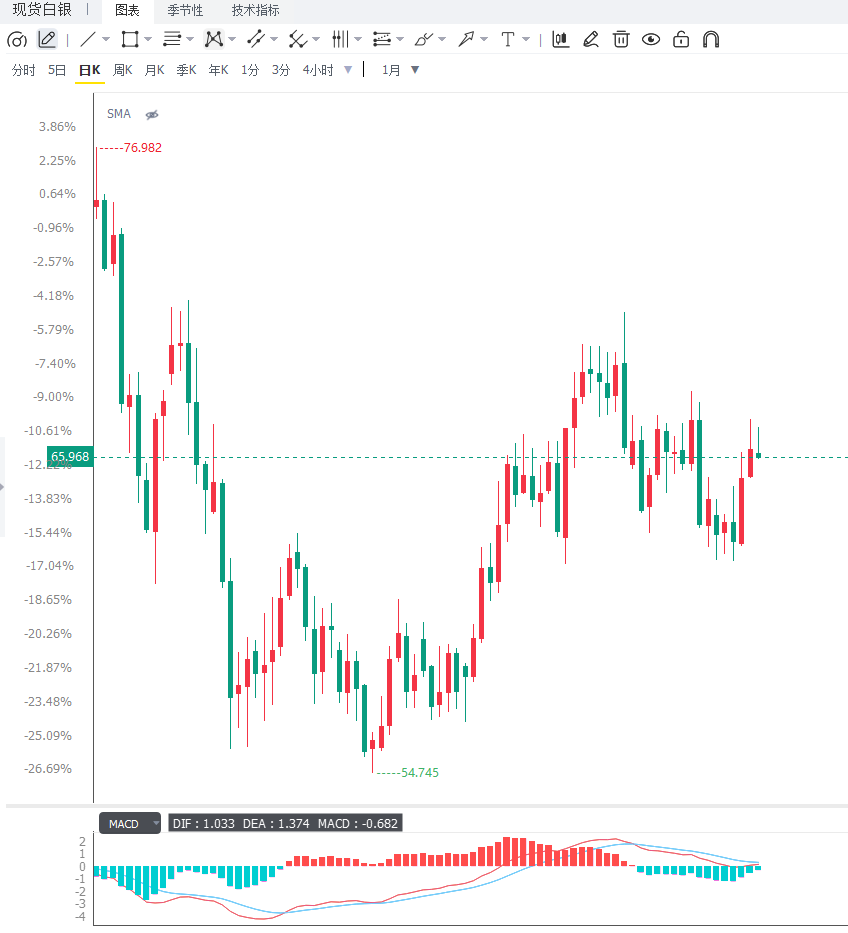
Spot silver traded in a narrow range during Asian trading hours on Monday, hovering around $66.35. After a significant rebound last week, silver has entered a consolidation phase, with the market currently focusing primarily on changes in crude oil prices and the outlook for US interest rate policy. Recent declines in oil prices have lowered inflation expectations, providing some support for silver, which does not generate interest income. However, continued hawkish signals from Federal Reserve officials are limiting silver's upside potential.  The decline in oil prices is easing market concerns about energy-driven inflation, which is a short-term positive factor for silver. The recent pullback in crude oil prices from their highs is mainly due to expectations of a recovery in energy supply and a de-escalation of tensions in the Middle East. Lower oil prices suggest that future inflationary pressures may ease, and market pricing in higher interest rates may cool, thus reducing the opportunity cost of holding non-yielding assets like silver. The decline in oil prices has already driven a rebound in the precious metals market, with silver rising by more than 2% last week. However, silver has not yet completely escaped the pressure of the Federal Reserve's policy. Last week, the Fed raised the target range for the federal funds rate by 25 basis points to 3.75% to 4.00%, while signaling further tightening of policy. The market currently expects a high probability of another rate hike in October. A high-interest-rate environment typically increases the attractiveness of dollar assets and US Treasury yields, putting downward pressure on non-interest-bearing assets like silver. Recent comments from Fed officials have further reinforced this policy backdrop. Minneapolis Federal Reserve President Neel Kashkari stated that inflationary pressures in the United States remain widespread and are not solely caused by rising energy prices; he also believes that the resilience of the US economy will increase price pressures. Kashkari supports a near-term interest rate hike and believes that inflation still needs to fall further towards the Fed's 2% target. This means that silver is currently facing two opposing macroeconomic variables. On the one hand, lower oil prices reduce inflation expectations, which is conducive to reducing upward pressure on yields and the dollar; on the other hand, if the US economy continues to perform strongly while inflation remains at a high level, the Fed may maintain a tighter policy for a longer period, and the dollar and real yields may strengthen again. Looking at recent price performance, silver's resilience remains quite evident. On September 18, silver rose to around $67 at one point, closing above $66, with a weekly gain of over 3%. Data shows that silver did not experience a sustained trend breakdown after the Fed's interest rate hike, but instead gained rebound momentum as oil prices and yields fell. Compared to gold, silver also has stronger industrial attributes, therefore, global economic growth expectations are also an important variable affecting its price. If the US and global economies continue to show resilience, industrial demand could provide additional support for silver; however, if high interest rates persist for too long and lead to a significant slowdown in economic growth, a decline in expected industrial demand could amplify silver's volatility. Currently, the market is awaiting more speeches from Federal Reserve officials and US economic data for new clues about the future path of interest rates. If future data begins to show cooling inflation and slower economic activity, the market may lower its expectations for further rate hikes, and a decline in the dollar and yields would be beneficial for silver to break out of its current trading range. Conversely, if inflation remains high and expectations for further Fed rate hikes increase, silver may retest key support levels. Silver is currently trading around $66.35 on the daily chart, still above the 20-day EMA of approximately $65.22, maintaining a slightly bullish short-term structure. The 14-day RSI is around 54, in the neutral-to-strong zone, indicating that bullish momentum remains but has not reached a significantly overbought level; therefore, it is currently closer to a consolidation at higher levels after the recent rise. The first support level to watch is around $65.22 near the 20-day EMA. If the price can hold this level, the short-term bullish structure remains intact. A decisive break below $65.22 on the daily chart would indicate weakening upward momentum, potentially leading to support in the $63.50-$63.00 area. Further downside support is around $62.30, a significant low formed during the previous pullback. On the upside, the initial focus is on the $67.30-$67.90 area, which corresponds to the recent high and is a key resistance zone for short-term breakouts. A successful break above this level would target resistance around $68.30 and $69.70; stronger resistance lies near the August 28 high of $71.12. A decisive break above $71.12 would suggest that silver may reopen its medium-term upside potential. On the 4-hour chart, silver is currently consolidating near $66, with a relatively balanced short-term bullish and bearish sentiment. If the price breaks through and holds above $67.30, the short-term rebound may extend to the $68.30 to $69.00 range; if it falls below $65.20, be wary of a wider correction and watch for support around $63.50.
  Editor's Summary: Silver is currently in a tug-of-war between easing inflationary pressures from falling oil prices and expectations of a hawkish Federal Reserve policy. Lower oil prices help reduce market concerns about high inflation and high interest rates, but continued emphasis on inflation risks by Fed officials means the dollar and yields may still exert some downward pressure on silver. In the short term, key support levels to watch are $65.22 and resistance levels around $67.30; the direction of these breakouts will determine the strength of the next phase of the market. In the medium term, it's crucial to observe whether $71.12 can be effectively broken.
The decline in oil prices is easing market concerns about energy-driven inflation, which is a short-term positive factor for silver. The recent pullback in crude oil prices from their highs is mainly due to expectations of a recovery in energy supply and a de-escalation of tensions in the Middle East. Lower oil prices suggest that future inflationary pressures may ease, and market pricing in higher interest rates may cool, thus reducing the opportunity cost of holding non-yielding assets like silver. The decline in oil prices has already driven a rebound in the precious metals market, with silver rising by more than 2% last week. However, silver has not yet completely escaped the pressure of the Federal Reserve's policy. Last week, the Fed raised the target range for the federal funds rate by 25 basis points to 3.75% to 4.00%, while signaling further tightening of policy. The market currently expects a high probability of another rate hike in October. A high-interest-rate environment typically increases the attractiveness of dollar assets and US Treasury yields, putting downward pressure on non-interest-bearing assets like silver. Recent comments from Fed officials have further reinforced this policy backdrop. Minneapolis Federal Reserve President Neel Kashkari stated that inflationary pressures in the United States remain widespread and are not solely caused by rising energy prices; he also believes that the resilience of the US economy will increase price pressures. Kashkari supports a near-term interest rate hike and believes that inflation still needs to fall further towards the Fed's 2% target. This means that silver is currently facing two opposing macroeconomic variables. On the one hand, lower oil prices reduce inflation expectations, which is conducive to reducing upward pressure on yields and the dollar; on the other hand, if the US economy continues to perform strongly while inflation remains at a high level, the Fed may maintain a tighter policy for a longer period, and the dollar and real yields may strengthen again. Looking at recent price performance, silver's resilience remains quite evident. On September 18, silver rose to around $67 at one point, closing above $66, with a weekly gain of over 3%. Data shows that silver did not experience a sustained trend breakdown after the Fed's interest rate hike, but instead gained rebound momentum as oil prices and yields fell. Compared to gold, silver also has stronger industrial attributes, therefore, global economic growth expectations are also an important variable affecting its price. If the US and global economies continue to show resilience, industrial demand could provide additional support for silver; however, if high interest rates persist for too long and lead to a significant slowdown in economic growth, a decline in expected industrial demand could amplify silver's volatility. Currently, the market is awaiting more speeches from Federal Reserve officials and US economic data for new clues about the future path of interest rates. If future data begins to show cooling inflation and slower economic activity, the market may lower its expectations for further rate hikes, and a decline in the dollar and yields would be beneficial for silver to break out of its current trading range. Conversely, if inflation remains high and expectations for further Fed rate hikes increase, silver may retest key support levels. Silver is currently trading around $66.35 on the daily chart, still above the 20-day EMA of approximately $65.22, maintaining a slightly bullish short-term structure. The 14-day RSI is around 54, in the neutral-to-strong zone, indicating that bullish momentum remains but has not reached a significantly overbought level; therefore, it is currently closer to a consolidation at higher levels after the recent rise. The first support level to watch is around $65.22 near the 20-day EMA. If the price can hold this level, the short-term bullish structure remains intact. A decisive break below $65.22 on the daily chart would indicate weakening upward momentum, potentially leading to support in the $63.50-$63.00 area. Further downside support is around $62.30, a significant low formed during the previous pullback. On the upside, the initial focus is on the $67.30-$67.90 area, which corresponds to the recent high and is a key resistance zone for short-term breakouts. A successful break above this level would target resistance around $68.30 and $69.70; stronger resistance lies near the August 28 high of $71.12. A decisive break above $71.12 would suggest that silver may reopen its medium-term upside potential. On the 4-hour chart, silver is currently consolidating near $66, with a relatively balanced short-term bullish and bearish sentiment. If the price breaks through and holds above $67.30, the short-term rebound may extend to the $68.30 to $69.00 range; if it falls below $65.20, be wary of a wider correction and watch for support around $63.50. Editor's Summary: Silver is currently in a tug-of-war between easing inflationary pressures from falling oil prices and expectations of a hawkish Federal Reserve policy. Lower oil prices help reduce market concerns about high inflation and high interest rates, but continued emphasis on inflation risks by Fed officials means the dollar and yields may still exert some downward pressure on silver. In the short term, key support levels to watch are $65.22 and resistance levels around $67.30; the direction of these breakouts will determine the strength of the next phase of the market. In the medium term, it's crucial to observe whether $71.12 can be effectively broken.- Risk Warning and Disclaimer
- The market involves risk, and trading may not be suitable for all investors. This article is for reference only and does not constitute personal investment advice, nor does it take into account certain users’ specific investment objectives, financial situation, or other needs. Any investment decisions made based on this information are at your own risk.