The euro started the new week lower. Will the 1.1400 level be the first to be breached as pricing in a Fed rate hike in October intensifies?
2026-09-21 14:16:10
The euro failed to sustain its slight rebound against the dollar on Monday (September 21), falling from around 1.1450 (its lowest level since the end of July) on Friday, and started the new week lower. The pair is currently trading slightly lower around 1.1470, appearing vulnerable amid escalating geopolitical tensions. 
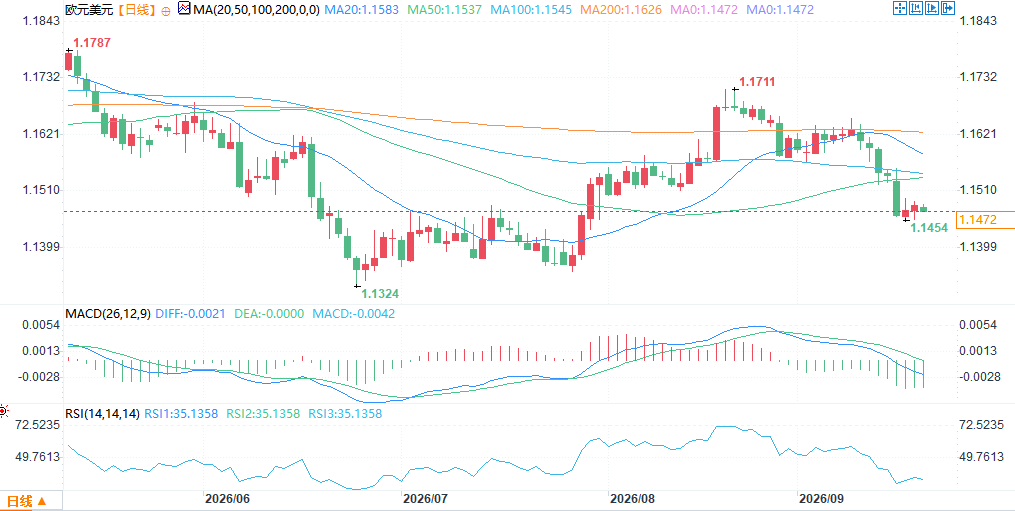 (Euro/USD daily chart, source: EasyForex) At 14:14 Beijing time, the euro was trading at 1.1471/72 against the US dollar.
Geopolitical risks: Dual pressure from the mixed threat from Russia and tensions in the Middle East
European officials have recently warned repeatedly that Russia may launch a hybrid operation in the coming months against NATO countries supporting Ukraine, including drone strikes, missile attacks, sabotage, and cyberattacks. The latest warning came from French President Macron, who explicitly stated last Friday that the hybrid threat from Russia to Europe and France is escalating. Such statements have been interpreted by the market as a potential weakening factor for the euro, as geopolitical uncertainty often reduces investors' risk appetite for eurozone assets. Meanwhile, escalating tensions in the Middle East have provided a tailwind for the dollar. The Houthi rebels launched missile and drone attacks on sensitive locations in Riyadh last Saturday, and Iran presented seven conditions for restarting negotiations, further pushing up market risk premiums. The persistent geopolitical risk premium, coupled with the Federal Reserve's hawkish stance, has strengthened the dollar's appeal as a safe-haven currency, thus putting downward pressure on the euro against the dollar. Currently, geopolitics presents two parallel fronts: the hybrid threat from Russia in Europe directly impacts euro confidence, while escalating conflict in the Middle East supports the dollar through safe-haven demand. These two forces working simultaneously put double pressure on the euro's exchange rate, while the dollar receives relative support, significantly limiting the euro's upside potential against the dollar in the short term.Policy Background: Contrast between the Fed's interest rate hikes and the ECB's warnings
The Federal Reserve announced an interest rate hike at its September meeting, which concluded last Wednesday, marking its first rate increase in over three years. The latest dot plot shows officials expect at least one more rate hike this year, further reinforcing market expectations of a dollar interest rate advantage. In contrast, the European Central Bank (ECB) warned that price pressures in the Eurozone may persist longer than previously anticipated, increasing market bets on further tightening in October and providing some support for the euro. The core policy contrast lies in the Fed's hawkish stance supporting the dollar by widening the US-EU interest rate differential, while the ECB's warnings about sticky inflation partially offset the euro's weakness through expectations of further rate hikes. This tug-of-war has put pressure on the euro against the dollar around 1.1475, but downside is also limited by ECB tightening expectations. In the short term, exchange rate movements will heavily depend on subsequent communication and data verification from both sides. If the Fed continues to send hawkish signals while the ECB's actions fall short of expectations, the euro may face further pressure; conversely, if the ECB's rate hike path becomes clearer, the euro is expected to gain some support. The current policy divergence is a significant anchoring factor for the euro's volatility against the dollar.Institutional Views
ING has set its year-end 2026 target for the euro against the US dollar at 1.1600. The bank notes that short-term interest rate differentials, oil prices, and global risk sentiment are the main drivers. With both the Federal Reserve and the European Central Bank likely to raise rates again in December, the impact of the front-end yield curve will be largely neutral until the end of the year, gradually benefiting the euro in 2027. A drop in oil prices to around $80/barrel, which the bank expects, will provide marginal support for the euro. However, short-term risks are clearly skewed to the downside: the Fed's hawkish stance makes the euro more vulnerable to the dollar, and the 1.1400 level could be tested. If oil prices surge again and the Fed raises rates in October, it could even test the June low of 1.1320. For 2027, ING previously expected a rise to 1.2000, but now believes downside risks have increased. Commerzbank has revised its forecast, expecting the euro against the dollar to remain largely unchanged around 1.15 by the end of 2026. Analyst Volkmar Baur stated that after the Fed's hawkish surprise, the market has fully priced in another rate hike in December, with the first rate cut not expected until the fourth quarter of 2027. The European Central Bank is also likely to raise rates in December, an expectation already fully priced into the market. Therefore, interest rate differentials will support a limited directional breakout in the exchange rate in the short term. Entering 2027, once the market confirms that the Fed is more likely to shift to rate cuts, the dollar will face slight pressure; simultaneously, uncertainty surrounding US government policy will also bring a risk premium to the dollar. Based on this, the bank sets its year-end target for 2027 at 1.18. The overall view is neutral to slightly bullish in the medium term, believing that the dollar's strength is unlikely to be sustained in the long term, and the euro is expected to gradually recover after the policy shift, but will likely remain in a sideways consolidation phase in the near term.Summarize
The euro fell against the dollar amid geopolitical risks and is currently trading around 1.1470. The mixed threat from Russia and Middle East tensions are putting pressure on the euro and supporting the dollar. A tug-of-war between the Fed's hawkish stance and ECB tightening expectations is limiting downside. Going forward, attention will be focused on Lagarde's remarks, developments in geopolitical headlines, and the pricing of a Fed rate hike in October. If geopolitical risks ease and Lagarde adopts a hawkish stance, the euro may rebound; if geopolitical tensions escalate or the dollar continues to strengthen, the euro may test support around 1.1400. (Euro/USD daily chart, source: EasyForex) At 14:14 Beijing time, the euro was trading at 1.1471/72 against the US dollar.
- Risk Warning and Disclaimer
- The market involves risk, and trading may not be suitable for all investors. This article is for reference only and does not constitute personal investment advice, nor does it take into account certain users’ specific investment objectives, financial situation, or other needs. Any investment decisions made based on this information are at your own risk.