The risk of yen intervention is rising, and the euro/yen exchange rate is hovering at low levels, awaiting a stress test.
2026-09-21 14:20:11
The euro/yen pair remained around 180.25 in early European trading on Monday, entering a consolidation phase after a significant rebound last week. With the Japanese market closed for a three-day holiday on Monday, market liquidity was relatively low, making the risk of intervention due to yen volatility a key focus in the foreign exchange market. The Bank of Japan raised its policy rate by 25 basis points to 1.25% last week, but the policy statement and Governor Kazuo Ueda's remarks did not signal a sufficiently strong further tightening, leading to a weakening of the yen.  The Bank of Japan's (BOJ) policy mix of "rate hikes but with a cautious approach" is a key reason for the recent strength of the euro/yen exchange rate. The BOJ raised interest rates to 1.25% at its September meeting, the highest level in 31 years, but two committee members voted against the hike, prompting the market to reassess the pace of future rate hikes. Data shows that the swap market is pricing in less than 20% of a rate hike at the end of October, while the probability of a December hike is close to 90%. This indicates that while the market still expects the BOJ to continue tightening policy, a clear expectation of consecutive rate hikes in the short term has not yet formed. Meanwhile, the risk of a Japanese exchange rate policy shift is clearly escalating. Reports indicate that Japanese officials recently conducted a "currency check," consulting banks to understand current exchange rates and market conditions. The market typically interprets this as a signal that the government may take further action. The yen weakened significantly against the dollar last week and failed to gain sustained support after the BOJ's rate hike, thus increasing market focus on the Japanese government's efforts to stabilize the yen. This factor is particularly important for the euro/yen exchange rate. The EUR/JPY exchange rate is essentially influenced by both Eurozone and Japanese interest rate expectations. However, if the Japanese government takes a tougher stance against a rapid yen depreciation, even without further interest rate hikes from the Bank of Japan in the short term, the yen may strengthen temporarily due to rising policy risk premiums, thus putting downward pressure on the EUR/JPY. Regarding the euro, ECB President Lagarde recently stated that future interest rate decisions will be made on a meeting-by-meeting basis based on economic data, and the possibility of a rate cut is currently low. Compared to the Bank of Japan, the ECB's policy outlook also faces some uncertainty, and the market needs to observe the impact of energy prices, inflation, and economic growth on the future interest rate path. From an interest rate differential perspective, the euro still has a significant interest rate advantage. Although the Bank of Japan has begun raising interest rates, its policy rate of 1.25% is still significantly lower than the ECB's interest rate level. Therefore, as long as the market does not significantly lower its expectations for ECB interest rates, the EUR/JPY can still receive some interest rate differential support. However, the current exchange rate is already at a high level, and any rapid appreciation of the yen could amplify the EUR/JPY pullback. The market also needs to pay attention to the impact of global energy prices on Japanese inflation and monetary policy. If energy prices remain high, it will increase Japan's import costs and intensify domestic inflationary pressures, theoretically increasing the Bank of Japan's (BOJ) policy case for further interest rate hikes. Conversely, if a recovery in energy supply drives a significant drop in oil prices, Japan's inflationary pressures may ease, thereby reducing market expectations for consecutive short-term BOJ rate hikes. Recent yen movements have fully reflected this shift in policy expectations. The BOJ's rate hikes themselves did not drive a sustained appreciation of the yen; instead, the market saw selling pressure due to perceived insufficiently hawkish policy guidance. The yen weakened significantly last week, with USD/JPY rising to around 158, and expectations of Japanese intervention in the exchange rate also increased. Therefore, the current trading logic for EUR/JPY is not simply about being bullish or bearish on the euro, but rather depends on whether the policy expectation gap between the BOJ and the ECB can be maintained, and whether the Japanese government will take stronger exchange rate stabilization measures. If the BOJ further signals a rate hike while intervention risks increase, the yen may quickly recover some of its losses; if the BOJ maintains a cautious stance while ECB rate cut expectations remain low, EUR/JPY may continue to fluctuate at high levels. The EUR/JPY pair is currently trading around 180.25 on the daily chart, remaining below the Bollinger Band middle line at 181.55 and the 100-day SMA at 184.18, indicating it's still within its previous consolidation structure. The 14-day RSI is around 41.7, below the neutral level of 50, suggesting that bullish momentum hasn't fully recovered. However, the pair recently rebounded from a low near 177.90 and returned above the 180 level, showing some signs of short-term stabilization. The first resistance level to watch is the Bollinger Band middle line around 181.55, which is also close to the recent rebound high and represents a significant resistance level in the short-term battle between bulls and bears. A decisive break above 181.55 would target the next resistance at the 100-day SMA around 184.18; a further break above that level would target the Bollinger Band upper line around 187.45. On the downside, the first support level to watch is the psychological level of 180.00; a break below that level would target the recent support area around 179.50. A more significant support level lies around the lower Bollinger Band at 175.60. A decisive break below this level would suggest that the current correction could extend further downwards. On the 4-hour chart, EUR/JPY is consolidating at higher levels in the short term, with the 180.00 area representing a current equilibrium between bulls and bears. A break above 181.55 would likely extend the short-term rebound; however, a failure to break higher and a break below 179.50 could lead to a larger pullback. Due to the Japanese market being closed, resulting in low liquidity, news related to the yen could amplify short-term volatility in EUR/JPY.
 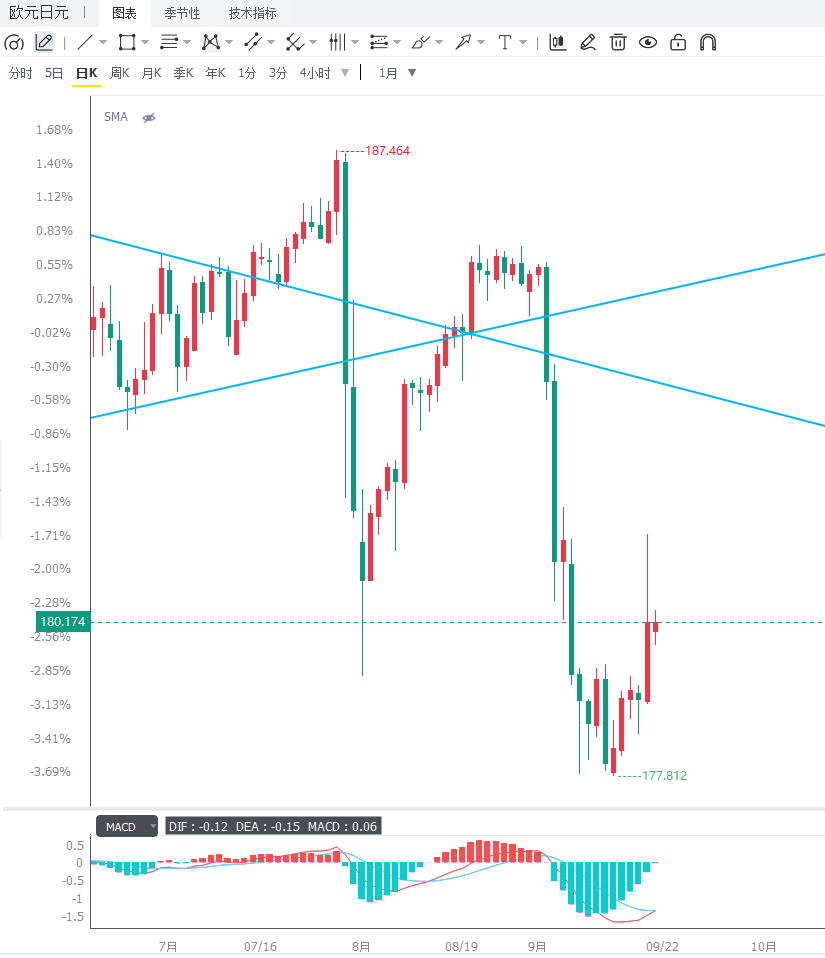 Editor's Summary: The EUR/JPY pair is currently in a tug-of-war between the support of the EUR/JPY interest rate differential and the risk of official intervention by the Bank of Japan. The lack of stronger hawkish guidance following the Bank of Japan's rate hike has put pressure on the yen, but exchange rate checks and potential intervention risks limit the yen's potential for further rapid depreciation. In the short term, key levels to watch are the resistance at 181.55 and the support at 179.50; a break in either direction could alter the current consolidation pattern. Close attention should also be paid to the Bank of Japan's policy statements and official exchange rate actions.
The Bank of Japan's (BOJ) policy mix of "rate hikes but with a cautious approach" is a key reason for the recent strength of the euro/yen exchange rate. The BOJ raised interest rates to 1.25% at its September meeting, the highest level in 31 years, but two committee members voted against the hike, prompting the market to reassess the pace of future rate hikes. Data shows that the swap market is pricing in less than 20% of a rate hike at the end of October, while the probability of a December hike is close to 90%. This indicates that while the market still expects the BOJ to continue tightening policy, a clear expectation of consecutive rate hikes in the short term has not yet formed. Meanwhile, the risk of a Japanese exchange rate policy shift is clearly escalating. Reports indicate that Japanese officials recently conducted a "currency check," consulting banks to understand current exchange rates and market conditions. The market typically interprets this as a signal that the government may take further action. The yen weakened significantly against the dollar last week and failed to gain sustained support after the BOJ's rate hike, thus increasing market focus on the Japanese government's efforts to stabilize the yen. This factor is particularly important for the euro/yen exchange rate. The EUR/JPY exchange rate is essentially influenced by both Eurozone and Japanese interest rate expectations. However, if the Japanese government takes a tougher stance against a rapid yen depreciation, even without further interest rate hikes from the Bank of Japan in the short term, the yen may strengthen temporarily due to rising policy risk premiums, thus putting downward pressure on the EUR/JPY. Regarding the euro, ECB President Lagarde recently stated that future interest rate decisions will be made on a meeting-by-meeting basis based on economic data, and the possibility of a rate cut is currently low. Compared to the Bank of Japan, the ECB's policy outlook also faces some uncertainty, and the market needs to observe the impact of energy prices, inflation, and economic growth on the future interest rate path. From an interest rate differential perspective, the euro still has a significant interest rate advantage. Although the Bank of Japan has begun raising interest rates, its policy rate of 1.25% is still significantly lower than the ECB's interest rate level. Therefore, as long as the market does not significantly lower its expectations for ECB interest rates, the EUR/JPY can still receive some interest rate differential support. However, the current exchange rate is already at a high level, and any rapid appreciation of the yen could amplify the EUR/JPY pullback. The market also needs to pay attention to the impact of global energy prices on Japanese inflation and monetary policy. If energy prices remain high, it will increase Japan's import costs and intensify domestic inflationary pressures, theoretically increasing the Bank of Japan's (BOJ) policy case for further interest rate hikes. Conversely, if a recovery in energy supply drives a significant drop in oil prices, Japan's inflationary pressures may ease, thereby reducing market expectations for consecutive short-term BOJ rate hikes. Recent yen movements have fully reflected this shift in policy expectations. The BOJ's rate hikes themselves did not drive a sustained appreciation of the yen; instead, the market saw selling pressure due to perceived insufficiently hawkish policy guidance. The yen weakened significantly last week, with USD/JPY rising to around 158, and expectations of Japanese intervention in the exchange rate also increased. Therefore, the current trading logic for EUR/JPY is not simply about being bullish or bearish on the euro, but rather depends on whether the policy expectation gap between the BOJ and the ECB can be maintained, and whether the Japanese government will take stronger exchange rate stabilization measures. If the BOJ further signals a rate hike while intervention risks increase, the yen may quickly recover some of its losses; if the BOJ maintains a cautious stance while ECB rate cut expectations remain low, EUR/JPY may continue to fluctuate at high levels. The EUR/JPY pair is currently trading around 180.25 on the daily chart, remaining below the Bollinger Band middle line at 181.55 and the 100-day SMA at 184.18, indicating it's still within its previous consolidation structure. The 14-day RSI is around 41.7, below the neutral level of 50, suggesting that bullish momentum hasn't fully recovered. However, the pair recently rebounded from a low near 177.90 and returned above the 180 level, showing some signs of short-term stabilization. The first resistance level to watch is the Bollinger Band middle line around 181.55, which is also close to the recent rebound high and represents a significant resistance level in the short-term battle between bulls and bears. A decisive break above 181.55 would target the next resistance at the 100-day SMA around 184.18; a further break above that level would target the Bollinger Band upper line around 187.45. On the downside, the first support level to watch is the psychological level of 180.00; a break below that level would target the recent support area around 179.50. A more significant support level lies around the lower Bollinger Band at 175.60. A decisive break below this level would suggest that the current correction could extend further downwards. On the 4-hour chart, EUR/JPY is consolidating at higher levels in the short term, with the 180.00 area representing a current equilibrium between bulls and bears. A break above 181.55 would likely extend the short-term rebound; however, a failure to break higher and a break below 179.50 could lead to a larger pullback. Due to the Japanese market being closed, resulting in low liquidity, news related to the yen could amplify short-term volatility in EUR/JPY. Editor's Summary: The EUR/JPY pair is currently in a tug-of-war between the support of the EUR/JPY interest rate differential and the risk of official intervention by the Bank of Japan. The lack of stronger hawkish guidance following the Bank of Japan's rate hike has put pressure on the yen, but exchange rate checks and potential intervention risks limit the yen's potential for further rapid depreciation. In the short term, key levels to watch are the resistance at 181.55 and the support at 179.50; a break in either direction could alter the current consolidation pattern. Close attention should also be paid to the Bank of Japan's policy statements and official exchange rate actions.
- Risk Warning and Disclaimer
- The market involves risk, and trading may not be suitable for all investors. This article is for reference only and does not constitute personal investment advice, nor does it take into account certain users’ specific investment objectives, financial situation, or other needs. Any investment decisions made based on this information are at your own risk.