If Wednesday's PMI falls short of expectations, will the euro drop below 1.15?
2026-09-21 15:24:14
The euro traded in a narrow range against the dollar during the European session on Monday (September 21), currently down slightly and trading around 1.1475. Danske Research noted that the euro consolidated below 1.15 against the dollar on Friday due to rising European yields. European interest rates rose on Friday, showing a bearish flattening trend, driven by rising energy prices and a sharp deterioration in French sovereign risk. The yield on German 2-year bonds rose 5-6 basis points to 3.28%, and the 10-year yield rose 5 basis points to 3.52%. 
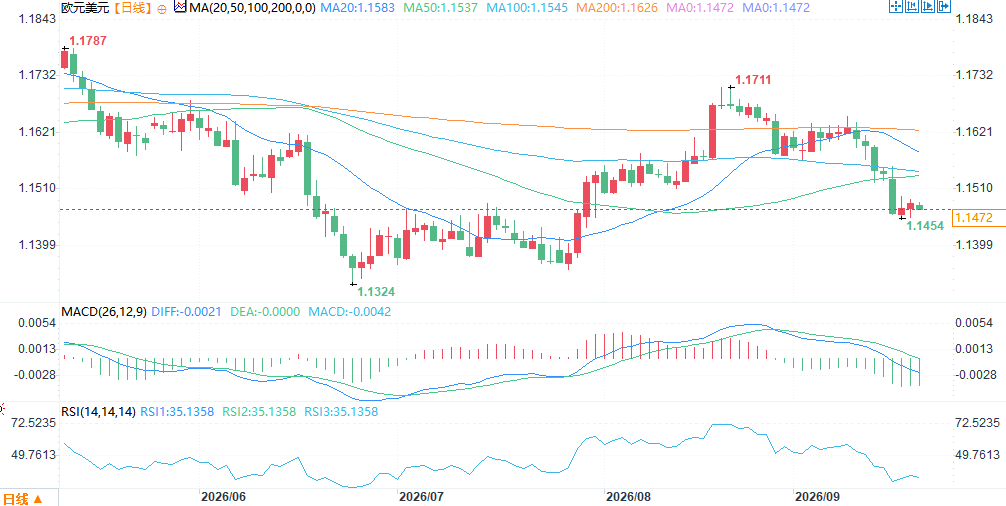 (Euro/USD daily chart, source: FX678) At 15:18 Beijing time, the euro was trading at 1.1471/72 against the US dollar.
Inflation expectations: Eurozone consumer expectations are stable around 3%, which the ECB may interpret as marginally hawkish.
In the Eurozone, the latest European Central Bank (ECB) consumer survey showed a slight rebound in inflation expectations in August. The median 1-year inflation expectation rose to 3.0%, while the median 3-year expectation rose to 2.9%. The downward trend in expectations since May now appears to be stabilizing around 3%. This change has policy implications: the end of the downward trend may be interpreted by the ECB as a marginally hawkish signal. Previously, the market and policymakers generally focused on the room for easing that would result from the continued decline in inflation expectations, but the current stabilization at 3% means that price pressures have not subsided as quickly as expected. The ECB may therefore have a basis for further tightening, especially when assessing the medium-term inflation path, and will be more cautious about the risk of turning to easing too early. However, the magnitude is expected to be limited, as expectations are only stabilizing around 3%, rather than accelerating upward. Overall, this data reinforces the "sticky inflation" narrative, adding hawkish weight to the October policy meeting, but is not enough to trigger a full repricing of expectations for a significant rate hike. The market will continue to observe subsequent surveys and actual inflation data to confirm whether this stabilization is sustainable.Key data: The preliminary September PMI is the focus this week, with attention drawn to manufacturing momentum.
The most crucial data release this week is Wednesday's preliminary September Purchasing Managers' Index (PMI) figures from most major economies. The Eurozone data is particularly noteworthy, as the economy has shown relatively strong growth momentum since the summer, giving the European Central Bank (ECB) more room to maneuver when tightening monetary policy. The market focus is currently on whether growth momentum will strengthen further, especially in the manufacturing sector. Manufacturing has been weak for a long time; if the latest PMI shows significant improvement in this sector, it will strengthen the breadth and sustainability of the Eurozone's economic recovery. Strong PMI readings could boost market expectations for further tightening by the ECB in October, thus supporting the euro; conversely, if the data reveals weakening momentum or a widening divergence between the services and manufacturing sectors, the euro may face downward pressure. As a leading indicator, the PMI directly reflects actual business activity, and its results often quickly influence exchange rate and interest rate expectations. Therefore, this week's PMI data is a core catalyst for the euro's movement, and the market will closely watch whether the Eurozone composite PMI and the manufacturing sub-index break through key thresholds to assess the policy path and the euro's medium-term direction.German Politics: Merz's Two Regional Election Defeats Strengthen the Narrative of Political Risk Premium
In Germany, Chancellor Merz's Christian Democratic Union (CDU) suffered significant defeats in Sunday's two regional elections. Preliminary results showed the party's vote share in Mecklenburg-Western Pomerania dropped to 4.9%, failing to cross the 5% parliamentary threshold; in Berlin, it garnered 18.8%. Meanwhile, the far-right Alternative for Germany (AfD) led the Social Democratic Party (SPD) in Mecklenburg-Western Pomerania with 38.2% of the vote, ahead of the SPD's 35.5%, despite other parties explicitly ruling out a coalition government. The Left Party won the Berlin state election with 25.7% of the vote. Merz himself called the results in the northeastern states a "disaster," but stated he would remain Chancellor and continue his established reform agenda. These electoral losses have further increased political pressure on Merz, raised the likelihood of a change of Chancellor, and reinforced the slowly accumulating political risk premium narrative in the markets. However, a federal coalition breakdown currently appears unlikely. Rising political uncertainty could marginally increase the risk premium for the euro, especially as investors assess the stability of German policies and the pace of reforms. In the short term, this factor may exert some psychological pressure on the euro, but it has not yet become the core driver of exchange rate fluctuations.Summarize
The euro is currently trading below 1.15 against the dollar, with European yields rising due to energy prices and French sovereign risk. Eurozone inflation expectations are stable around 3%, which may be interpreted as hawkish by the ECB. Wednesday's preliminary September PMI is the focus this week, particularly for the Eurozone, as strong summer growth makes it easier for the ECB to tighten. Merz's defeat in two regional elections in Germany has strengthened the political risk premium narrative, but a breakup of the federal coalition remains unlikely. Going forward, attention will be focused on PMI data, the evolution of French sovereign risk, political developments in Germany, and the pricing of ECB tightening in October. 1.15 is a short-term resistance level; a strong PMI and easing political risk could see the euro break through, while increased political pressure or a weak PMI could put downward pressure on the euro. (Euro/USD daily chart, source: FX678) At 15:18 Beijing time, the euro was trading at 1.1471/72 against the US dollar.
- Risk Warning and Disclaimer
- The market involves risk, and trading may not be suitable for all investors. This article is for reference only and does not constitute personal investment advice, nor does it take into account certain users’ specific investment objectives, financial situation, or other needs. Any investment decisions made based on this information are at your own risk.