Behind the continued weakening of the yen: verbal intervention is effective in the short term, but long-term action is needed to deliver results.
2026-09-21 15:24:13
On Monday (September 21), during the European session, the USD/JPY pair continued its gains from last Friday, currently trading around 157. Behind the continued rise in the exchange rate is a deepening market skepticism regarding the Bank of Japan's resolve to tighten monetary policy. 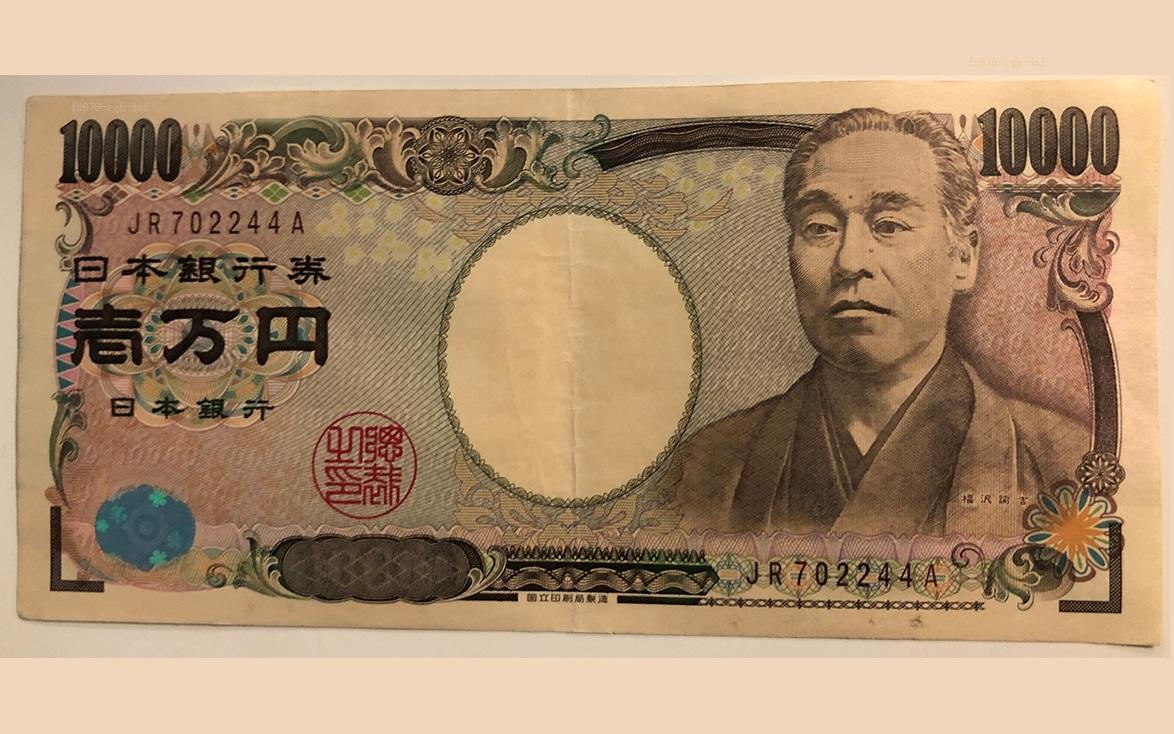
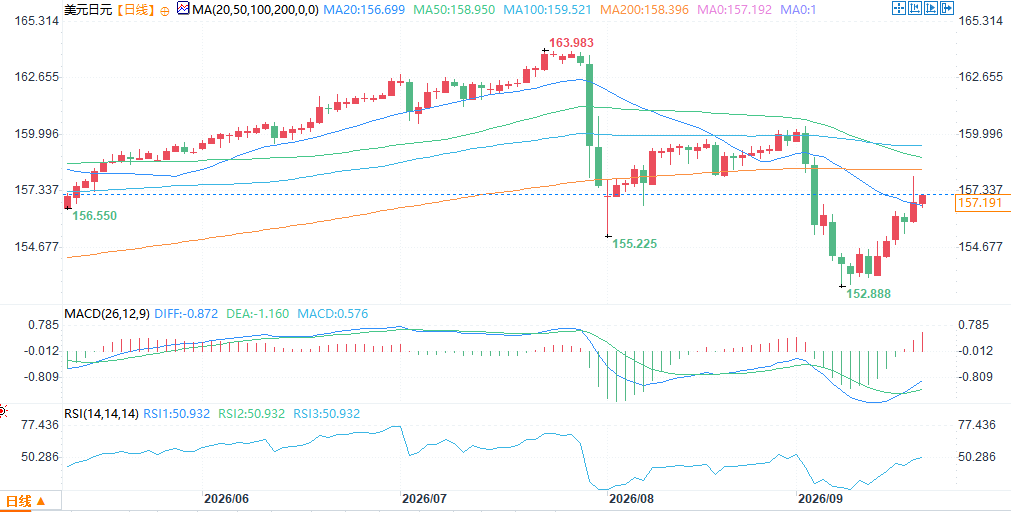 (USD/JPY daily chart, source: EasyForex) At 15:13 Beijing time, USD/JPY was trading at 157.18/19.
Key assessment: Policy delays may weaken the yen; the Bank of Japan faces credibility risks.
Commerzbank analyst Thu Lan Nguyen points out that the Bank of Japan (BOJ) is facing renewed significant pressure amid a persistently weak yen and market skepticism regarding its tightening commitments. The latest interest rate hike failed to satisfy domestic officials or gain sufficient international support, and the reliance on threats of foreign exchange intervention is widely seen as insufficient. Nguyen further warns that a delayed and overly cautious tightening path could ultimately harm both yen stability and economic growth prospects. This core assessment accurately pinpoints the BOJ's current predicament: the rate hike failed to effectively boost the yen's exchange rate, while the market remains skeptical of its resolve to further tighten policy. The gap between policy communication and actual action is eroding the central bank's credibility. If this uncertainty persists, speculative selling could resurface, creating a vicious cycle of yen depreciation and policy passivity. Analysts emphasize that the BOJ must address this credibility risk; otherwise, policy delays themselves could become a significant driver of further yen weakness.Short-term vs. long-term: Threat intervention is effective in the short term, but requires concrete action in the long term.
In the short term, the Bank of Japan's currency checks and verbal threats of intervention may indeed have a deterrent effect on some market participants, preventing them from further large-scale selling of yen. This "talking" strategy often plays a temporary stabilizing role during periods of liquidity sensitivity or heightened speculative sentiment. However, from a long-term perspective, relying solely on threats of intervention is far from sufficient. Sooner or later, the Bank of Japan must deliver on its policy pronouncements through concrete actions, whether it's a clearer path for interest rate hikes or actual intervention in the foreign exchange market. This distinction between short-term and long-term is crucial: verbal warnings and currency checks can curb speculative selling and alleviate immediate depreciation pressure in the short term; however, if the central bank delays in following up with substantial tightening or intervention measures, market patience will gradually wear thin. Once investors believe that the "wolf is coming" signal lacks follow-through support, the yen may face renewed selling pressure, and exchange rate volatility will increase significantly. Therefore, there is a clear tension between short-term stabilization and long-term credibility maintenance, and the Bank of Japan needs to carefully weigh the two.The fundamental problem: with priorities uncertain, the market may be unwilling to wait indefinitely.
The fundamental problem facing the Bank of Japan (BOJ) lies in the continued significant uncertainty surrounding its policy priorities. On the one hand, the BOJ clearly wants to prevent a further sharp depreciation of the yen, and achieving this requires sending credible signals to the market that additional, and possibly even faster, interest rate hikes remain a policy option. Ideally, the BOJ might prefer a middle path: continuing to raise interest rates, but at a moderate pace, to avoid derailing economic growth. However, the practical challenge is that the market may not be willing to wait indefinitely for this balance to be achieved. If the BOJ gives the impression of being unwilling to decisively defend the yen, its policy credibility will be quickly damaged. This dilemma is acute: overly dovish communication could trigger a renewed yen sell-off; overly hawkish communication could cause unnecessary harm to the domestic economy. The ambiguity of priorities itself is amplifying exchange rate volatility, and the market's thirst for clear signals is growing stronger.Historical warning: The lesson of the Swedish central bank's 500% interest rate
Historical experience offers a profound warning: once investors lose confidence in a currency, even extremely aggressive interest rate hikes may be insufficient to reverse the depreciation trend. The most typical example occurred in Sweden in the early 1990s. To defend the krona's exchange rate, the Swedish central bank temporarily raised its policy rate by a staggering 500%, attempting to stem capital outflows through extremely high interest rates. However, this unconventional operation ultimately failed, and Sweden soon abandoned its currency peg. This case clearly demonstrates that once a currency's credibility is lost, the effectiveness of traditional policy tools rapidly diminishes, and market expectations can create a self-reinforcing depreciation spiral. For the Bank of Japan, if it is widely perceived by the market as lacking the will and ability to decisively defend the yen, it may face a similar risk of credibility collapse. The cost of extreme policies is extremely high, yet they may not restore confidence; this historical lesson deserves our utmost attention.Conclusion: Time is running out, and the Bank of Japan needs to choose between stability and growth.
In short, the Bank of Japan's window of opportunity is rapidly narrowing. The longer it attempts to maintain a delicate balance between monetary stability and economic growth, the greater the risk that both will eventually spiral out of control. This conclusion has direct and practical implications for yen traders: policy delays themselves may already be becoming an independent driver of yen weakness. If the Bank of Japan fails to deliver clearer and stronger tightening signals at subsequent monetary policy meetings, the market may resume its sell-off of the yen, and the downward pressure on the exchange rate may continue. Conversely, if the central bank chooses to act decisively, it must be prepared to bear the potential economic costs, including the potential impact on exports and domestic demand. In the current environment, the costs of ambiguity and delay are rising, and the Bank of Japan needs to make a more decisive choice between stabilizing the exchange rate and protecting growth as soon as possible to rebuild market confidence and avoid falling into a passive position. (USD/JPY daily chart, source: EasyForex) At 15:13 Beijing time, USD/JPY was trading at 157.18/19.
- Risk Warning and Disclaimer
- The market involves risk, and trading may not be suitable for all investors. This article is for reference only and does not constitute personal investment advice, nor does it take into account certain users’ specific investment objectives, financial situation, or other needs. Any investment decisions made based on this information are at your own risk.