













The war of words between the US and Iran has caused oil prices to fall, but this may also indicate a potential rebound.
2026-09-21 16:30:11
On Monday (September 21), during the Asian and European sessions, international oil prices continued to decline steadily. WTI crude oil futures (November forward price) fell 2.24% to trade at 93.91. The geopolitical situation in the Middle East has entered a delicate period of balance. The US and Iran are releasing signals of confrontation and diplomatic easing at the same time. Coupled with the upcoming UN General Assembly, the market has given a positive revision expectation to the geopolitical situation. Oil prices fell in tandem, but the market is still fluctuating between the expectation of restarting US-Iran peace talks and the risk of escalating geopolitical conflict. During the decline in oil prices, the Revolutionary Guard made a strong and confrontational statement. Oil prices showed a typical volatile trend, and the battle between bulls and bears was extremely fierce. 
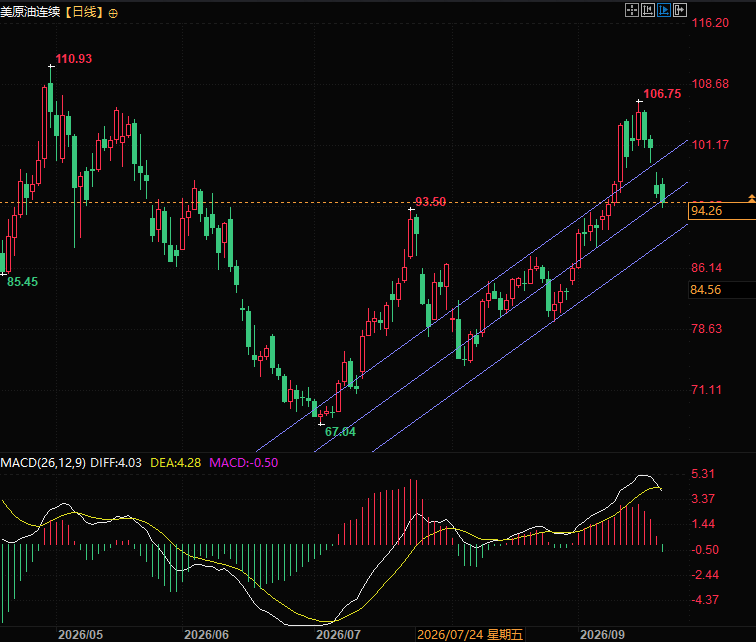 (WTI crude oil futures main contract daily chart, source: EasyTrade) At 16:23 Beijing time, WTI crude oil futures main contract was trading at $93.74 per barrel.
Peace talks break the ice: The US hopes for peace talks, but Iran puts forward seven conditions.
The recent signs of diplomatic détente between the US and Iran began last weekend, marking a crucial turning point in the geopolitical situation. According to a high-ranking Iranian source, Qatar and Pakistan, the two mediators, formally conveyed to Iran that the US is prepared to negotiate and reach an agreement with Iran, and is taking the negotiations very seriously. Following this, Mohsen Rezaei, Secretary of Iran's Supreme National Security Council, confirmed that Iran had formally submitted seven preconditions for negotiations to the US through Qatar and is currently awaiting a formal response from the US, setting clear preconditions for the resumption of the long-stalled US-Iran negotiations. Among the core negotiation conditions disclosed by Iran, three key demands are particularly clear: a complete cessation of all US military operations against Iran, the unfreezing of Iranian overseas assets frozen by the US, and the complete lifting of the naval blockade against Iran. At the same time, Iran clearly stated that it has no intention of provoking war, and that the current conflict is not in the overall interests of Iran, the Middle East, and the international community. Iran stated that if the US returns to the Islamabad Memorandum of Understanding and strictly implements its terms, Iran can resume the implementation of the corresponding memorandum within days, while also demanding reliable security guarantees from the US to eliminate the risk of subsequent military strikes. Meanwhile, Qatari Foreign Ministry spokesman Majid Ansari stated on the 20th that Qatar is maintaining communication with the United States and Iran to promote the resumption of negotiations between the two countries. He said that several US government officials have indicated that the US hopes to reach an agreement and end the conflict. Speaking at the Qatar Economic Forum in New York, Ansari said that Qatar has been exchanging views with the US and Iran over the past few weeks and is working to bridge its differences, but he did not provide a timetable for resuming negotiations. He said, "We have heard statements from several US government officials confirming that the US hopes to reach an agreement and find a solution to end this war." Ansari stated that any solution should ensure regional stability while promoting international consensus on protecting strategic waterways, including the Strait of Hormuz. He pointed out that the Bab el-Mandeb Strait is also currently affected by the regional conflict.Short-term outlook: The UN General Assembly presents a crucial window for US-Iran diplomacy.
The biggest short-term market easing expectation comes from the diplomatic window opened this week at the UN General Assembly. It is understood that US President Trump will deliver a speech at the UN General Assembly early Wednesday morning, having previously stated publicly that he is open to meeting with Iranian President Pezechzian. Iran has also released positive diplomatic signals; Pezechzian will lead a high-level delegation to Wednesday's UN General Assembly meeting, planning to publicly articulate Iran's official position on the US-Israel military action and hold consultations with leaders of several countries. The Iranian Foreign Minister has also departed for New York, stopping in Doha en route to coordinate the situation with various regional parties. The market generally anticipates that the US-Iran diplomatic interactions during the UN General Assembly could be a key turning point in breaking the deadlock between the two sides, leading to a temporary easing of geopolitical tensions.Geopolitical constraints remain: Intense clashes between the US and Iran on the eve of the UN General Assembly, multiple risks solidify the bottom for oil prices.
On Sunday, on the eve of the UN General Assembly, tensions between the US and Iran escalated sharply. Intense rhetoric and military maneuvering continued to push up geopolitical risk premiums in the Middle East, providing strong support for international oil prices. The US adopted an extremely tough stance, with Trump publicly stating that the US had entered "decision mode" regarding Iran, threatening to completely destroy the Iranian economy and eliminate its leadership if Iran refused to reach an agreement. He also maintained the diplomatic possibility of a meeting with the Iranian president during the UN General Assembly, creating a dual stance of "military deterrence + diplomatic probing." US embassies in several Middle Eastern countries issued security alerts, pizza shops near the Pentagon saw a surge in orders, and Trump cut short his vacation. Affected by the tensions, the US State Department issued an emergency Middle East security alert, warning citizens of the risks of escalation, flight cancellations, and airspace closures, leading to a rapid rise in regional risk aversion. Faced with extreme pressure from the US, Iran responded strongly and refused to compromise. The Iranian military issued an official warning that it had detected the United States and its allies preparing for a new round of large-scale military strikes, and issued a strong warning that it would launch a sustained, effective and painful retaliatory strike against the United States and Middle Eastern countries involved in the strikes. All US military outposts in the Middle East and overseas interests are included in the scope of the strikes.Institutional View: Oil Prices Unlikely to Plunge Rapidly, High Levels to Continue
However, institutions remain cautious about the future trend of oil prices, denying the possibility of a rapid decline. Faced with a short-term market correction and Trump's statement that "oil prices will fall after the US midterm elections," Chevron's CEO explicitly expressed a different view, believing that the various regulatory measures previously used to buffer the geopolitical conflict with Iran have been largely exhausted. He added that supply-side risks in crude oil will remain in the coming months, and oil prices are likely to remain high or even rise again, making a rapid decline unlikely. Overall, the current supply and demand fundamentals of the crude oil market are still dominated by geopolitical risks, and expectations of easing lack substantial support.Game theory logic: The US and Iran's contrasting stances, one soft and one hard, shape the rhythm of oil price fluctuations.
The current volatile oil price trend is essentially a direct reflection of the "soft" and "hard" rhetoric game between the US and Iran, creating a cyclical pattern where rising oil prices are met with positive US statements, and falling oil prices are met with strong Iranian rhetoric. Whenever oil prices surge due to geopolitical risks and intensified domestic inflation and public pressure in the US, the US proactively expresses goodwill and willingness to meet to appease the market and suppress price increases. Conversely, once oil prices fall as expectations of easing tensions subside, Iran's hardline faction actively releases confrontational signals. On Monday, the Iranian Revolutionary Guard repeatedly made public statements, claiming that the current situation still has room for territorial expansion and that US overseas bases in the Middle East have lost their effective self-defense capabilities. This continuous release of provocative rhetoric and intensification of geopolitical tensions, with the Iranian Revolutionary Guard stating that there is still room for territorial expansion and that US bases today lack even the ability to protect themselves, has prevented the market from forming a unilateral trend, ultimately resulting in a wide-range, high-level fluctuation in the crude oil market.Summary and Technical Analysis:
Short-term diplomatic interactions at the UN General Assembly are expected to continue to suppress oil price increases. However, with the Strait of Hormuz navigation deadlock unresolved, Iran's negotiating conditions not yet finalized, and the threat of regional military conflict unresolved, geopolitical risks remain. Therefore, once the decline in oil prices begins to slow, a significant rebound is possible. The ongoing tug-of-war between the US and Iran means that international oil prices will continue to exhibit high volatility, with each marginal shift in the geopolitical situation dominating short-term price movements. Technically, WTI futures have recently fallen rapidly to the middle of the channel, indicating a slowdown in the rate of increase, but the overall bullish trend remains intact. (WTI crude oil futures main contract daily chart, source: EasyTrade) At 16:23 Beijing time, WTI crude oil futures main contract was trading at $93.74 per barrel.
- Risk Warning and Disclaimer
- The market involves risk, and trading may not be suitable for all investors. This article is for reference only and does not constitute personal investment advice, nor does it take into account certain users’ specific investment objectives, financial situation, or other needs. Any investment decisions made based on this information are at your own risk.

