What exactly is wrong with Germany?
2026-09-21 18:26:10
Germany is currently mired in multiple development dilemmas, facing three major intertwined and mutually reinforcing challenges. These three problems have combined and fermented, causing Germany to completely abandon its long-term stable development trend.  First, Germany's core growth model has completely collapsed, and its economic development has lost its endogenous driving force. Many commentators simply attribute Germany's economic weakness to the loss of cheap Russian energy following the Russia-Ukraine conflict, but this is only a superficial cause, not the core problem. As I have previously stated, the decline of German industry is the result of accumulated long-term structural problems. The stagnation of German industry and the decline in its industrial competitiveness had already been evident long before the outbreak of the Russia-Ukraine conflict and subsequent geopolitical changes. Behind this lies a deeper structural flaw in industrial layout, policy system, and lagging industrial transformation. Second, the inherent defects of the Eurozone system continue to drag Germany down, leaving it in a long-term predicament of passively paying the price. The Eurozone's institutional design itself has inherent loopholes. The vast differences in economic size and fiscal conditions among member states, coupled with the use of a unified currency and monetary policy, inevitably create an imbalance of power and responsibility. Whenever Europe encounters major external economic or geopolitical shocks, Germany, as the economic core of the Eurozone, is forced to passively negotiate and compromise with a group of highly indebted member states. Just like with aid to Ukraine, Germany, based on its responsibility as a major European power and the need for Eurozone stability, directly shouldered the vast majority of the financial burden. During the COVID-19 pandemic, the Eurozone's joint bond issuance policy further allowed Germany to indirectly subsidize the fiscal deficits of highly indebted countries. This Euro mechanism has long solidified the unbalanced pattern of "Germany paying the bill, weaker countries benefiting." This unfair distribution of benefits is inherently unsustainable politically. Now, coupled with the failure of Germany's domestic growth model and slowing economic growth, internal contradictions have been amplified, and public discontent continues to rise. Third, the centrist forces in German politics have completely disintegrated, leading to a more extreme and fragmented political landscape. The rigid governance of the grand coalition government will ultimately erode the trust of centrist voters, pushing for political polarization. Recent local election results in Germany perfectly illustrate this point: traditional mainstream centrist parties have suffered significant vote losses, while emerging parties such as the Alternative for Germany (AfD) have achieved successive victories and rapidly risen to prominence. The mainstream centrist ruling camp is mired in governance paralysis and policy ineffectiveness, unable to address the economic, immigration, and livelihood issues of concern to the public. A growing number of Germans, even those in previously politically moderate West Germany, have completely lost faith in the centrists, turning instead to the extreme left and right wings. The moderate political landscape that had characterized Germany for decades since World War II has been shattered. Previous articles have detailed Germany's three core crises. This article will provide a more detailed and in-depth analysis of these three key issues, incorporating the latest election trends and economic data.
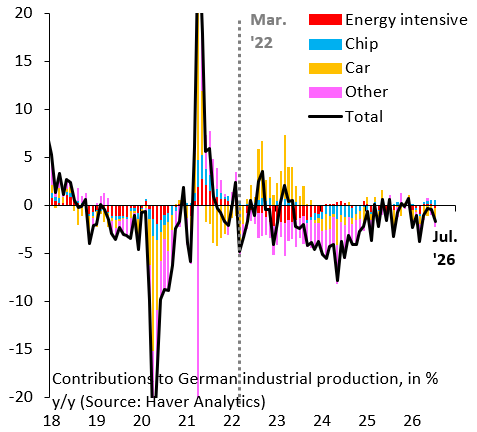
 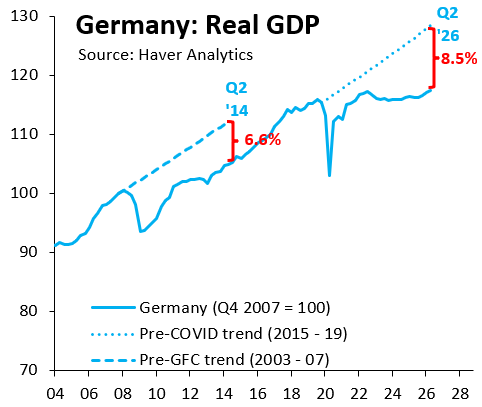 The Collapsing Growth Model: Structural Decline Far Exceeds the Impact of the Energy Crisis Relevant economic charts clearly illustrate the trajectory of Germany's real GDP changes. A comparison of economic growth trends before the 2008 global financial crisis and before the COVID-19 pandemic clearly shows that Germany's potential growth space has been continuously shrinking. This trend projection restores the scale that the German economy should have reached under stable development, and also directly confirms a core conclusion: Germany's current output gap, that is, the difference between the actual GDP level and the potential output level under full employment, has far exceeded the trough after the 2008 financial crisis, and the problems of weak economic recovery and slowing growth are becoming increasingly severe. Energy shortages are only a short-term shock and cannot explain Germany's long-term industrial stagnation. Supporting data charts clearly show that after the outbreak of geopolitical conflicts in 2022, Germany's energy-intensive industries did indeed suffer a significant impact and a sharp decline in output. However, the overall continuous contraction of industrial production and the decline in industrial vitality covered many sectors, including manufacturing, processing, and supporting services. Moreover, this downward trend had already been brewing and worsening year by year before the Russia-Ukraine conflict. At its root, the Volkswagen diesel emissions scandal severely damaged the reputation of German manufacturing; German automakers lagged far behind in the global wave of new energy transformation; the domestic administrative regulatory system was cumbersome and redundant; and business costs continued to rise. These multiple negative factors combined to completely destroy the traditional competitive advantages of German industry. Germany has historically been labeled the "sick man of Europe," but in the past, it has always managed to recover through reforms. The most representative example is the comprehensive labor market reforms implemented by former Chancellor Gerhard Schröder, which successfully reshaped German industrial competitiveness and put the economy back on a growth trajectory by optimizing employment systems, reducing the burden on enterprises, and revitalizing the market. Today, Germany's governing system has long lost the ability to implement sweeping reforms. The current grand coalition government suffers from severe factional checks and balances and low decision-making efficiency, resulting in a stalemate in all key areas such as economic reform, industrial upgrading, and institutional optimization. It is completely unable to replicate past reform measures and can only allow structural economic problems to continue to worsen.
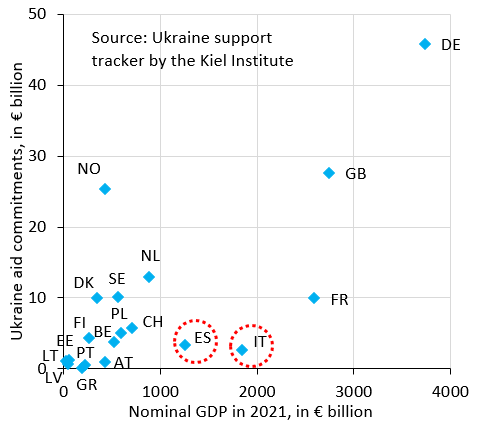
  The Eurozone Dilemma: Imbalances Fuel Populist Demands This article will not delve into the constraints of the Eurozone on Germany. Relevant data charts, using national economic size as the horizontal axis and aid to Ukraine as the vertical axis, visually demonstrate the proportion of responsibility borne by European countries, clearly illustrating Germany's excessive pressure in European affairs. Of particular note is the recent significant shift in German political winds. The Alternative for Germany (AfD) has once again listed "leaving the Eurozone" as a core campaign platform. The party has accurately captured public discontent with the imbalances within the Eurozone and is leveraging this issue to garner votes. For many years, immigration has been a core tool for the AfD to attract voters, while the issue of leaving the Eurozone has always been secondary. The fact that the party is now actively increasing the weight of the Eurozone exit issue demonstrates that it has become a core pain point of widespread concern and high dissatisfaction among the German public. Objectively speaking, Germany's long-term practice of subsidizing highly indebted Eurozone member states without compensation and bearing the costs of regional economic stability alone is inherently unreasonable. The AfD is precisely seizing upon this public pain point, continuously amplifying public opinion and rallying public support. The optimal solution is not for Germany to leave the Eurozone, but for the current government to take proactive measures, actively fight for its rights within the Eurosystem, and firmly defend Germany's domestic economic interests. However, the reality is that the current German government is weak and inactive, completely unwilling to fight for the legitimate rights of its industries and citizens. The most typical manifestation of this is the government's continued support for Bundesbank President Joachim Nagel and a group of European Central Bank officials who favor the interests of highly indebted member states. I have previously criticized the governing tendencies of these core European economic policymakers; their policies essentially sacrifice German interests to bail out weaker Eurozone countries, further exacerbating Germany's development predicament.
  Dramatic Changes in the Political Landscape: Failure of Centrist Governance Fuels a Wave of Extremism The latest results of the German local elections lead to a radical political conclusion: the era of moderate governance has come to a complete end.
 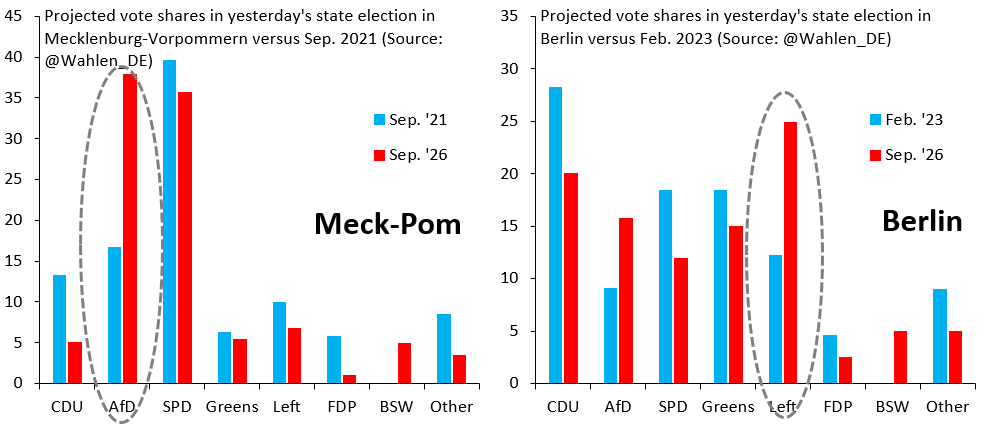 First, the moderate and conservative political foundation that had characterized Germany for decades after World War II has completely collapsed. In this election, Mecklenburg-Western Pomerania witnessed a historic shift, with the Alternative for Germany (AfD) achieving its most significant electoral victory since its founding, greatly expanding its influence. The election results in Berlin were equally unexpected, with the left-wing party, inheriting the legacy of the East German Communist Party, winning the most votes. Furthermore, many of this party's political platforms are more radical and extreme than those of the AfD. The rise of these two extreme factions and the defeat of mainstream centrist parties have completely shattered the long-standing political balance in Germany. Second, the immigration issue has become the core trigger for the German political upheaval, leading to a full-blown outbreak of public discontent. For a long time, issues such as immigrant resettlement, social integration, and resource allocation have accumulated substantial public resentment. The grand coalition government's delays and inaction on immigration issues have continuously eroded public trust, providing an opportunity for the rise of extreme parties. Now, this issue has fully erupted, driving a rapid rise in the AfD's support rate nationwide. Even in West Germany, traditionally politically moderate and averse to extremist ideologies, a large number of voters have switched their allegiance to the AfD, accelerating the polarization of the political landscape. Historically, Germany's grand coalition government model has always had fatal flaws. Factional checks and balances outweigh effective governance, easily leading to policy paralysis and inefficiency. It fails to address the core demands of the people, ultimately forcing voters to abandon the middle ground and turn to political extremism. Germany is currently on a double downward spiral of economic recession and political division, making a comprehensive political and economic disaster almost inevitable. More importantly, as the largest and most influential economy in Europe, a full-blown crisis in Germany would trigger a powerful chain reaction, dragging the entire European economic and political system into turmoil.
First, Germany's core growth model has completely collapsed, and its economic development has lost its endogenous driving force. Many commentators simply attribute Germany's economic weakness to the loss of cheap Russian energy following the Russia-Ukraine conflict, but this is only a superficial cause, not the core problem. As I have previously stated, the decline of German industry is the result of accumulated long-term structural problems. The stagnation of German industry and the decline in its industrial competitiveness had already been evident long before the outbreak of the Russia-Ukraine conflict and subsequent geopolitical changes. Behind this lies a deeper structural flaw in industrial layout, policy system, and lagging industrial transformation. Second, the inherent defects of the Eurozone system continue to drag Germany down, leaving it in a long-term predicament of passively paying the price. The Eurozone's institutional design itself has inherent loopholes. The vast differences in economic size and fiscal conditions among member states, coupled with the use of a unified currency and monetary policy, inevitably create an imbalance of power and responsibility. Whenever Europe encounters major external economic or geopolitical shocks, Germany, as the economic core of the Eurozone, is forced to passively negotiate and compromise with a group of highly indebted member states. Just like with aid to Ukraine, Germany, based on its responsibility as a major European power and the need for Eurozone stability, directly shouldered the vast majority of the financial burden. During the COVID-19 pandemic, the Eurozone's joint bond issuance policy further allowed Germany to indirectly subsidize the fiscal deficits of highly indebted countries. This Euro mechanism has long solidified the unbalanced pattern of "Germany paying the bill, weaker countries benefiting." This unfair distribution of benefits is inherently unsustainable politically. Now, coupled with the failure of Germany's domestic growth model and slowing economic growth, internal contradictions have been amplified, and public discontent continues to rise. Third, the centrist forces in German politics have completely disintegrated, leading to a more extreme and fragmented political landscape. The rigid governance of the grand coalition government will ultimately erode the trust of centrist voters, pushing for political polarization. Recent local election results in Germany perfectly illustrate this point: traditional mainstream centrist parties have suffered significant vote losses, while emerging parties such as the Alternative for Germany (AfD) have achieved successive victories and rapidly risen to prominence. The mainstream centrist ruling camp is mired in governance paralysis and policy ineffectiveness, unable to address the economic, immigration, and livelihood issues of concern to the public. A growing number of Germans, even those in previously politically moderate West Germany, have completely lost faith in the centrists, turning instead to the extreme left and right wings. The moderate political landscape that had characterized Germany for decades since World War II has been shattered. Previous articles have detailed Germany's three core crises. This article will provide a more detailed and in-depth analysis of these three key issues, incorporating the latest election trends and economic data. The Collapsing Growth Model: Structural Decline Far Exceeds the Impact of the Energy Crisis Relevant economic charts clearly illustrate the trajectory of Germany's real GDP changes. A comparison of economic growth trends before the 2008 global financial crisis and before the COVID-19 pandemic clearly shows that Germany's potential growth space has been continuously shrinking. This trend projection restores the scale that the German economy should have reached under stable development, and also directly confirms a core conclusion: Germany's current output gap, that is, the difference between the actual GDP level and the potential output level under full employment, has far exceeded the trough after the 2008 financial crisis, and the problems of weak economic recovery and slowing growth are becoming increasingly severe. Energy shortages are only a short-term shock and cannot explain Germany's long-term industrial stagnation. Supporting data charts clearly show that after the outbreak of geopolitical conflicts in 2022, Germany's energy-intensive industries did indeed suffer a significant impact and a sharp decline in output. However, the overall continuous contraction of industrial production and the decline in industrial vitality covered many sectors, including manufacturing, processing, and supporting services. Moreover, this downward trend had already been brewing and worsening year by year before the Russia-Ukraine conflict. At its root, the Volkswagen diesel emissions scandal severely damaged the reputation of German manufacturing; German automakers lagged far behind in the global wave of new energy transformation; the domestic administrative regulatory system was cumbersome and redundant; and business costs continued to rise. These multiple negative factors combined to completely destroy the traditional competitive advantages of German industry. Germany has historically been labeled the "sick man of Europe," but in the past, it has always managed to recover through reforms. The most representative example is the comprehensive labor market reforms implemented by former Chancellor Gerhard Schröder, which successfully reshaped German industrial competitiveness and put the economy back on a growth trajectory by optimizing employment systems, reducing the burden on enterprises, and revitalizing the market. Today, Germany's governing system has long lost the ability to implement sweeping reforms. The current grand coalition government suffers from severe factional checks and balances and low decision-making efficiency, resulting in a stalemate in all key areas such as economic reform, industrial upgrading, and institutional optimization. It is completely unable to replicate past reform measures and can only allow structural economic problems to continue to worsen. The Eurozone Dilemma: Imbalances Fuel Populist Demands This article will not delve into the constraints of the Eurozone on Germany. Relevant data charts, using national economic size as the horizontal axis and aid to Ukraine as the vertical axis, visually demonstrate the proportion of responsibility borne by European countries, clearly illustrating Germany's excessive pressure in European affairs. Of particular note is the recent significant shift in German political winds. The Alternative for Germany (AfD) has once again listed "leaving the Eurozone" as a core campaign platform. The party has accurately captured public discontent with the imbalances within the Eurozone and is leveraging this issue to garner votes. For many years, immigration has been a core tool for the AfD to attract voters, while the issue of leaving the Eurozone has always been secondary. The fact that the party is now actively increasing the weight of the Eurozone exit issue demonstrates that it has become a core pain point of widespread concern and high dissatisfaction among the German public. Objectively speaking, Germany's long-term practice of subsidizing highly indebted Eurozone member states without compensation and bearing the costs of regional economic stability alone is inherently unreasonable. The AfD is precisely seizing upon this public pain point, continuously amplifying public opinion and rallying public support. The optimal solution is not for Germany to leave the Eurozone, but for the current government to take proactive measures, actively fight for its rights within the Eurosystem, and firmly defend Germany's domestic economic interests. However, the reality is that the current German government is weak and inactive, completely unwilling to fight for the legitimate rights of its industries and citizens. The most typical manifestation of this is the government's continued support for Bundesbank President Joachim Nagel and a group of European Central Bank officials who favor the interests of highly indebted member states. I have previously criticized the governing tendencies of these core European economic policymakers; their policies essentially sacrifice German interests to bail out weaker Eurozone countries, further exacerbating Germany's development predicament. Dramatic Changes in the Political Landscape: Failure of Centrist Governance Fuels a Wave of Extremism The latest results of the German local elections lead to a radical political conclusion: the era of moderate governance has come to a complete end. First, the moderate and conservative political foundation that had characterized Germany for decades after World War II has completely collapsed. In this election, Mecklenburg-Western Pomerania witnessed a historic shift, with the Alternative for Germany (AfD) achieving its most significant electoral victory since its founding, greatly expanding its influence. The election results in Berlin were equally unexpected, with the left-wing party, inheriting the legacy of the East German Communist Party, winning the most votes. Furthermore, many of this party's political platforms are more radical and extreme than those of the AfD. The rise of these two extreme factions and the defeat of mainstream centrist parties have completely shattered the long-standing political balance in Germany. Second, the immigration issue has become the core trigger for the German political upheaval, leading to a full-blown outbreak of public discontent. For a long time, issues such as immigrant resettlement, social integration, and resource allocation have accumulated substantial public resentment. The grand coalition government's delays and inaction on immigration issues have continuously eroded public trust, providing an opportunity for the rise of extreme parties. Now, this issue has fully erupted, driving a rapid rise in the AfD's support rate nationwide. Even in West Germany, traditionally politically moderate and averse to extremist ideologies, a large number of voters have switched their allegiance to the AfD, accelerating the polarization of the political landscape. Historically, Germany's grand coalition government model has always had fatal flaws. Factional checks and balances outweigh effective governance, easily leading to policy paralysis and inefficiency. It fails to address the core demands of the people, ultimately forcing voters to abandon the middle ground and turn to political extremism. Germany is currently on a double downward spiral of economic recession and political division, making a comprehensive political and economic disaster almost inevitable. More importantly, as the largest and most influential economy in Europe, a full-blown crisis in Germany would trigger a powerful chain reaction, dragging the entire European economic and political system into turmoil.
- Risk Warning and Disclaimer
- The market involves risk, and trading may not be suitable for all investors. This article is for reference only and does not constitute personal investment advice, nor does it take into account certain users’ specific investment objectives, financial situation, or other needs. Any investment decisions made based on this information are at your own risk.