Expectations of a warming of US-Iran relations have resurfaced, causing oil prices to fall.
2026-09-21 19:48:12
On Monday (September 21), WTI crude oil prices fell further below $94 during the European trading session, dropping nearly 8% from last week's high, marking the fourth consecutive trading day of weakness. Despite the continued uncertainty in the Middle East, news of a significant rebound in Saudi crude oil exports in September continued to weigh on prices.  A report released by JPMorgan Chase on Saturday stated that despite damage to Saudi Arabia's east-west oil pipeline, Saudi crude oil shipments remained "exceptionally strong," alleviating market concerns about supply disruptions to some extent. Admiral Brad Cooper, commander of U.S. Central Command, confirmed on Sunday that thanks to U.S. naval escorts and mine clearance efforts, oil shipments through the Strait of Hormuz reached a near six-month high in the past two weeks. Furthermore, U.S. President Trump indicated his willingness to meet with the Iranian president, who is expected to attend the UN General Assembly in New York this week. Meanwhile, Iran also presented preconditions for resuming negotiations. However, tensions in the Middle East have not completely dissipated: the Houthi rebels in Yemen attacked key Saudi facilities and crude oil export hubs. The highly uncertain regional situation has also prevented oil prices from falling further from the $100 range. The Iranian-backed Houthi rebels in Yemen launched missile and drone attacks on the Saudi capital, Riyadh; both the U.S. and Iran have again issued confrontational statements, and the conflict has been deadlocked for seven months. OCBC analyst Christopher Wang pointed out that although Saudi officials reported that attacks on Yanbu and other locations had been intercepted and that "no new damage to oil infrastructure was reported," the latest round of attacks over the weekend could still provide new support for oil prices. OCBC stated that the existing damage to Saudi East-West oil pipelines and disruptions to oil loading operations at Yanbu port remind the market that the risk of supply disruptions remains. Wang noted in a research report, "In this context, unless Saudi crude oil exports return to normal and attacks on energy facilities subside, the downside for oil prices may be limited." Nevertheless, Saudi crude oil exports rebounded to approximately 4 million barrels per day in September; August exports had fallen to 2.4 million barrels per day, the lowest since 2013. Shipping data shows that only 12 commodity vessels passed through the Strait of Hormuz on Saturday and Sunday, compared to 35 over the weekend. Furthermore, JPMorgan analysts stated that satellite data shows Saudi crude oil shipments via the Strait of Hormuz averaged 2.9 million barrels per day over the past six days, compared to only 700,000 barrels per day in August. The oil market is not expecting a formal agreement from both sides; the core focus is on preventing further escalation of the conflict. (Technical Analysis)
 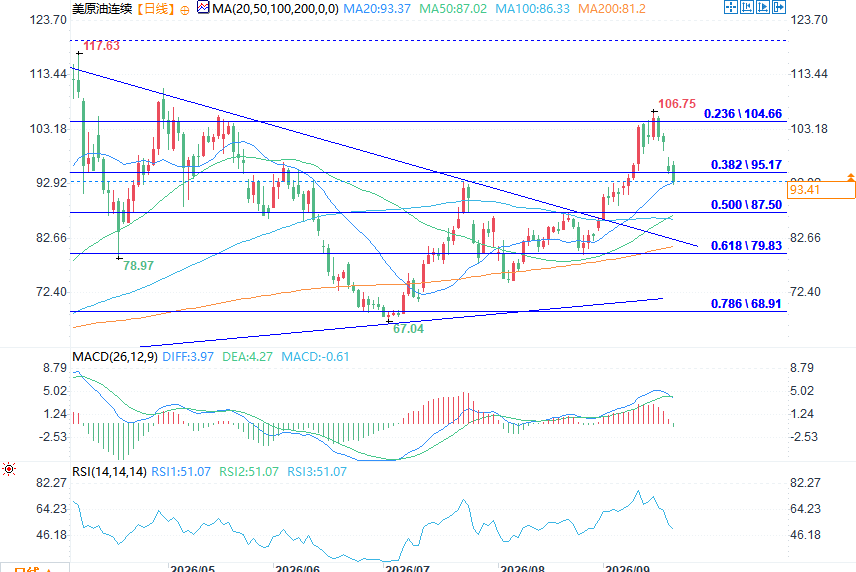 After breaking out of a symmetrical triangle pattern, oil prices encountered resistance above $106 and subsequently retreated. They are currently testing the $95 support level, which is the 38.2% Fibonacci retracement of the $55 to $120 rally. However, oil prices remain above the 50-day and 200-day exponential moving averages. Although upward momentum has clearly weakened, the medium- to long-term trend remains optimistic. For bears to reverse the downward trend, a break below the $95 support zone (the 38.2% Fibonacci retracement and the July high) would open up downside potential to $88—the 50% Fibonacci retracement and the 50-day exponential moving average. A break below this level would target the 200-day moving average around $82. If the $95 support holds, bulls will first aim to reclaim the psychological level of $100, then retest the $105 resistance zone, which coincides with the 23.6% Fibonacci retracement and the September high. If the price reaches $105, it will form a higher high, and oil prices could potentially reach $110.
A report released by JPMorgan Chase on Saturday stated that despite damage to Saudi Arabia's east-west oil pipeline, Saudi crude oil shipments remained "exceptionally strong," alleviating market concerns about supply disruptions to some extent. Admiral Brad Cooper, commander of U.S. Central Command, confirmed on Sunday that thanks to U.S. naval escorts and mine clearance efforts, oil shipments through the Strait of Hormuz reached a near six-month high in the past two weeks. Furthermore, U.S. President Trump indicated his willingness to meet with the Iranian president, who is expected to attend the UN General Assembly in New York this week. Meanwhile, Iran also presented preconditions for resuming negotiations. However, tensions in the Middle East have not completely dissipated: the Houthi rebels in Yemen attacked key Saudi facilities and crude oil export hubs. The highly uncertain regional situation has also prevented oil prices from falling further from the $100 range. The Iranian-backed Houthi rebels in Yemen launched missile and drone attacks on the Saudi capital, Riyadh; both the U.S. and Iran have again issued confrontational statements, and the conflict has been deadlocked for seven months. OCBC analyst Christopher Wang pointed out that although Saudi officials reported that attacks on Yanbu and other locations had been intercepted and that "no new damage to oil infrastructure was reported," the latest round of attacks over the weekend could still provide new support for oil prices. OCBC stated that the existing damage to Saudi East-West oil pipelines and disruptions to oil loading operations at Yanbu port remind the market that the risk of supply disruptions remains. Wang noted in a research report, "In this context, unless Saudi crude oil exports return to normal and attacks on energy facilities subside, the downside for oil prices may be limited." Nevertheless, Saudi crude oil exports rebounded to approximately 4 million barrels per day in September; August exports had fallen to 2.4 million barrels per day, the lowest since 2013. Shipping data shows that only 12 commodity vessels passed through the Strait of Hormuz on Saturday and Sunday, compared to 35 over the weekend. Furthermore, JPMorgan analysts stated that satellite data shows Saudi crude oil shipments via the Strait of Hormuz averaged 2.9 million barrels per day over the past six days, compared to only 700,000 barrels per day in August. The oil market is not expecting a formal agreement from both sides; the core focus is on preventing further escalation of the conflict. (Technical Analysis) After breaking out of a symmetrical triangle pattern, oil prices encountered resistance above $106 and subsequently retreated. They are currently testing the $95 support level, which is the 38.2% Fibonacci retracement of the $55 to $120 rally. However, oil prices remain above the 50-day and 200-day exponential moving averages. Although upward momentum has clearly weakened, the medium- to long-term trend remains optimistic. For bears to reverse the downward trend, a break below the $95 support zone (the 38.2% Fibonacci retracement and the July high) would open up downside potential to $88—the 50% Fibonacci retracement and the 50-day exponential moving average. A break below this level would target the 200-day moving average around $82. If the $95 support holds, bulls will first aim to reclaim the psychological level of $100, then retest the $105 resistance zone, which coincides with the 23.6% Fibonacci retracement and the September high. If the price reaches $105, it will form a higher high, and oil prices could potentially reach $110.
- Risk Warning and Disclaimer
- The market involves risk, and trading may not be suitable for all investors. This article is for reference only and does not constitute personal investment advice, nor does it take into account certain users’ specific investment objectives, financial situation, or other needs. Any investment decisions made based on this information are at your own risk.