How will Warsh's proposed easing measures rewrite the pricing of US Treasury bonds?
2026-09-21 18:56:10
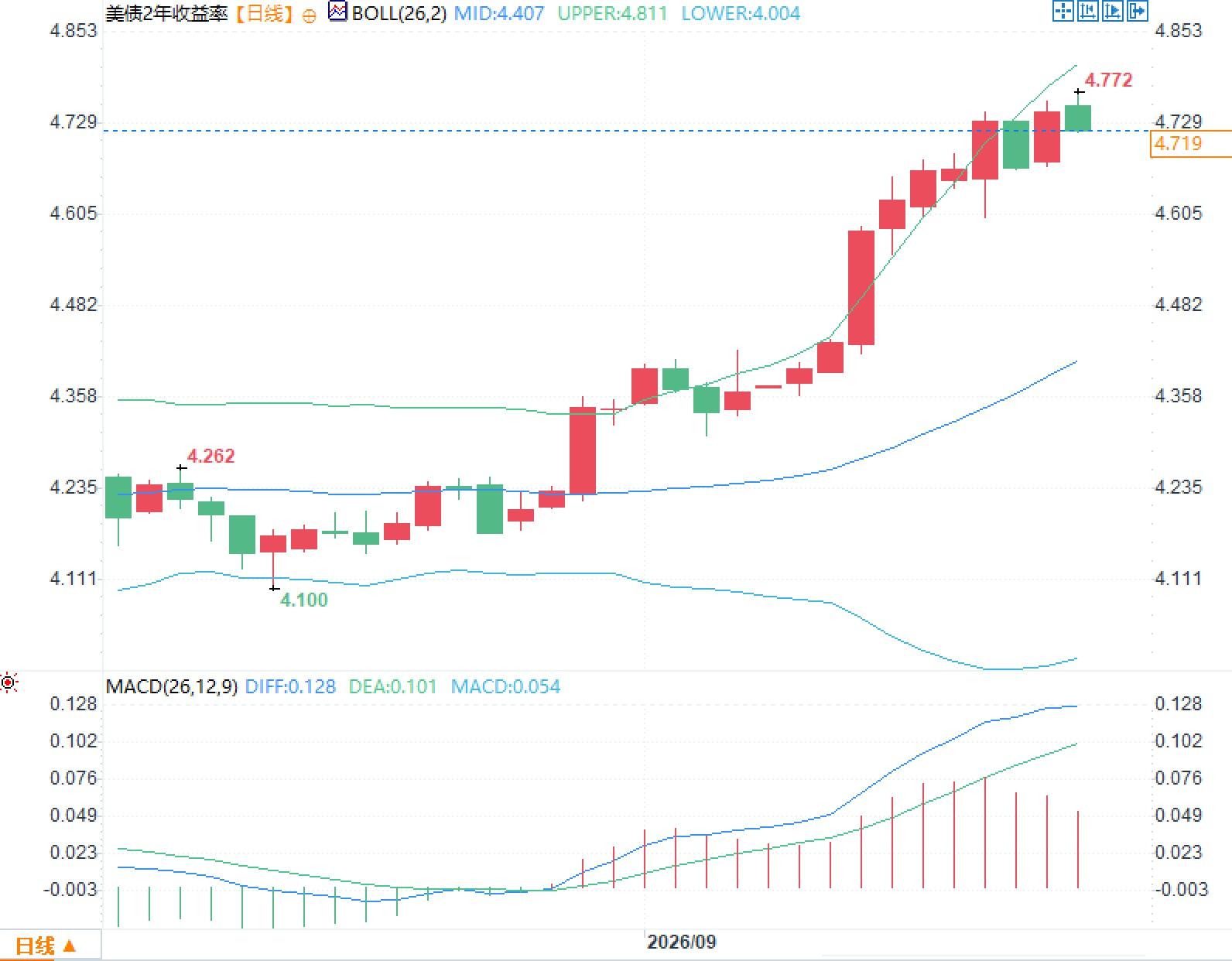
On Monday, September 21, the US Treasury market remained in a pricing and consolidation phase following the Federal Reserve's resumption of interest rate hikes. The two-year Treasury yield hovered around 4.72%, having risen to approximately 4.75% to 4.76% in the previous few trading days, reaching a high range in recent years. Meanwhile, the target range for the US federal funds rate was 3.75% to 4.00%, and the ten-year Treasury yield was approximately 4.96%, narrowing the spread between the two-year and ten-year yields to approximately 21 to 25 basis points. The market's focus has shifted from whether interest rates will be raised again to whether the short-term rate has already factored in too much of the subsequent path. 
 Overnight funding rate futures indicate that an additional 80 basis points of tightening is still implied over the next year. Swap contracts are pricing in a September 2027 policy rate of around 4.68%. Meanwhile, the two-year yield is around 4.72% to 4.75%, already close to or even higher than some forward policy rate implied levels. WisdomTree Investments points out that if we observe which segment of the yield curve might have gone too far, the short end is the most prominent; the two-year yield is significantly higher than the current federal funds rate, indicating that the front end is ahead of the official target. This discussion does not constitute a directional prediction. The relatively high coupon rates, shorter duration, and lower exposure to sharp fluctuations at the long end are structural reasons why institutions are shifting their allocation focus forward. Whether prices can rebound still depends on the speed of inflation decline and whether the policy path is lower than the current implied level, both of which are yet to be settled.
Short-term yields have significantly outpaced policy rates.
The two-year US Treasury yield is most sensitive to policy expectations. Since its low in February, the yield on this maturity has risen by approximately 140 basis points. At that time, the market was still pricing in a rate-cutting path; now, pricing has shifted to tightening. Currently, the two-year yield is significantly higher than the upper limit of the policy rate, meaning that the short end has already priced in some of the subsequent rate hikes. Overnight funding rate futures indicate that an additional 80 basis points of tightening is still implied over the next year. Swap contracts are pricing in a September 2027 policy rate of around 4.68%. Meanwhile, the two-year yield is around 4.72% to 4.75%, already close to or even higher than some forward policy rate implied levels. WisdomTree Investments points out that if we observe which segment of the yield curve might have gone too far, the short end is the most prominent; the two-year yield is significantly higher than the current federal funds rate, indicating that the front end is ahead of the official target. This discussion does not constitute a directional prediction. The relatively high coupon rates, shorter duration, and lower exposure to sharp fluctuations at the long end are structural reasons why institutions are shifting their allocation focus forward. Whether prices can rebound still depends on the speed of inflation decline and whether the policy path is lower than the current implied level, both of which are yet to be settled.The dot plot does not coincide with the implied market path.
On September 16, the Federal Open Market Committee (FOMC) raised the target range for the federal funds rate by 25 basis points to 3.75% to 4.00%, the first rate hike since 2023, with a unanimous vote. Chairman Kevin Warsh stated after the meeting that this adjustment was equivalent to removing a dose of easing, and that financial and credit conditions needed to be closer to the ultimate goal. The median of the Summary of Economic Projections indicates that the appropriate policy rate at the end of the year will be 4.1%, and will remain at 4.1% in 2027, corresponding to one more rate hike this year followed by a prolonged period of consolidation. The Personal Consumption Expenditures (PCE) price index is projected at 3.7% in 2026 and 2.3% in 2027; real GDP growth is projected at 2.3%, and the unemployment rate at 4.1%. Warsh himself did not submit the dot plot and emphasized that he would not substitute pre-commitments for data verification. The market path is steeper than the dot plot suggests. Some institutions have warned that if inflation stickiness exceeds expectations, the policy rate could rise above 5%. The key lies in the confidence range of the terminal interest rate one year from now; in previous rate hike cycles, the market has often underestimated the final rate hike magnitude. The probability of pricing three more times is low, making it easier to establish a comparable value for the short end. The coexistence of these two statements indicates that terminal interest rates are still distributed, not a single point.Auctions and official speeches will test the short-end acceptance.
The U.S. Treasury is scheduled to auction $69 billion in two-year Treasury notes on September 22 and $70 billion in five-year Treasury notes on September 23. The scale is similar to recent months, and the market is more focused on the proportion of indirect bidding, bid-to-cover ratios, and the deviation of the issuance rate from the pre-issuance rate. Whether short-term allocation is merely a verbal consensus will leave traces in the bidding structure. This week, New York Fed President John Williams will deliver a keynote speech at the Treasury Markets Conference, and Cleveland Fed President Beth Hammark will address the Inflation Drivers and Dynamics Conference. Hammark previously emphasized that inflation has been persistently above target for a long time and believes that financial conditions are not significantly constrained. Williams, on the other hand, emphasizes data dependence, arguing that there is no clear answer as to whether current policies are sufficient to bring inflation back to target within one or two years. Their statements are not asymmetrical, and any hawkish or cautious wording could rewrite the implied probabilities of the October and December meetings. Vanguard European Multi-Assets notes that fixed-income benchmarks are being redesigned; the U.S. market is experiencing a rotation from stocks to bonds, while Europe still views bonds as an untapped allocation.Conflict premium and growth resilience constitute a two-way disturbance
The ongoing conflicts in the Middle East and Ukraine mean that energy prices are an external variable in short-term pricing. West Texas Intermediate (WTI) crude oil has recently fallen from above $100 per barrel to around $93, indicating that supply expectations and risk premiums are still rapidly shifting. A renewed rise in oil prices could push up inflation expectations and raise the ceiling for the Fed's rate hikes; conversely, if signs of easing conflict emerge and oil flows improve, the short-term rate hike premium could narrow. Growth is also not a one-way street. Warsh stated that this rate hike was removing a dose of easing, implying that the policy was not yet considered by the committee to have suppressed aggregate demand. Bank of America's strategy team warns of the need to prepare for a scenario where the policy rate is higher than the current market average. Allspring Global Investments believes that after Warsh's comments on restoring price stability at Jackson Hole, the institution increased its bond holdings, and recent meetings have further strengthened its discussion on mid-term duration. The real focus should be on three sets of falsifiable variables: whether the gap between short-term yields and policy rates, and between forward implied rates, is narrowing; whether the auction subscription structure is stable; and whether energy and inflation data are rewriting the distribution of terminal interest rates. The gap may narrow as inflation falls, or it may widen further if the interest rate hike path is revised upward.Frequently Asked Questions
Question 1: The two-year US Treasury yield is significantly higher than the policy rate. Does this mean the short end has already been priced in? Answer: Not necessarily. The two-year yield around 4.72% is higher than the policy range of 3.75% to 4.00%, and also close to some of the implied levels for the 2027 forward contract, indicating that a large portion of the expected rate hike has been priced in. However, futures still imply about 80 basis points of subsequent tightening, and the median of the dot plot only points to one more rate hike this year followed by a continuation of the current pattern. The gap reflects a probability distribution, not a settlement result. Question 2: Why do institutions discuss the short end more than the long end? Answer: The two-year Treasury yield has the highest elasticity to the policy path, a shorter duration, and is relatively less affected by term premiums and fiscal supply shocks. The long end simultaneously prices growth, inflation risk premiums, and issuance size, resulting in more sources of volatility. Using the short end to compare coupon rates with implied policy rates does not equate to avoiding long-term risks. Question 3: What information this week is most likely to rewrite short-term pricing? Answer: The subscription structure of the $69 billion two-year and $70 billion five-year auctions, and the policy statements from Williams and Hammark. If bidding is weak or officials emphasize the risk of rising inflation, the implied path of interest rate hikes may be revised upwards again; if oil prices continue to fall and auctions go smoothly, the short-term premium may also be given back.- Risk Warning and Disclaimer
- The market involves risk, and trading may not be suitable for all investors. This article is for reference only and does not constitute personal investment advice, nor does it take into account certain users’ specific investment objectives, financial situation, or other needs. Any investment decisions made based on this information are at your own risk.