Gold Trading Alert: The Fed's hawkish stance puts downward pressure on gold prices, while oil price declines trigger a rebound. Should you buy the dip or wait and see?
2026-09-22 07:46:11
On Monday (September 21), spot gold fluctuated and fell, briefly breaking below the key support level of $4335, hitting a low of around $4322 per ounce before closing at $4343.70, a drop of 0.78%. Gold futures also weakened, closing down nearly 0.9%. The US dollar index continued its upward trend, driven by expectations of further tightening of monetary policy by the Federal Reserve, becoming the core force suppressing gold prices. Meanwhile, geopolitical conflicts in the Middle East continued to escalate, and the interplay of energy price volatility and inflation expectations significantly pressured gold's appeal as a traditional safe-haven and inflation hedge in a high-interest-rate environment. Entering Tuesday's (September 22) Asian morning session, easing inflation concerns stemming from falling oil prices pushed gold prices to a rebound to around $4365, seemingly giving bulls a brief respite. However, whether this rebound is a technical correction or a prelude to a trend reversal still needs to be examined in conjunction with deeper policy and macroeconomic logic. 
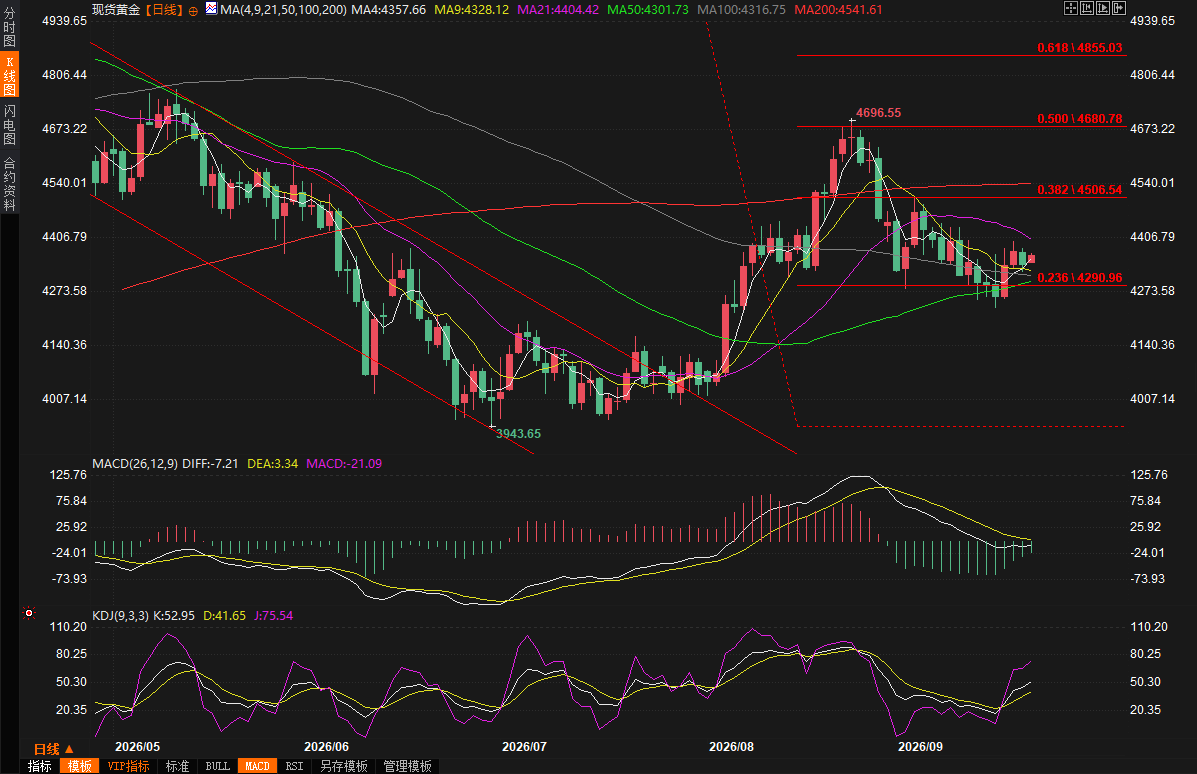 (Spot gold daily chart, source: EasyTrade) At 07:42 Beijing time, spot gold is currently trading at $4366.15 per ounce.
A strong US dollar and interest rate expectations are the biggest factors suppressing gold prices.
The long-standing negative correlation between gold and the US dollar has once again been fully reflected in this round of market movements. The dollar index, which measures the dollar against a basket of major currencies, rose 0.2% on Monday, extending its gains of over 1% following last week's Fed rate hike and reaching its highest level in more than two months. A stronger dollar directly increases the cost of gold for holders of other currencies, thus suppressing demand. Jim Wickoff, a market analyst at the US Gold Exchange, pointed out that bulls remain concerned about further tightening of US monetary policy, and these negative factors continue to put pressure on the precious metals market. The CME Group's FedWatch tool shows that traders currently expect an 88% probability of a Fed rate hike in December, and the probability of a rate hike of at least 25 basis points at the October meeting has also risen to around 55%. More importantly, statements from several Fed officials have further reinforced hawkish expectations. Chicago Fed President Goolsby said on Monday that the drivers of US inflation may no longer be limited to the tariffs and energy price shocks of the past 18 months; strong demand may now also be pushing up inflation, which may require the Fed to accelerate the pace of rate hikes. He specifically mentioned that the booming growth in artificial intelligence investment could push up prices on a larger scale, and persistently high inflation in the service sector means that cost pressures are not solely due to the oil price shock. Goolsby bluntly stated that if the main driver of inflation is overheated demand, interest rate measures need to be more aggressive and require more proactive measures. St. Louis Fed President Musaleem similarly stated that the Fed may need to raise interest rates further to reduce inflation caused by strong demand and the price shock that has spread from oil to other commodities, emphasizing that it is best to act as soon as possible. Behind these remarks is the Fed's reassessment of the persistence of inflation. The personal consumption expenditure price index rose 3.7% year-on-year in July, showing little recent improvement and still significantly short of the 2% target. Goolsby even described the path back to the target as a "difficult path"—raising interest rates and bearing the risks to growth and employment from an economic slowdown. In a high-interest-rate environment, the relative attractiveness of gold as a non-interest-bearing asset naturally decreases, and funds tend to flow to interest-bearing dollar assets, which becomes the fundamental logic suppressing gold prices.A complex interplay of geopolitical conflicts, energy volatility, and inflation expectations.
The ongoing conflict with Iran has pushed up energy prices, exacerbating inflation concerns and reinforcing the restrictive policy stances of central banks, causing gold prices to fall by about 17% from their intraday high on February 27. However, oil prices saw a significant pullback on Monday, with Brent crude falling to a 12-day low, closing at $100.34 per barrel, and U.S. crude plunging more than 4%. The market hopes that this week's UN General Assembly will push for diplomatic progress in the Iran-Iraq conflict. Trump's willingness to meet with Iranian President Pezechzian, and reports that Iran has conveyed its conditions for restarting negotiations to mediators, have eased some concerns about energy supply disruptions. Meanwhile, the activities of the Houthi rebels in Yemen continue to destabilize the Middle East. The Houthis have expanded their offensive, attempting to sever connections between the Red Sea coast and areas controlled by Saudi-backed forces, and have even reportedly attacked facilities in Riyadh and Saudi Aramco. Trump reportedly called off airstrikes against the Houthis at the last minute, highlighting the U.S. dilemma between escalating the conflict and aiding its allies. Saudi Arabia increased its oil exports via the Strait of Hormuz to hedge against risks on other shipping routes. The pullback in oil prices slightly eased inflation concerns and pressure for further Federal Reserve rate hikes in the short term, which was the direct trigger for the rebound in gold prices in early Asian trading on Tuesday. The US Treasury market also reflected a repricing of policy paths. The two-year Treasury yield rose to a more than two-year high, and the yield curve continued to flatten with the 10-year yield, indicating that investors are pricing in expectations of further Fed rate hikes. While the 10-year Treasury yield fell somewhat due to lower oil prices, it remains high. Long-term inflation expectations are still supported by the break-even yield on Treasury Inflation-Protected Securities (TIPS) at around 2.3%, indicating that inflationary pressures have not completely subsided.Short-term pressure is unlikely to change the long-term investment value.
TD Securities analysts believe that any short-term weakness in the precious metals market will be limited, influenced only by mild selling from commodity trading advisors, and will increasingly be seen as a good opportunity to buy gold. This view reveals the core contradiction in the current market: short-term interest rates and the dollar's logic are suppressing gold prices, but medium- to long-term inflation risks, geopolitical uncertainties, and central bank gold purchases still provide underlying support for gold. After falling 17% from its high, gold prices have entered a relatively oversold range technically, and the marginal benefits from falling oil prices may attract bargain hunters. However, if Federal Reserve officials continue to release hawkish signals, and expectations of rate hikes in October and December further strengthen, the strong dollar will be difficult to reverse quickly, limiting the height and sustainability of the gold price rebound. Conversely, if there is a substantial breakthrough in geopolitical diplomacy, energy prices fall further, inflation expectations cool, and the pace of Fed rate hikes slows, gold may regain upward momentum. In summary, the current gold market is caught in a dual game of policy tightening and geopolitical risks. The dollar and interest rates are the dominant short-term factors, while the persistence of inflation and the situation in the Middle East constitute medium- to long-term variables. While investors are paying close attention to subsequent statements from Federal Reserve officials and key economic data, they also need to closely monitor the correlation between oil prices and diplomatic developments. Every dip in gold prices may be accumulating opportunities for the next round of allocation, but bulls should remain cautious and patiently wait for clearer signals before the high-interest-rate cycle truly reverses. Several Federal Reserve officials will speak today, and investors should pay close attention. (Spot gold daily chart, source: EasyTrade) At 07:42 Beijing time, spot gold is currently trading at $4366.15 per ounce.
- Risk Warning and Disclaimer
- The market involves risk, and trading may not be suitable for all investors. This article is for reference only and does not constitute personal investment advice, nor does it take into account certain users’ specific investment objectives, financial situation, or other needs. Any investment decisions made based on this information are at your own risk.