Crude oil trading alert: Unexpected increase in API inventories coupled with easing geopolitical tensions led to a continued decline in US crude oil prices.
2026-09-23 09:28:14
International oil prices continued their decline in early Asian trading on Wednesday, with WTI crude trading around $90, as the market reassessed the balance between Middle East supply risks and diplomatic developments. Recent price action indicates that the geopolitical premium previously accumulated in crude oil is being rapidly reversed, with WTI having fallen significantly from its mid-September high of over $100 . As of September 23, the main driver of WTI's continued weakness has gradually shifted from "supply disruption risks" to "expectations of potential supply recovery."  The core variable in this adjustment is the negotiation signals released between the US and Iran. US President Trump stated that the US and Iranian representatives held approximately three hours of talks during the UN General Assembly, noting that the meeting progressed well. Previously, the US had also signaled a possible pursuit of a negotiated solution, causing the market to re-priced in the possibility of regional easing and a restoration of energy supplies. For the crude oil market, if these diplomatic contacts continue, the risk premium previously priced in for transportation disruptions, supply interruptions, and infrastructure attacks may further decrease. Meanwhile, another change on the supply side is also putting pressure on bullish sentiment. Data from the American Petroleum Institute shows that US crude oil inventories increased by 1.786 million barrels in the week ending September 18, significantly deviating from the market's initial expectation of a 500,000-barrel decrease, although the increase was lower than the previous week's 7.14 million barrels. The continuous increase in inventories suggests that the short-term supply and demand balance in the US crude oil market is not as tight as some market participants had anticipated, putting additional pressure on oil prices. However, inventory data is not enough to completely change the potential risks facing global crude oil supply. Although US commercial crude oil inventories have increased continuously, they have still been affected by factors such as the release of strategic petroleum reserves and regional supply disruptions this year. Meanwhile, previous declines in US gasoline and distillate fuel inventories indicate a continued tightness in the refined product market. Therefore, the market is currently more focused on whether the increase in crude oil inventories can be sustained and whether refinery demand will continue to absorb supply in the coming weeks. The situation in the Middle East remains a significant risk variable for oil prices. Saudi Arabia previously reported that the Houthi rebels launched ballistic missiles towards Riyadh and claimed to have attacked energy facilities in Yanbu and other locations; Saudi Arabia stated that the attacks were intercepted and there is currently no evidence of a new large-scale disruption to oil production. As Yanbu is a crucial Red Sea export hub for Saudi Arabia, the market remains closely watching whether related facilities can maintain stable operation. The resumption of the Saudi East-West oil pipeline has also become a significant variable for recent oil prices. This pipeline, connecting Saudi Arabia's eastern oil fields with the Red Sea port of Yanbu, has a transport capacity of approximately 7 million barrels per day, and its resumption could reduce Saudi Arabia's dependence on the Strait of Hormuz to some extent. Saudi Arabia is pushing forward with the resumption of related facilities and plans to gradually restore exports towards Yanbu. If the pipeline and Yanbu port exports continue to recover, the global crude oil supply risk premium may further contract . Therefore, current oil prices are actually caught in a tug-of-war between two opposing forces. On the one hand, expectations of US-Iran talks, the restoration of Saudi oil pipelines, and improved shipping conditions in the Strait of Hormuz are all driving the market to lower its pricing of extreme supply disruptions. On the other hand, Saudi energy infrastructure remains at risk of attack, and shipping security in the Strait of Hormuz and the Red Sea has not fully returned to normal. Oil prices are therefore prone to significant short-term fluctuations rather than forming a one-sided trend. From a market sentiment perspective, long positions previously built on expectations of supply disruptions are facing repricing. The rapid decline of WTI from above $100 to around $90 indicates that the market has significantly reduced some geopolitical risk premiums. At the same time, if subsequent diplomatic processes falter, or if Saudi energy infrastructure is again substantially affected, profit-taking by short sellers could quickly amplify any rebound in oil prices. The core issue for oil prices recently has shifted from "whether supply has been impacted" to "whether the speed of supply recovery can outpace the speed of risk deterioration." Going forward, key attention should be paid to the US Energy Information Administration's inventory data, the progress of the Saudi East-West pipeline restoration, crude oil exports from Yanbu port, and whether US-Iran talks can continue. If US crude oil inventories continue to rise, and Middle Eastern supply recovers faster than market expectations, WTI may continue to test lower support levels. Conversely, if inventory data weakens, Saudi energy facilities are attacked again, or diplomatic progress stalls significantly, the oil market may quickly re-induce geopolitical risk premiums. From a daily chart perspective, WTI previously broke through $100 and quickly retreated, currently retesting the short-term support area around $90. The current price remains above the 100-day simple moving average of approximately $85, so the medium-term trend has not yet fully turned bearish. Regarding the Bollinger Bands, the middle band is around $92.10, forming the resistance area that the current rebound needs to break through first; the upper band is around $102.40, corresponding to higher resistance from the previous strong upward trend. Meanwhile, the RSI is currently around 47.42, having clearly retreated from its high and entered the neutral zone, indicating that upward momentum is weakening, but it has not yet entered a clearly oversold state. In the short term, the area around $90 is an important price pivot point. If WTI can hold this area and reclaim $92.10, the market may retest the $95 or even $100 level. If the $90 support is breached, the next target will be the 100-day moving average around $85, with further downside focus on the lower Bollinger Band around $81.75. Overall, the daily chart structure still retains some medium-term bullish foundation, but short-term momentum has clearly weakened. On the 4-hour chart, WTI has recently formed a continuous downward structure, with short-term moving averages and momentum indicators both under pressure, reflecting that bears are temporarily in control. If the price finds support around $90 and rebounds from the lows, while simultaneously recovering the $92 level, the short-term correction may evolve into a technical recovery. If it falls below $89 and fails to recover after a rebound, the downtrend may further target the $85 area. Currently, technical and fundamental factors are somewhat in sync, with diplomatic developments and increased inventories jointly suppressing oil prices. However, Saudi supply risks could still be a variable triggering a rapid rebound, therefore, short-term caution is needed regarding sharp fluctuations near key support levels.
 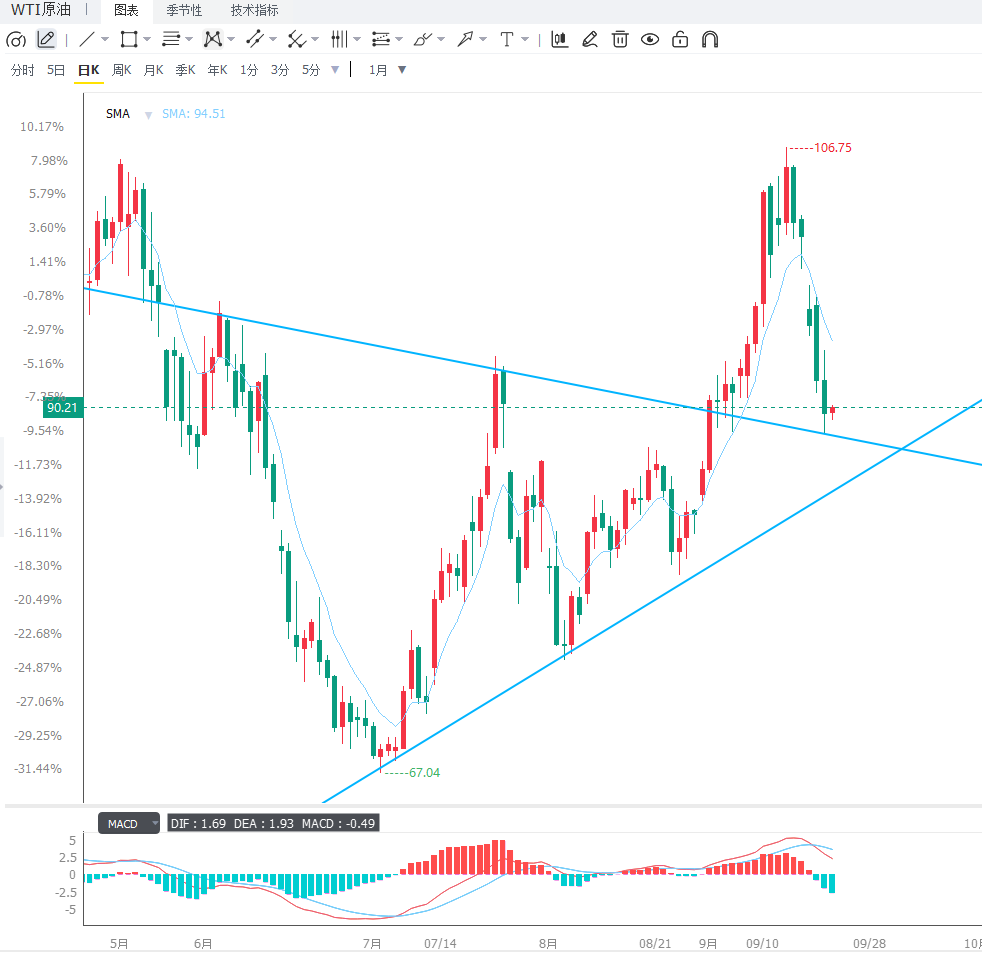 The editor summarizes that WTI crude oil has retreated from above $100 to around $89, reflecting a rapid weakening of the previously accumulated geopolitical supply premium. The easing signals from US-Iran talks, the gradual restoration of Saudi oil pipelines, and an unexpected increase in US crude oil inventories have all put pressure on oil prices. However, uncertainties remain regarding the security of Saudi energy facilities, Red Sea shipping, and transportation through the Strait of Hormuz, meaning oil prices have not yet fully escaped supply risks. In the coming trading days, $92 and $90 will be crucial levels for judging the short-term strength or weakness of WTI . If supply recovery and diplomatic progress continue to improve, the possibility of oil prices seeking support near $85 will increase; if Middle East supply risks escalate again, the previous risk premium may quickly return. For the market, the real focus now is not on a single event, but on the changing dynamics between the speed of supply recovery and the speed of renewed geopolitical risk deterioration.
The core variable in this adjustment is the negotiation signals released between the US and Iran. US President Trump stated that the US and Iranian representatives held approximately three hours of talks during the UN General Assembly, noting that the meeting progressed well. Previously, the US had also signaled a possible pursuit of a negotiated solution, causing the market to re-priced in the possibility of regional easing and a restoration of energy supplies. For the crude oil market, if these diplomatic contacts continue, the risk premium previously priced in for transportation disruptions, supply interruptions, and infrastructure attacks may further decrease. Meanwhile, another change on the supply side is also putting pressure on bullish sentiment. Data from the American Petroleum Institute shows that US crude oil inventories increased by 1.786 million barrels in the week ending September 18, significantly deviating from the market's initial expectation of a 500,000-barrel decrease, although the increase was lower than the previous week's 7.14 million barrels. The continuous increase in inventories suggests that the short-term supply and demand balance in the US crude oil market is not as tight as some market participants had anticipated, putting additional pressure on oil prices. However, inventory data is not enough to completely change the potential risks facing global crude oil supply. Although US commercial crude oil inventories have increased continuously, they have still been affected by factors such as the release of strategic petroleum reserves and regional supply disruptions this year. Meanwhile, previous declines in US gasoline and distillate fuel inventories indicate a continued tightness in the refined product market. Therefore, the market is currently more focused on whether the increase in crude oil inventories can be sustained and whether refinery demand will continue to absorb supply in the coming weeks. The situation in the Middle East remains a significant risk variable for oil prices. Saudi Arabia previously reported that the Houthi rebels launched ballistic missiles towards Riyadh and claimed to have attacked energy facilities in Yanbu and other locations; Saudi Arabia stated that the attacks were intercepted and there is currently no evidence of a new large-scale disruption to oil production. As Yanbu is a crucial Red Sea export hub for Saudi Arabia, the market remains closely watching whether related facilities can maintain stable operation. The resumption of the Saudi East-West oil pipeline has also become a significant variable for recent oil prices. This pipeline, connecting Saudi Arabia's eastern oil fields with the Red Sea port of Yanbu, has a transport capacity of approximately 7 million barrels per day, and its resumption could reduce Saudi Arabia's dependence on the Strait of Hormuz to some extent. Saudi Arabia is pushing forward with the resumption of related facilities and plans to gradually restore exports towards Yanbu. If the pipeline and Yanbu port exports continue to recover, the global crude oil supply risk premium may further contract . Therefore, current oil prices are actually caught in a tug-of-war between two opposing forces. On the one hand, expectations of US-Iran talks, the restoration of Saudi oil pipelines, and improved shipping conditions in the Strait of Hormuz are all driving the market to lower its pricing of extreme supply disruptions. On the other hand, Saudi energy infrastructure remains at risk of attack, and shipping security in the Strait of Hormuz and the Red Sea has not fully returned to normal. Oil prices are therefore prone to significant short-term fluctuations rather than forming a one-sided trend. From a market sentiment perspective, long positions previously built on expectations of supply disruptions are facing repricing. The rapid decline of WTI from above $100 to around $90 indicates that the market has significantly reduced some geopolitical risk premiums. At the same time, if subsequent diplomatic processes falter, or if Saudi energy infrastructure is again substantially affected, profit-taking by short sellers could quickly amplify any rebound in oil prices. The core issue for oil prices recently has shifted from "whether supply has been impacted" to "whether the speed of supply recovery can outpace the speed of risk deterioration." Going forward, key attention should be paid to the US Energy Information Administration's inventory data, the progress of the Saudi East-West pipeline restoration, crude oil exports from Yanbu port, and whether US-Iran talks can continue. If US crude oil inventories continue to rise, and Middle Eastern supply recovers faster than market expectations, WTI may continue to test lower support levels. Conversely, if inventory data weakens, Saudi energy facilities are attacked again, or diplomatic progress stalls significantly, the oil market may quickly re-induce geopolitical risk premiums. From a daily chart perspective, WTI previously broke through $100 and quickly retreated, currently retesting the short-term support area around $90. The current price remains above the 100-day simple moving average of approximately $85, so the medium-term trend has not yet fully turned bearish. Regarding the Bollinger Bands, the middle band is around $92.10, forming the resistance area that the current rebound needs to break through first; the upper band is around $102.40, corresponding to higher resistance from the previous strong upward trend. Meanwhile, the RSI is currently around 47.42, having clearly retreated from its high and entered the neutral zone, indicating that upward momentum is weakening, but it has not yet entered a clearly oversold state. In the short term, the area around $90 is an important price pivot point. If WTI can hold this area and reclaim $92.10, the market may retest the $95 or even $100 level. If the $90 support is breached, the next target will be the 100-day moving average around $85, with further downside focus on the lower Bollinger Band around $81.75. Overall, the daily chart structure still retains some medium-term bullish foundation, but short-term momentum has clearly weakened. On the 4-hour chart, WTI has recently formed a continuous downward structure, with short-term moving averages and momentum indicators both under pressure, reflecting that bears are temporarily in control. If the price finds support around $90 and rebounds from the lows, while simultaneously recovering the $92 level, the short-term correction may evolve into a technical recovery. If it falls below $89 and fails to recover after a rebound, the downtrend may further target the $85 area. Currently, technical and fundamental factors are somewhat in sync, with diplomatic developments and increased inventories jointly suppressing oil prices. However, Saudi supply risks could still be a variable triggering a rapid rebound, therefore, short-term caution is needed regarding sharp fluctuations near key support levels. The editor summarizes that WTI crude oil has retreated from above $100 to around $89, reflecting a rapid weakening of the previously accumulated geopolitical supply premium. The easing signals from US-Iran talks, the gradual restoration of Saudi oil pipelines, and an unexpected increase in US crude oil inventories have all put pressure on oil prices. However, uncertainties remain regarding the security of Saudi energy facilities, Red Sea shipping, and transportation through the Strait of Hormuz, meaning oil prices have not yet fully escaped supply risks. In the coming trading days, $92 and $90 will be crucial levels for judging the short-term strength or weakness of WTI . If supply recovery and diplomatic progress continue to improve, the possibility of oil prices seeking support near $85 will increase; if Middle East supply risks escalate again, the previous risk premium may quickly return. For the market, the real focus now is not on a single event, but on the changing dynamics between the speed of supply recovery and the speed of renewed geopolitical risk deterioration.
- Risk Warning and Disclaimer
- The market involves risk, and trading may not be suitable for all investors. This article is for reference only and does not constitute personal investment advice, nor does it take into account certain users’ specific investment objectives, financial situation, or other needs. Any investment decisions made based on this information are at your own risk.