Saudi Arabia's East-West oil pipeline resumes operation, Brent crude oil falls below $100, and the global 4% supply gap gradually narrows.
2026-09-23 09:22:14
Positive signs have emerged from Saudi Arabia's key energy infrastructure. Sources familiar with the matter revealed that the east-west oil pipeline has resumed operation, and crude oil exports from Yanbu port on the Red Sea coast are expected to restart in the near future. This development directly alleviated market concerns about disruptions to Middle Eastern oil supplies, leading to a significant correction in international oil prices, with Brent crude falling below the $100 mark. 
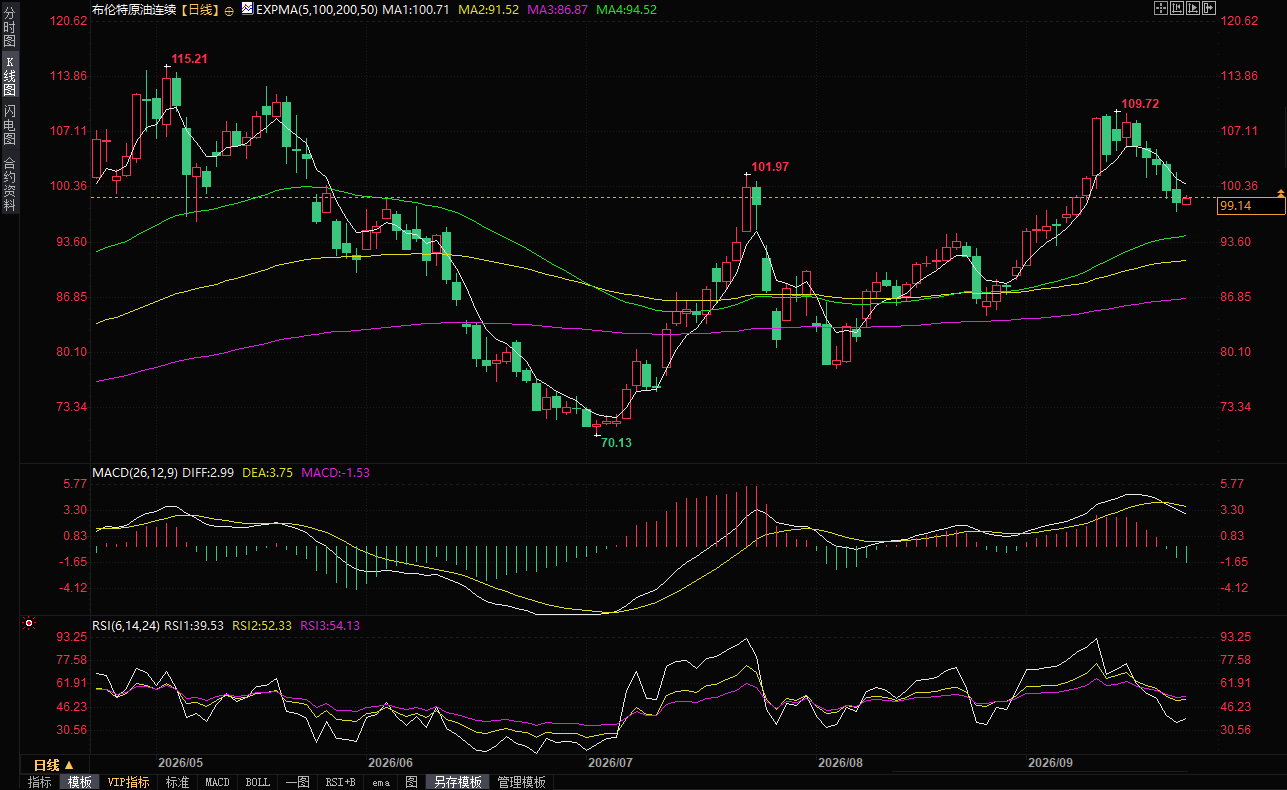 (Brent crude oil daily chart, source: EasyForex)
I. Pipeline restart triggers market sell-off, Brent crude oil falls for five consecutive days.
Saudi Arabia's key energy infrastructure, the East-West Pipeline, has resumed operations. According to three sources familiar with the matter, crude oil exports from Yanbu port on the Red Sea are expected to restart later on September 22, with a tanker scheduled to load crude oil that day and transport it to a major Asian country. This news quickly spread to the global oil market, triggering a new round of selling. Data from the Intercontinental Exchange in London showed that Brent crude oil for November delivery closed at $99.25 per barrel on Tuesday (September 22), down 1.1% from the previous trading day, marking the first time it closed below $100 since September 8. WTI crude oil for October delivery on the New York Mercantile Exchange also fell 1.2%, closing at $94.59 per barrel. Brent crude oil prices fell as low as $97.37 per barrel during the session, the lowest level since September 8. This decline marks the fifth consecutive trading day of losses, reflecting growing market expectations for a resumption of Saudi oil supply. Previously, affected by the shutdown of Saudi pipelines and the escalation of the conflict between the United States and Iran, Brent crude oil broke through $100 per barrel on September 9 and reached a high of $109.72 per barrel on September 14. The cumulative increase this year is still over 60%.II. Recovery is slow; full repair may take 6 to 8 weeks.
Although the pipeline has been restarted, the recovery process is far from quick. Two sources said that the pipeline is currently operating at a low rate, and Saudi Aramco is working to restore throughput to 4 million barrels per day, compared to its designed capacity of 7 million barrels per day. A security source indicated that reaching 40% of the designed capacity would take several days, while full recovery would require 6 to 8 weeks. Another oil industry source gave a similar assessment, suggesting that restoring full capacity could take up to six weeks. Saudi Aramco has not yet responded to these reports. The pipeline damage is far more severe than initially thought. According to satellite imagery and industry sources, the drone attack damaged three pumping stations along the pipeline. The pipeline is approximately 1,200 kilometers long and has 11 pumping stations and two independent pressure relief stations along its route. These pumping stations are the most vulnerable points because the pipeline is exposed above ground at these locations. Industry assessments indicate that repairs to one of the main pumping stations could take 3 to 5 weeks.III. Alternative routes under pressure: Ship-to-ship transshipment costs soar.
During the pipeline shutdown, Saudi Arabia was forced to revert its export routes back to the Strait of Hormuz. Saudi Aramco loads crude oil from the Persian Gulf port of Rastanura, sails through the Strait of Hormuz, and then transfers the cargo at sea to other vessels for delivery. Data from ship tracking agency Kpler shows that Saudi oil transit through the Strait of Hormuz has rebounded to approximately 2.4 million barrels per day in the past two weeks, a level last reached in early July. Multiple trade sources indicate that Saudi Arabia has sold approximately 60 million barrels of crude oil from Rastanura, which will be loaded onto ships via ship-to-ship transfers at Oman's port of Sohar this month and next month, with major Asian powers and South Korean refiners being the main buyers. Saudi Aramco's exports from within the Gulf region have rebounded to an average of 1 million to 1.5 million barrels per day. This alternative route is costly and risky. Michael Hague, head of commodities research at Societe Generale, points out that the cost of transporting crude oil from Rastanura to major Asian powers has risen from approximately $4.5 million per voyage to nearly $63 million. Large tanker freight rates hit a record high this week as more ships are being used to transport oil through the Strait of Hormuz.IV. European refineries face supply disruptions and a shortage of alternative oil products.
The shutdown of the Saudi pipeline has had a particularly significant impact on European refineries. Saudi Aramco has notified at least two European refining customers that it will no longer allocate crude oil under long-term contracts in October, a decision that effectively applies to all European long-term contract buyers. European OECD countries imported approximately 577,000 barrels of Saudi crude oil per day in June, of which about 600,000 to 800,000 barrels came from Saudi Arabia. Analysts point out that the pipeline primarily transports Saudi medium-sulfur crude oil, and finding equivalent alternatives is not easy. Analyst Shah believes the closest alternatives might be crude oil from Oman and UAE oil fields, but these regions also face logistical challenges when shipping to Asia. European refiners are scrambling to find alternative crudes; Polish refiner Orlen has issued more than 10 tenders since last Friday to secure alternative crude oil supplies. European spot crude oil price spreads have reached record highs. The premium of North Sea Johan Sverdrup crude over spot Brent crude is assessed at $33 to $35 per barrel, compared to only 60 cents on September 8th.V. Multiple negative factors combined to put short-term pressure on oil prices.
Besides pipeline restoration, other factors contributed to the decline in oil prices this week. Iran indicated it might reopen the Strait of Hormuz within seven days, provided the US takes concrete action to ease military pressure. Furthermore, increased Saudi shipments at Ras Tanura port further reinforced market expectations of rising exports via the Strait of Hormuz. However, supply risks have not been completely eliminated. Saudi Arabia's Yanbu port has a storage capacity of approximately 35 million barrels, but it is not fully utilized. If pipeline restoration progresses slower than expected, Yanbu port's storage could soon be depleted, severely reducing Saudi Arabia's supply capacity to the global market. The International Energy Agency previously stated that Saudi oil supplies in August had fallen to a 30-year low, and global oil supplies are projected to decrease by 4.3 million barrels per day by 2026, a drop of approximately 4%.Editor's Summary
The resumption of operations on Saudi Arabia's East-West oil pipeline is a crucial step in alleviating the current global energy supply shortage, but the complexity of the repair process means the supply gap will not be quickly closed. The slow restart rate of the pipeline, the weeks-long repair time for pump stations, and high ship-to-ship transshipment costs all contribute to a transitional period of "partial recovery, continued pressure." Brent crude falling below $100 reflects market optimism about the return of supply, but limited inventories at Yanbu port, the risk of supply disruptions to European refineries, and the continued uncertainty in the Strait of Hormuz mean that the downside potential for oil prices may be limited. The next six to eight weeks will be a critical window for observing the pace of Saudi Arabia's supply capacity recovery, the progress of alternative procurement by European refiners, and the direction of the US-Iran trade war. (Brent crude oil daily chart, source: EasyForex)Frequently Asked Questions
Q: Why is the Saudi East-West oil pipeline so important? A: The pipeline, approximately 1200 kilometers long, traverses Saudi Arabia, extending from the Persian Gulf oil-producing region to the port of Yanbu on the Red Sea, with a designed capacity of 7 million barrels per day. Against the backdrop of disrupted transport in the Strait of Hormuz due to the US-Iran conflict, this pipeline has become a core alternative route for Saudi Arabia to bypass the strait and maintain its crude oil exports. Before the shutdown, approximately 4 million barrels per day of crude oil were transported to Yanbu via this pipeline, accounting for about 4% of global oil supply. If the pipeline is not operational for an extended period, Saudi Arabia will be forced to rely on the riskier Strait of Hormuz for transport, and the global crude oil market will face a significant supply gap. Q: What caused the pipeline damage? A: Saudi Arabia claims that the pipeline was attacked multiple times by drones in the Riyadh and Medina areas on September 10, resulting in injuries. Saudi Arabia believes these drones were launched from Iraq and carried out by Iranian-backed Iraqi militias. Satellite images show that one pumping station suffered extensive fire damage, and another pumping station also experienced fire and thick smoke. The pipeline was previously attacked in April, damaging one pumping station and reducing its capacity by approximately 700,000 barrels per day. However, Saudi Arabia restored full capacity within days at that time. This time, the damage is more severe, affecting three pumping stations. Q: Why can't the pipeline quickly return to full capacity? A: The East-West pipeline system consists of two parallel pipelines, each using its own independent pumping facilities. This means that even if one pipeline is still under repair, the other may be operational after safety checks are completed. However, repairing damaged pumping stations is more complex. Industry assessments indicate that repairing a major pumping station could take 3 to 5 weeks. Security sources say that reaching 40% of design capacity would take several days, and full recovery would take 6 to 8 weeks. Saudi Aramco's current goal is to first increase throughput to 4 million barrels per day, but when this goal will be achieved remains uncertain. Q: What impact has the pipeline shutdown had on international oil prices? A: News of the pipeline shutdown initially pushed Brent crude oil prices above $109 per barrel, a cumulative increase of over 60% this year. However, with the news of the pipeline restart, Brent crude oil prices quickly fell, closing at $99.25 per barrel on September 22, marking five consecutive trading days of decline. Analysts pointed out that the extent of the price decline depends on how much transport volume Saudi Arabia can restore. If the recovery is slow or the Yanbu port's inventory is depleted, oil prices may regain upward support. Furthermore, Saudi Arabia has limited alternative sources for medium-sulfur crude oil, and European and Asian refineries face the dual challenges of matching cost and quality when searching for alternative oil types. Q: What alternative export measures did Saudi Arabia take during the pipeline shutdown? A: Saudi Arabia changed its export route back to the transport channel via the Strait of Hormuz. Saudi Aramco loads crude oil at Rastanura port, and after passing through the strait, it conducts ship-to-ship transshipment at sea. Saudi Arabia has sold approximately 60 million barrels of crude oil from Rastanura port, planning to complete the transshipment at Sohar port in Oman, with major Asian countries and South Korean refiners as the main buyers. However, this alternative is extremely costly. Transportation costs from Rastanura to the major Asian country have risen from approximately $4.5 million per voyage to nearly $63 million, and freight rates for large oil tankers have also reached record highs. At 09:19 Beijing time, Brent crude oil was trading at $99.15 per barrel.- Risk Warning and Disclaimer
- The market involves risk, and trading may not be suitable for all investors. This article is for reference only and does not constitute personal investment advice, nor does it take into account certain users’ specific investment objectives, financial situation, or other needs. Any investment decisions made based on this information are at your own risk.