As US-Iran peace talks continue, the first glimmer of hope for open air routes through the Hormuz region emerges.
2026-09-23 16:14:11
On Wednesday (September 23), during the Asian and European sessions, international oil prices continued their weak consolidation, showing no significant rebound despite the recent sharp decline. Currently, the WTI crude oil futures contract is trading around 89.70. The US-Iran war has entered a critical phase involving military pressure, financial sanctions, and diplomatic negotiations. During the UN General Assembly, the two sides held a three-hour indirect meeting in New York with the help of mediators from Qatar and Pakistan. On the surface, Iran has put forward three negotiating conditions: lifting the maritime blockade, unfreezing frozen assets, and ceasing operations against the resistance front. However, from an energy fundamentals perspective, lifting the maritime blockade on oil is Iran's most pressing demand; the other two are essentially financial issues, and the foundation of Iran's finances lies in its oil export revenue. Currently, Iran's oil inventories are nearing their storage limits. If the continued blockade forces oil fields to shut down, some older oil fields may suffer permanent production losses. Iran urgently needs a temporary ceasefire to clear its accumulated oil inventories. This fundamental constraint is profoundly changing the bargaining chips in US-Iran negotiations and the logic of international oil pricing. 
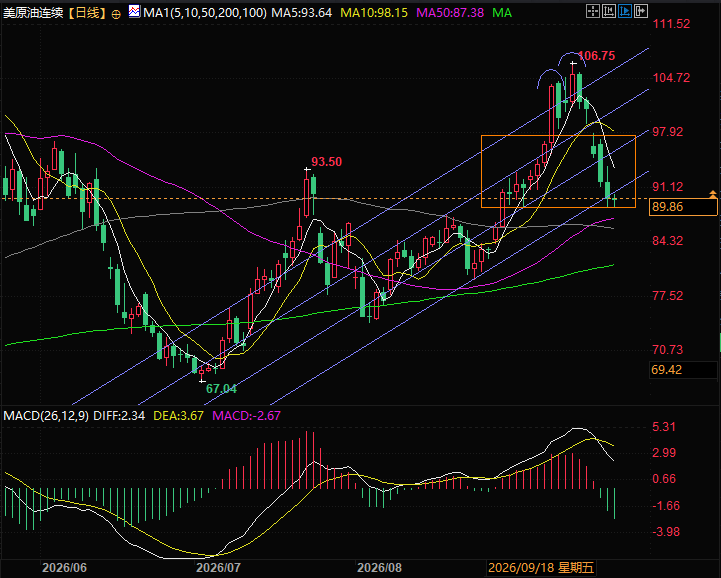 (WTI crude oil futures main contract daily chart, source: EasyTrade) At 16:11 Beijing time, WTI crude oil futures main contract was trading at $90.11 per barrel.
A Complete Overview of the UN General Assembly Negotiations: Two-Pronged Diplomacy Under a Tough Rhetoric
Trump's speech at the UN General Assembly was highly threatening, publicly presenting a binary choice: either reach an agreement allowing Iran to rebuild, or swiftly "destroy the Iranian regime." Just hours after the speech, US special envoys Witkov and Kushner held a three-hour meeting with the Iranian delegation at a side event of the General Assembly. Subtle differences emerged in their accounts: Trump described it as a direct meeting between officials, while Witkov stated that the negotiations relied on mediators to relay information, making it an indirect negotiation. Iran confirmed that Foreign Minister Araghchi and Witkov met, emphasizing that the talks were initiated by the US, with the core objective being to discuss a plan for reopening the Strait of Hormuz. The Iranian delegation possessed full negotiating authority and had already submitted its latest negotiating proposal through mediators as early as September 16th. Iran sent a clear signal: if the US reduces military pressure and lifts its maritime blockade, Iran could reopen the Strait of Hormuz within seven days. Meanwhile, the US Treasury Department implemented secondary sanctions targeting Iran's civil aviation system starting September 23, continuing to maintain economic pressure. Trump also met with regional countries including the Gulf Cooperation Council, Jordan, and Turkey to coordinate regional security positions. A Qatari proposal for a common security framework involving Iran and Gulf states is currently under evaluation in Iran. The Iranian military responded to Trump's war threats, stating that the US's tough stance exposed strategic weakness and that Iran would launch a heavier and more unpredictable retaliation should it face a new round of attacks. This also confirms the previous power structure: the civilian diplomatic team is responsible for on-the-ground negotiations, while the Revolutionary Guard holds actual control over shipping, missiles, and proxy forces in the Strait of Hormuz. Any agreement requires the approval of the Supreme Leader and the Revolutionary Guard to be finalized.Deconstructing Iran's Negotiation Demands: Oil Blockade is the Core Controversy
Iran has announced three bottom lines for negotiations: lifting the US naval blockade, releasing frozen assets, and ceasing hostilities against the resistance front. The market easily views these three conditions as parallel, but from an energy and fiscal perspective, their priorities differ significantly. Unfreezing overseas assets and ceasing hostilities both fall under the realm of financial and regional proxy warfare. Even if assets are unfrozen, if crude oil cannot be exported, Iran will not be able to sustain stable foreign exchange earnings; the resistance front's expenditures have long been highly dependent on cash flow from oil exports. In other words, the latter two demands are the "outcomes," while lifting the naval blockade and restoring oil export channels are the true source of Iran's fiscal support. Currently, Iran's crude oil inventories are nearing their storage limits. The first US naval blockade of Iranian oil exports lasted 66 days from April to June, while this current blockade, initiated on July 14th, has already lasted 71 days, with onshore storage tanks and the floating storage tanker off Kharg Island continuously depleting space. Oil extraction differs from ordinary industrial operations. Once storage tanks are full and oil fields are forced to shut down, Iran's many older oil fields have weak geological conditions. Prolonged shutdowns can lead to problems such as paraffin deposition, formation pressure imbalances, and groundwater intrusion, resulting in permanent production losses. Once this damage occurs, even after the conflict ends, some wells may not be able to recover to pre-war levels, representing an irreversible long-term supply loss. This creates Iran's most pressing pressure: it needs to replicate the previous phased ceasefire model to gain a window of opportunity to move crude oil stored in domestic and offshore facilities, freeing up storage space and avoiding large-scale shutdowns to prevent permanent damage to oil fields. This is Iran's underlying energy motivation for being willing to sit down and negotiate, surpassing political demands such as asset unfreezing and the establishment of a resistance front.The pricing logic of oil prices: a "temporary easing" of trade tensions, rather than a complete peace.
The market has already priced in the diplomatic signals from the UN General Assembly, and international crude oil prices have recently retreated sharply, driven by news of the US-Iran talks. If the two sides reach a phased interim agreement, mediated and guaranteed by third parties such as Qatar and Oman: the US will first ease its maritime blockade, allowing Iran to export crude oil in stages; Iran will, as promised, gradually restore navigation in the Strait of Hormuz, retaining the right to monitor vessels violating regulations. The agreement will not be a complete end to the war, but a reversible phased arrangement. Once implemented, the market will quickly trade on the expectation of restored navigation in the Strait, further compressing the risk premium in oil prices. However, the US will maintain some sanctions and retain the option of military strikes, and will not accept all three demands from Iran at once, to avoid being perceived domestically as "compromising with Iran."Key indicators to watch next
Whether the mediating countries (Qatar and Oman) can introduce a feasible implementation guarantee plan is key to the success of the phased agreement; whether Iran's Supreme Leader and senior Revolutionary Guard leaders have publicly expressed their support for the negotiation results (a statement from the Foreign Minister alone is insufficient to confirm the agreement's implementation); whether there will be a phased resumption of crude oil exports, rather than just verbal promises to reopen the Strait; and whether there are signs of a de-escalation in the fighting between Saudi Arabia and the Houthis.Summary and technical analysis:
Iran's core demand is to lift the blockade on oil, expedite the export of its stockpiled crude oil, and avoid permanent damage to oil field production capacity. The issues of assets and the resistance front are more like bargaining chips on the negotiating table. Current oil price movements reflect market expectations of a possible agreement. If the positive news materializes, oil prices may briefly bottom out and rebound. Whether they will continue to fall depends on potential tail risks, such as Iran's insistence on a strait toll or continued pressure from the US due to the Iranian nuclear issue. Previously, after the strait was opened, WTI oil prices briefly fell to around $70. Technically, oil prices broke slightly below the upward channel of this accelerated rise today, currently reaching a small double-top measured gain. The downside potential in the short term is limited, and a rebound is possible. However, due to the broken upward structure, further declines are possible after the rebound. (WTI crude oil futures main contract daily chart, source: EasyTrade) At 16:11 Beijing time, WTI crude oil futures main contract was trading at $90.11 per barrel.
- Risk Warning and Disclaimer
- The market involves risk, and trading may not be suitable for all investors. This article is for reference only and does not constitute personal investment advice, nor does it take into account certain users’ specific investment objectives, financial situation, or other needs. Any investment decisions made based on this information are at your own risk.