Gold Trading Alert: The Fed's hawkish rhetoric sends the dollar breaking through 101, causing gold prices to plummet by nearly $80! The 55-day moving average is in danger.
2026-09-24 07:04:11
The gold market experienced a veritable storm on Wednesday (September 24). Spot gold prices fell more than 1.7%, closing at $4,286.85 per ounce, after hitting a low of $4,274.76 during the session, the lowest level since September 17. US gold futures for December delivery also succumbed to the downturn, closing down 1.3% at $4,318.40. This was the result of multiple negative factors, the core driver being the increasingly hawkish monetary policy signals from the Federal Reserve. In early Asian trading on Thursday (September 24), spot gold traded in a narrow range, currently at $4,289.53 per ounce. Peter Grant, Vice President and Senior Metals Strategist at Zaner Metals, noted, "A stronger dollar has put pressure on gold. The Fed's statements after the FOMC meeting were quite hawkish, and the market expects at least one more rate hike before the end of the year." 
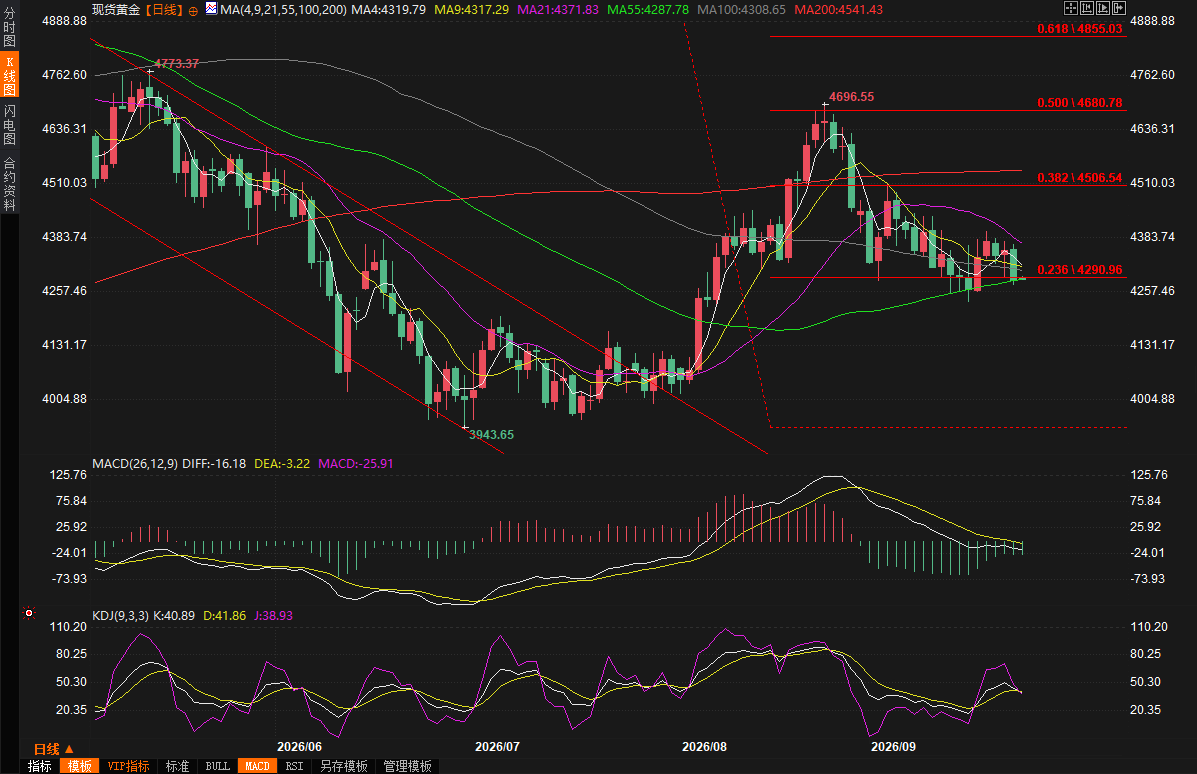 (Spot gold daily chart, source: EasyTrade) At 07:00 Beijing time, spot gold is currently trading at $4289.94 per ounce.
The hawkish sentiment surrounding the Federal Reserve is growing stronger, and expectations for interest rate hikes are rapidly rising.
Last week, the Federal Reserve raised interest rates for the first time since 2023, increasing the target range to 3.75%-4.00%. However, what truly chilled the market was the flurry of hawkish signals from Fed officials following the rate hike. Chicago Fed President Goolsby explicitly stated that the Fed may need to view the current energy shock as a persistent source of inflation, rather than expecting it to subside on its own. Richmond Fed President Barkin and Boston Fed President Collins also expressed support for further rate hikes given continued concerns about inflation. Fed Governor Barr went even further, stating that last week's rate hike was an important step in "recalibrating" short-term borrowing costs, and that further policy tightening may be necessary in the future. The market reaction was swift and dramatic. According to the CME Group's FedWatch tool, after the data release, the market's expectation of a Fed rate hike of at least 25 basis points in October surged to approximately 70%, a significant increase from 53% before the release. Traders' expectations for a December rate hike were even higher, reaching 95%. The sharp rise in expectations of interest rate hikes has directly diminished the appeal of gold as a non-interest-bearing asset—the opportunity cost of holding gold becomes increasingly high when investors can obtain higher returns from interest-bearing assets.The US dollar index broke through the 101 mark, and gold suffered a "double blow".
A stronger dollar was another straw that broke the camel's back for gold prices. On Wednesday, the dollar index rose 0.58%, hitting a high of 101.23, its highest level since July 29. S&P Global's preliminary US September composite PMI output index rose to 58.4 from 56.0 in August, the highest since July 2021, driven by a surge in new orders. Strong economic data further supported the dollar. Elias Haddad, global head of market strategy at Brown Brothers Harriman, aptly summarized: "The current theme is interest rates. The dollar's rise is driven by the aftermath of last week's hawkish rate hike by the Federal Reserve, which has given the dollar some renewed upward momentum." A stronger dollar has put double pressure on gold. On the one hand, dollar-denominated gold has become more expensive for investors holding other currencies, directly suppressing overseas demand; on the other hand, the increased yields on dollar-denominated assets have attracted funds out of the gold market and into alternative assets such as US Treasuries. The yield on the 10-year U.S. Treasury note rose 14.1 basis points on Wednesday to 5.108%, having touched 5.135% earlier in the session, its highest level since July 2007. The spread between the two-year and 10-year Treasury yields narrowed to 16.9 basis points, the flattest since February 2025. This flattening of the yield curve reflects deep market concerns about inflationary pressures and continued monetary policy tightening.The Middle East powder keg has been reignited, causing oil prices to soar.
Geopolitical factors played a rather "abnormal" role in this gold price decline. US President Trump warned at the UN General Assembly on Tuesday that he might "completely destroy" Iran. Iranian President Peskhchian immediately responded from the same podium, stating that Tehran would never succumb to US pressure. This tit-for-tat exchange quickly cooled market optimism regarding peace negotiations. Brent crude futures closed up 3.86% on Wednesday at $103.08 a barrel. On the surface, the tense situation in the Middle East should boost safe-haven demand for gold, but the current market logic has changed. Since the US-Israel war against Iran in late February, gold and oil prices have moved almost inversely—rising energy prices have fueled concerns about inflation and central bank tightening, with rising interest rate expectations, in turn, dragging down gold prices.The short-term downward pressure is unlikely to change, but the foundation for a medium- to long-term bull market remains unshaken.
In the short term, gold faces considerable pressure. The hawkish stance of Federal Reserve officials is unlikely to reverse in the short term, interest rate hike expectations continue to strengthen, and the strong dollar shows no signs of weakening. Ole Hansen, head of commodity strategy at Saxo Bank, points out that the comments from Fed officials and their impact on interest rates, bond yields, and the dollar are providing key direction for short-term traders. Technically, the 55-day moving average (currently absent at 4287) has become a key battleground between bulls and bears. The 100-day moving average is around $4312; failure to quickly recover this level increases the likelihood of a break below the 55-day moving average. Analysts warn that gold may test the 55-day moving average support multiple times, and a break below could lead to a drop to around $4200. However, if funds continue to flow back in, a rebound could gradually be confirmed. However, the situation is quite different when viewed in the long term. Several top international institutions maintain a long-term bullish outlook for gold. Goldman Sachs maintained its year-end 2027 gold price target at $5,400 per ounce, representing an upside of approximately 23% from current prices. UBS predicts gold will reach $4,600 by December 2026 and $5,400 by September 2027. The underlying logic supporting these optimistic forecasts remains unchanged despite short-term interest rate fluctuations. Rising global fiscal deficits, a weakening dollar, and strong strategic gold purchases by central banks provide solid support for gold prices. CITIC Securities, in its latest research report, points out that short-term gold price fluctuations are mainly influenced by liquidity and private sector positioning, but the medium- to long-term trend depends more on US fiscal credit, changes in the global monetary system, and central bank reserve diversification. The slope for a second round of upward trend in gold prices depends on confirmation of substantial easing by the Federal Reserve.In the midst of a storm, where does gold's "safe haven" status go?
The current gold market is caught in a fierce battle between short-term interest rate pressures and long-term credit concerns. Rising expectations of interest rate hikes, a strong dollar, and the transmission effect of oil prices collectively constitute a powerful short-term downward pressure. However, at the same time, the continued expansion of US debt, the ongoing global de-dollarization trend, and the firm steps of central bank gold purchases have solidified the medium- to long-term value foundation for gold. For investors, in the short term, it is crucial to closely monitor the direction of subsequent economic data from the Federal Reserve, especially whether inflation will substantially decline and whether the long-term yield on US Treasury bonds can fall from its high of around 5%. The view of Alex Kupsikovich, Chief Market Analyst at FxPro, is worth considering: against the backdrop of the Fed's interest rate hikes driving down gold prices, this may actually create an excellent opportunity to allocate gold. Short-term interest rate logic dominates gold price fluctuations, but medium- to long-term factors such as geopolitical games and massive debt continue to provide underlying support for gold. Today's focus is on news related to the US-China leaders' summit, speeches by Fed officials, and changes in US initial jobless claims. (Spot gold daily chart, source: EasyTrade) At 07:00 Beijing time, spot gold is currently trading at $4289.94 per ounce.
- Risk Warning and Disclaimer
- The market involves risk, and trading may not be suitable for all investors. This article is for reference only and does not constitute personal investment advice, nor does it take into account certain users’ specific investment objectives, financial situation, or other needs. Any investment decisions made based on this information are at your own risk.