With the USD/JPY pair rising above 158.00, will Japan intervene again before reaching the 160 mark?
2026-09-24 08:36:13
On Thursday (September 24) during Asian trading hours, the USD/JPY pair traded above 158.00, poised to close above the 200-day moving average (around 158.43) for the first time since September 4. Japan's Ministry of Finance purchased 15.4 trillion yen between July 30 and August 26, exceeding the 11.7 trillion yen spent in April and May, with the US Treasury joining in on July 31. This largest monthly intervention by Japan kept the USD/JPY pair below 160.00 for four weeks. However, the yen has given back most of its gains as discussions about a Fed rate hike intensify. 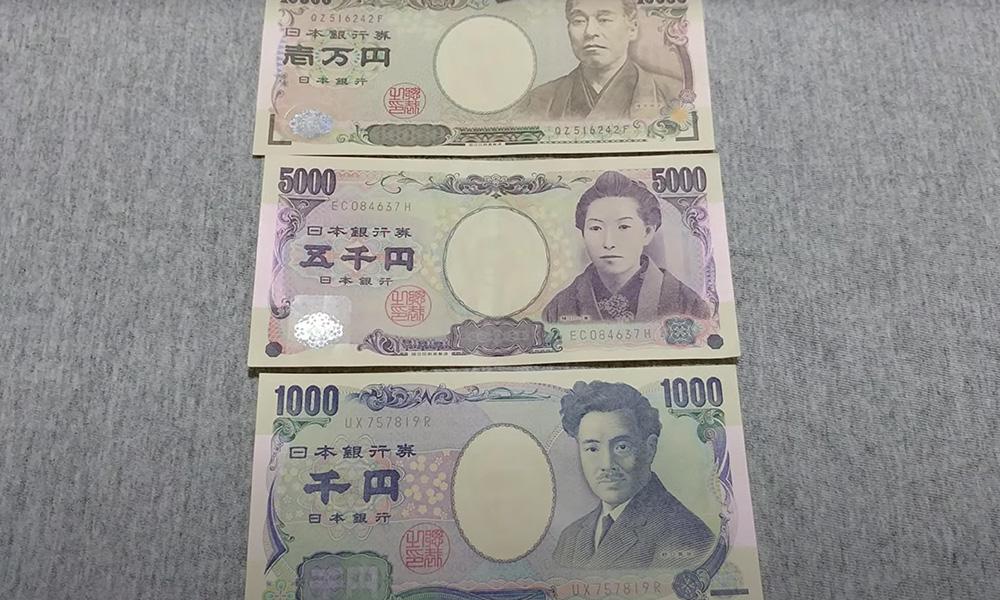
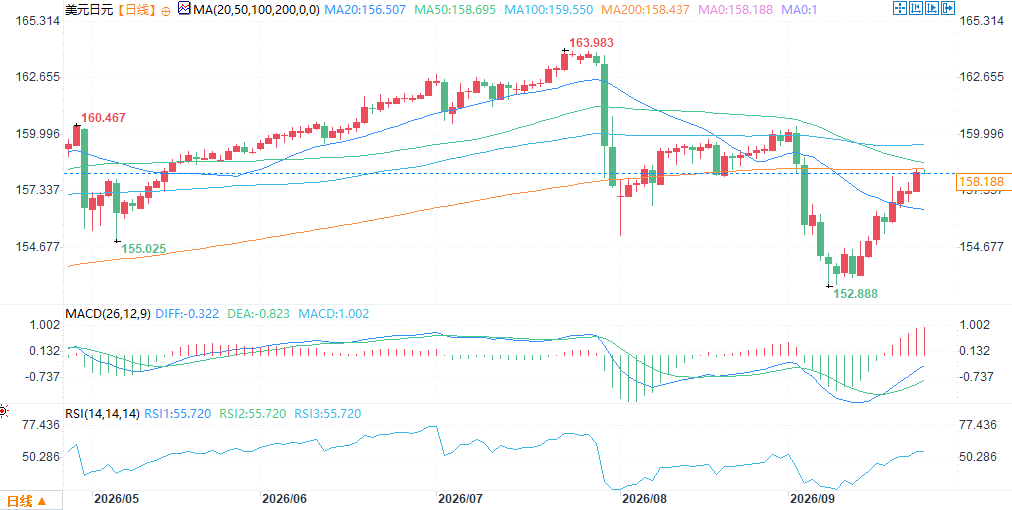 (USD/JPY daily chart, source: EasyForex) At 8:30 Beijing time, USD/JPY was trading at 158.18/19.
Japan's intervention was record-breaking in scale, but its effects lasted only four weeks.
To curb the continued depreciation of the yen and stabilize the foreign exchange market, Japan's Ministry of Finance launched its largest-ever foreign exchange intervention operation from July 30 to August 26, spending a total of 15.4 trillion yen to buy yen, far exceeding the total intervention of 11.7 trillion yen in April and May of this year. Simultaneously, the US Treasury Department also intervened on July 31, forming a joint intervention. This large-scale operation achieved significant short-term results, successfully suppressing the USD/JPY exchange rate below the 160.00 level and stabilizing market panic. However, in the long term, this intervention exposed the core flaws of Japan's foreign exchange control, exhibiting a clear characteristic of "increasing costs and diminishing returns." The stabilization period of past interventions has gradually shortened; the effects of this record-breaking intervention lasted only four weeks before quickly fading. The USD/JPY exchange rate is currently stable above 158.00 and is even poised to close above the 200-day moving average (around 158.43) for the first time since September 2nd. This directly demonstrates that the short-term effectiveness of official intervention is limited and cannot reverse the exchange rate trend dominated by market fundamentals.The Bank of Japan's interest rate hike took effect, but the yen was weaker than on the day of the policy decision.
The Bank of Japan held its monetary policy meeting on September 18th and ultimately decided to raise interest rates by a 7-2 vote, raising the benchmark interest rate to 1.25%, the highest level since 1995. The new rate officially took effect that Thursday. This rate hike is a significant move by the Bank of Japan to tighten monetary policy, and the market initially expected it to boost the yen's exchange rate and narrow the interest rate differential between the US and Japan. However, compared to the US monetary policy environment, the US-Japan interest rate differential has not improved substantially. Currently, the Federal Reserve's benchmark interest rate remains in the 3.75%-4.00% range, and Federal Reserve Governor Barr publicly signaled further hawkishness on Wednesday. The significant interest rate differential means that cross-border carry trades still offer ample profit potential, and arbitrage activities involving borrowing low-interest yen and buying high-yield dollar assets continue to be prevalent among market investors. In addition, U.S. Treasury Secretary Bessant's remarks on September 8 triggered market volatility. He claimed to have more information on the Bank of Japan's subsequent policy moves. On that day, the dollar fell to a September low of around 153.00 against the yen, but then quickly rebounded to recover nearly three-quarters of the losses. After the interest rate hike was implemented, the yen exchange rate fell instead of rising on the day the decision was announced, and the policy's boosting effect was far less than expected.The yen's decline occurred entirely during the Japanese holiday period.
This round of yen depreciation exhibits a strong phased characteristic, with the overall decline concentrated entirely within the holiday window when Japanese markets were closed, highlighting the time limitations of Japan's foreign exchange intervention. The Japanese domestic market was completely closed from the beginning of the week due to national holidays, with trading suspended and official control channels simultaneously restricted, only officially reopening on Thursday. This Thursday also happened to be a crucial date for the Bank of Japan's new interest rate to take effect. As early as September 18th, Japanese financial authorities had conducted exchange rate checks with market traders, serving as a pre-emptive warning signal for Japan to initiate yen buying intervention. Referring to the intervention experience in July, when officials quickly intervened to stabilize the USD/JPY exchange rate when it touched around 164.00. However, due to the holiday closure, Japanese regulators were unable to conduct any intervention operations throughout the process, leaving the market in a regulatory vacuum. After Tokyo traders resumed work and the market reopened on Thursday, the USD/JPY exchange rate had risen sharply, exceeding all trading prices on the day of the exchange rate checks. The accumulated depreciation pressure during the holiday was released in a concentrated manner, rendering the official warnings ineffective and directly exacerbating the yen's depreciation.The interplay between intervention and interest rate differentials
The Japanese yen exchange rate is currently in a tug-of-war between two forces. The Japanese government's intervention in the foreign exchange market, while providing support, is continuously offset by the interest rate differential pressure resulting from the divergence in US and Japanese monetary policies, becoming the core logic driving the yen's movement. Although the Japanese government has implemented the largest-ever foreign exchange intervention, quickly suppressing the USD/JPY exchange rate in the short term and stabilizing the exchange rate while alleviating market sentiment towards one-sided depreciation, this only provides temporary support and cannot change the core market trading logic. Fundamentally, the arbitrage trading momentum driven by the US-Japan interest rate differential remains strong. While the Bank of Japan's 1.25% interest rate hike is a near 30-year peak, it is still significantly lower than the Federal Reserve's high interest rates of 3.75%-4.00%. Given the Federal Reserve's continued hawkish monetary policy and the possibility of further interest rate hikes, the US-Japan interest rate differential is likely to continue widening, and the arbitrage profits from borrowing yen and holding dollar assets will remain substantial. As long as the interest rate differential does not reverse, the market's trading logic of shorting the yen and going long on the dollar will not collapse, making it difficult for the yen to gain sustained upward support, and it will continue to face downward pressure.Summarize
The yen is currently caught in a tug-of-war between Japanese intervention and the widening interest rate differential between the US and Japan. Japan's record ¥15.4 trillion intervention kept the USD/JPY exchange rate below 160.00 for four weeks, but the effect is waning, with the USD/JPY pair rising above 158.00 and poised to close above the 200-day moving average for the first time. The Bank of Japan raised interest rates to 1.25% on Thursday, but this remains low compared to the Federal Reserve's 3.75% to 4.00% rates, keeping carry trade motives intact. The yen's decline occurred entirely during the Japanese holiday period, and Tokyo traders will face higher exchange rates upon their return. Going forward, attention will be focused on whether Japanese authorities will intervene again, the Fed's interest rate path, changes in the US-Japan interest rate differential, and subsequent policy guidance from the Bank of Japan. If the Fed raises rates further or Japanese authorities take no new action, the yen may continue to be under pressure; if Japanese authorities intervene on a large scale again or expectations of a Fed rate hike cool, the yen may find some respite. (USD/JPY daily chart, source: EasyForex) At 8:30 Beijing time, USD/JPY was trading at 158.18/19.
- Risk Warning and Disclaimer
- The market involves risk, and trading may not be suitable for all investors. This article is for reference only and does not constitute personal investment advice, nor does it take into account certain users’ specific investment objectives, financial situation, or other needs. Any investment decisions made based on this information are at your own risk.