Crude Oil Trading Alert: Uncertainty surrounding US-Iran negotiations coupled with transportation risks supports oil price rebound; awaiting stress tests.
2026-09-24 09:56:14
WTI crude oil gave back some of the previous day's modest gains during Asian trading on Thursday, hovering around $91.60. Recent oil price movements have been clearly driven by both geopolitical tensions and supply expectations. On the one hand, the US-Iran negotiations have released some signs of easing tensions, raising market expectations for a supply recovery; on the other hand, significant uncertainty remains regarding the progress of the negotiations, and the shipping risks in the Strait of Hormuz have not been completely eliminated, keeping a high risk premium in the crude oil market.  Representatives from the United States and Iran maintained contact during the UN General Assembly. The US previously stated that the talks were somewhat constructive, but no concrete agreement has yet been reached that could significantly alter the energy supply landscape. Iranian President Masoud Pezechiyan, addressing the UN General Assembly, stated that Iran would not abandon its position under pressure, while reiterating the importance of diplomatic channels. Meanwhile, Iran's stance on the Strait of Hormuz remains relatively firm, meaning that even with continued diplomatic contact, the speed of recovery in oil transportation remains uncertain. The Strait of Hormuz remains one of the most important supply risk variables in the current oil market. Market focus has gradually shifted from "whether new supply disruptions will occur" to "how quickly existing transportation restrictions can be eased." If the US-Iran negotiations make substantial progress and promote the gradual recovery of maritime transportation, the previously accumulated geopolitical risk premium may further diminish; conversely, if negotiations stall again, oil prices may regain support from safe-haven flows and supply concerns. There are already some signs of improvement on the supply side. Saudi Arabia recently restarted its East-West oil pipeline, which can bypass the Strait of Hormuz and transport some oil to the port of Yanbu on the Red Sea coast. Reports indicate that the pipeline has resumed operation, but remains at a low level of transport, and a full recovery to its designed capacity of approximately 7 million barrels per day may take several weeks. This means that while Saudi supply recovery can alleviate some market pressure, it is insufficient to completely offset the risks associated with the Hormuz transport route. Meanwhile, US energy policy is also beginning to impact refined product supply. US Energy Secretary Chris Wright stated that the US government is working with domestic refiners to voluntarily reduce diesel exports to mitigate the impact of overseas supply shortages on the domestic energy market. If this measure continues, it could further alter US refined product inventories, refinery profits, and global diesel trade flows, indirectly affecting crude oil demand expectations. From a market sentiment perspective, investors are currently highly sensitive to every piece of news regarding US-Iran negotiations. TD Securities believes that as speculative positions in crude oil further increase, oil prices will become more sensitive to intraday information and policy statements. In the absence of a clear agreement and actual supply recovery data, the market is more likely to exhibit a pattern of "news-driven rallies followed by rapid pullbacks after supply improvements." Therefore, the recent resilience of WTI prices does not entirely represent a renewed strengthening of fundamentals; some of the price fluctuations still stem from rapid changes in geopolitical risk premiums. It is worth noting that oil prices have clearly retreated from their previous highs after breaking through $100. The resumption of Saudi oil pipelines and expectations of supply recovery pushed WTI below $90 at one point, before subsequently returning above $90, indicating that this psychological level has become a key battleground for both bullish and bearish funds. Against this backdrop, investors need to closely monitor whether there is any verifiable substantial progress in US-Iran negotiations, changes in ship traffic in the Strait of Hormuz, and the speed of the Saudi oil pipeline resumption. Meanwhile, US diesel export policies and inventory data may also become new variables affecting short-term oil price fluctuations. Looking at the daily chart for WTI, after a rapid decline from above $100, oil prices are currently in a low-level consolidation phase, and the short-term trend has shifted from a strong upward trend to a consolidation structure after a high-level correction. The $90 level is a key psychological support area. If prices can hold above this level and rebound towards the $93-$95 range, it indicates that bulls are still attempting to recover from the previous decline. Further resistance lies in the $97-$100 area; a break above $100 would suggest a potential rapid escalation of geopolitical risk premiums. Conversely, if WTI breaks below $90, it may seek support in the $87-$88 area. In terms of momentum indicators, the short-term oversold pressure has eased somewhat after the previous rapid decline, but the overall rebound strength still depends on whether prices can form a continuous pattern of higher highs and higher lows. On the 4-hour chart, WTI is currently fluctuating around the $90 mark, with a weak short-term price structure but not yet fully forming a new one-sided decline. If oil prices can regain $92-$93 and break through the recent rebound high, a further test of the $95 area is possible in the short term; if the rebound is blocked near $92, the market may remain in a weak, volatile state. From a technical perspective, short-term momentum is attempting to recover, but a clear trend reversal signal has not yet formed. Therefore, it is more appropriate to focus on the breakout direction of the $90 support and the resistance around $93. If $90 is breached, a further pullback to $88 or even lower should be anticipated; if $93 is effectively broken, the short-term downward pressure may be significantly alleviated.
 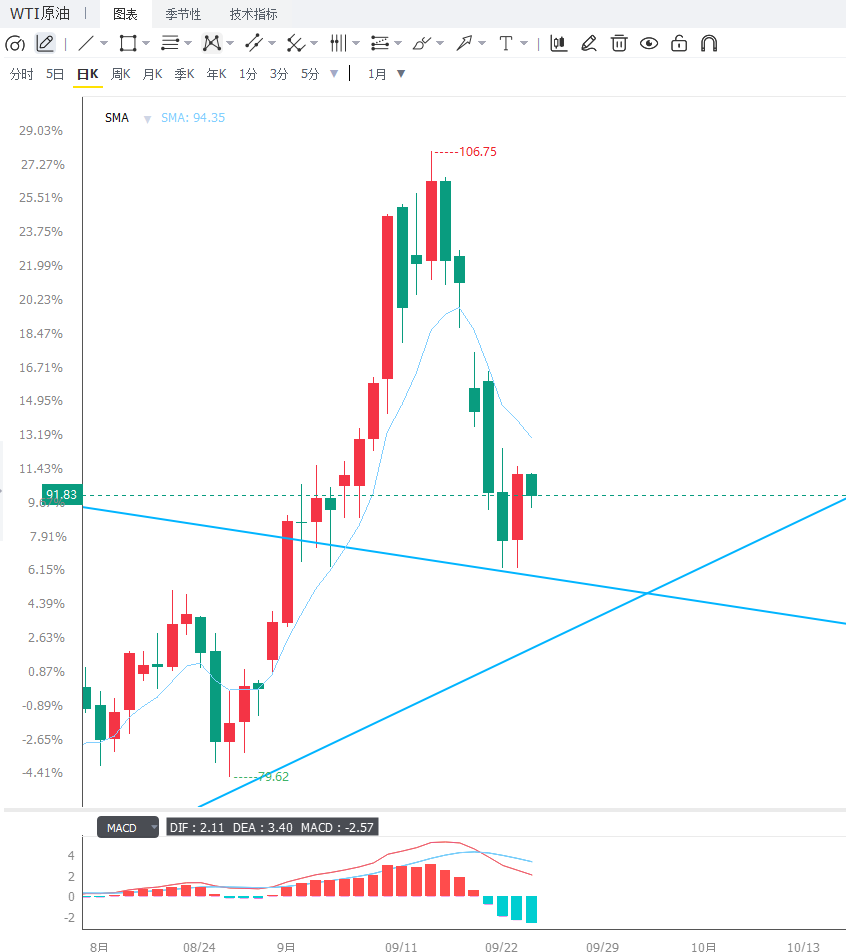 Editor's Summary: The WTI market is currently in a repricing phase, caught between declining geopolitical risk premiums and expectations of supply recovery. Substantial progress in US-Iran negotiations, coupled with the gradual reopening of Saudi oil pipelines, could further compress the previously accumulated risk premium in crude oil; however, the incomplete recovery of shipping through the Strait of Hormuz leaves significant uncertainty on the supply side. In the short term, $90 is a crucial level for observing market strength. Whether oil prices can regain a foothold above $93 will determine the extent of any rebound, while a breach of $90 could open up further downside potential. Investors should remain vigilant for sharp price fluctuations caused by news of negotiations, shipping data, and the progress of supply recovery.
Representatives from the United States and Iran maintained contact during the UN General Assembly. The US previously stated that the talks were somewhat constructive, but no concrete agreement has yet been reached that could significantly alter the energy supply landscape. Iranian President Masoud Pezechiyan, addressing the UN General Assembly, stated that Iran would not abandon its position under pressure, while reiterating the importance of diplomatic channels. Meanwhile, Iran's stance on the Strait of Hormuz remains relatively firm, meaning that even with continued diplomatic contact, the speed of recovery in oil transportation remains uncertain. The Strait of Hormuz remains one of the most important supply risk variables in the current oil market. Market focus has gradually shifted from "whether new supply disruptions will occur" to "how quickly existing transportation restrictions can be eased." If the US-Iran negotiations make substantial progress and promote the gradual recovery of maritime transportation, the previously accumulated geopolitical risk premium may further diminish; conversely, if negotiations stall again, oil prices may regain support from safe-haven flows and supply concerns. There are already some signs of improvement on the supply side. Saudi Arabia recently restarted its East-West oil pipeline, which can bypass the Strait of Hormuz and transport some oil to the port of Yanbu on the Red Sea coast. Reports indicate that the pipeline has resumed operation, but remains at a low level of transport, and a full recovery to its designed capacity of approximately 7 million barrels per day may take several weeks. This means that while Saudi supply recovery can alleviate some market pressure, it is insufficient to completely offset the risks associated with the Hormuz transport route. Meanwhile, US energy policy is also beginning to impact refined product supply. US Energy Secretary Chris Wright stated that the US government is working with domestic refiners to voluntarily reduce diesel exports to mitigate the impact of overseas supply shortages on the domestic energy market. If this measure continues, it could further alter US refined product inventories, refinery profits, and global diesel trade flows, indirectly affecting crude oil demand expectations. From a market sentiment perspective, investors are currently highly sensitive to every piece of news regarding US-Iran negotiations. TD Securities believes that as speculative positions in crude oil further increase, oil prices will become more sensitive to intraday information and policy statements. In the absence of a clear agreement and actual supply recovery data, the market is more likely to exhibit a pattern of "news-driven rallies followed by rapid pullbacks after supply improvements." Therefore, the recent resilience of WTI prices does not entirely represent a renewed strengthening of fundamentals; some of the price fluctuations still stem from rapid changes in geopolitical risk premiums. It is worth noting that oil prices have clearly retreated from their previous highs after breaking through $100. The resumption of Saudi oil pipelines and expectations of supply recovery pushed WTI below $90 at one point, before subsequently returning above $90, indicating that this psychological level has become a key battleground for both bullish and bearish funds. Against this backdrop, investors need to closely monitor whether there is any verifiable substantial progress in US-Iran negotiations, changes in ship traffic in the Strait of Hormuz, and the speed of the Saudi oil pipeline resumption. Meanwhile, US diesel export policies and inventory data may also become new variables affecting short-term oil price fluctuations. Looking at the daily chart for WTI, after a rapid decline from above $100, oil prices are currently in a low-level consolidation phase, and the short-term trend has shifted from a strong upward trend to a consolidation structure after a high-level correction. The $90 level is a key psychological support area. If prices can hold above this level and rebound towards the $93-$95 range, it indicates that bulls are still attempting to recover from the previous decline. Further resistance lies in the $97-$100 area; a break above $100 would suggest a potential rapid escalation of geopolitical risk premiums. Conversely, if WTI breaks below $90, it may seek support in the $87-$88 area. In terms of momentum indicators, the short-term oversold pressure has eased somewhat after the previous rapid decline, but the overall rebound strength still depends on whether prices can form a continuous pattern of higher highs and higher lows. On the 4-hour chart, WTI is currently fluctuating around the $90 mark, with a weak short-term price structure but not yet fully forming a new one-sided decline. If oil prices can regain $92-$93 and break through the recent rebound high, a further test of the $95 area is possible in the short term; if the rebound is blocked near $92, the market may remain in a weak, volatile state. From a technical perspective, short-term momentum is attempting to recover, but a clear trend reversal signal has not yet formed. Therefore, it is more appropriate to focus on the breakout direction of the $90 support and the resistance around $93. If $90 is breached, a further pullback to $88 or even lower should be anticipated; if $93 is effectively broken, the short-term downward pressure may be significantly alleviated. Editor's Summary: The WTI market is currently in a repricing phase, caught between declining geopolitical risk premiums and expectations of supply recovery. Substantial progress in US-Iran negotiations, coupled with the gradual reopening of Saudi oil pipelines, could further compress the previously accumulated risk premium in crude oil; however, the incomplete recovery of shipping through the Strait of Hormuz leaves significant uncertainty on the supply side. In the short term, $90 is a crucial level for observing market strength. Whether oil prices can regain a foothold above $93 will determine the extent of any rebound, while a breach of $90 could open up further downside potential. Investors should remain vigilant for sharp price fluctuations caused by news of negotiations, shipping data, and the progress of supply recovery.
- Risk Warning and Disclaimer
- The market involves risk, and trading may not be suitable for all investors. This article is for reference only and does not constitute personal investment advice, nor does it take into account certain users’ specific investment objectives, financial situation, or other needs. Any investment decisions made based on this information are at your own risk.