The widening divergence in monetary policy between the US and the UK, coupled with the dollar remaining at a high level, has led to a continued decline in the pound against the dollar.
2026-09-24 14:28:11
GBP/USD rebounded slightly to around 1.3240 in early European trading on Thursday, but the overall trend remained weak. The pound has recently been pulled by two forces: firstly, the UK interest rate market is still pricing in expectations of further rate hikes; secondly, strong US economic data and continued emphasis on inflation risks by Federal Reserve officials have given the dollar a renewed interest rate advantage. Against the backdrop of widening policy expectations between the US and the UK, the pound's short-term upside potential is limited.  US economic data has been a key driver of the recent strengthening of the US dollar. The preliminary reading of the S&P Global Composite PMI for September rose to 58.4, significantly higher than August's 56.0; the manufacturing PMI further rose to 57.0, a significant improvement from the previous reading of 53.9, and also higher than the market expectation of 53.5. The data indicates that US business activity remains strong, prompting the market to refocus on the impact of economic resilience on inflation and monetary policy. Meanwhile, the Federal Reserve's policy signals remain hawkish. Federal Reserve Governor Michael Barr stated that further policy adjustments may still be needed to control inflation. Earlier this week, Richmond Fed President Tom Barkin and Boston Fed President Susan Collins also supported a near-term rate hike and emphasized that inflationary pressures remain. If subsequent US employment and inflation data continue to show resilience, market expectations for further Fed tightening may continue to rise, providing additional support for the dollar. In the UK, rising energy prices have renewed inflationary pressures, making market judgments on the Bank of England's future policy more complex. Bank of America Global Research predicts that the Bank of England may raise interest rates twice in the next six months, mainly because rising energy prices may keep inflation at a high level. Meanwhile, the OECD believes that the UK's current monetary policy is already tight enough, and there is no need to further raise interest rates. This significant divergence means that the market currently has considerable uncertainty regarding the extent of future interest rate hikes by the Bank of England. The interest rate market has already priced in some of the Bank of England's expectations for further tightening. Data shows that the market currently expects a 67% probability of a rate hike by the Bank of England in November, and is further betting on a possible rate hike in December. However, Brown Brothers Harriman points out that the market's current pricing of the Bank of England's interest rate hikes over the next year may be too high. The institution believes that the UK economy is still operating below its potential capacity, current interest rates are already close to the upper end of its estimated neutral range, and fiscal policy may be further tightened. Therefore, the Bank of England may not need to raise interest rates significantly as the market currently prices. This means that the subsequent trend of GBP/USD will be highly dependent on changes in the US-UK interest rate differential. If the US economy continues to be significantly stronger than the UK economy, and the Federal Reserve maintains a hawkish stance, while UK economic data weakens and leads the Bank of England to lower its expectations for interest rate hikes, the pound may continue to be under pressure. Conversely, if UK inflation rebounds and forces the Bank of England to accelerate policy tightening, while US economic data shows a significant cooling, narrowing the policy divergence between the US and the UK, it could provide the pound with a temporary rebound momentum. From a market sentiment perspective, the recent rapid decline in GBP/USD has pushed the technical indicators into oversold territory. Therefore, continued dollar strength does not necessarily mean a sustained one-sided decline in the pound. Short-term investors need to be wary of a technical rebound after overselling, but given the still hawkish Fed policy expectations, whether the rebound can evolve into a trend reversal still requires more fundamental confirmation. The daily chart structure for GBP/USD remains bearish, with the exchange rate currently trading below major moving averages and the key Bollinger Band area, and the overall downtrend has not changed. The primary resistance level to watch is the lower Bollinger Band around 1.3258. If the exchange rate can regain a foothold above this level, the rebound may further test the 100-day moving average around 1.3428 and the middle Bollinger Band around 1.3455, which constitute strong resistance. Further upside, watch the upper Bollinger Band around 1.3652. The first support level to watch is around 1.3140, the low from June 24th. A break below this level would target 1.3038, and if that area is also broken, the psychological level of 1.3000 will become the next target. The RSI is around 25.44, already in oversold territory, indicating that bears are in control, but also suggesting a possible slowdown in short-term downward momentum. On the 4-hour chart, GBP/USD remains in a clear downtrend, and the current rebound around 1.3240 is more of a technical correction. If the price fails to break through 1.3258, bears may retest the support around 1.3140; if it breaks through 1.3258 and holds firmly, the short-term rebound could extend to the 1.3350-1.3430 area. Since the daily RSI is already in oversold territory, short-term attention should be paid to both a further strengthening of the US dollar leading to a trend reversal and a rapid rebound triggered by the oversold condition.
 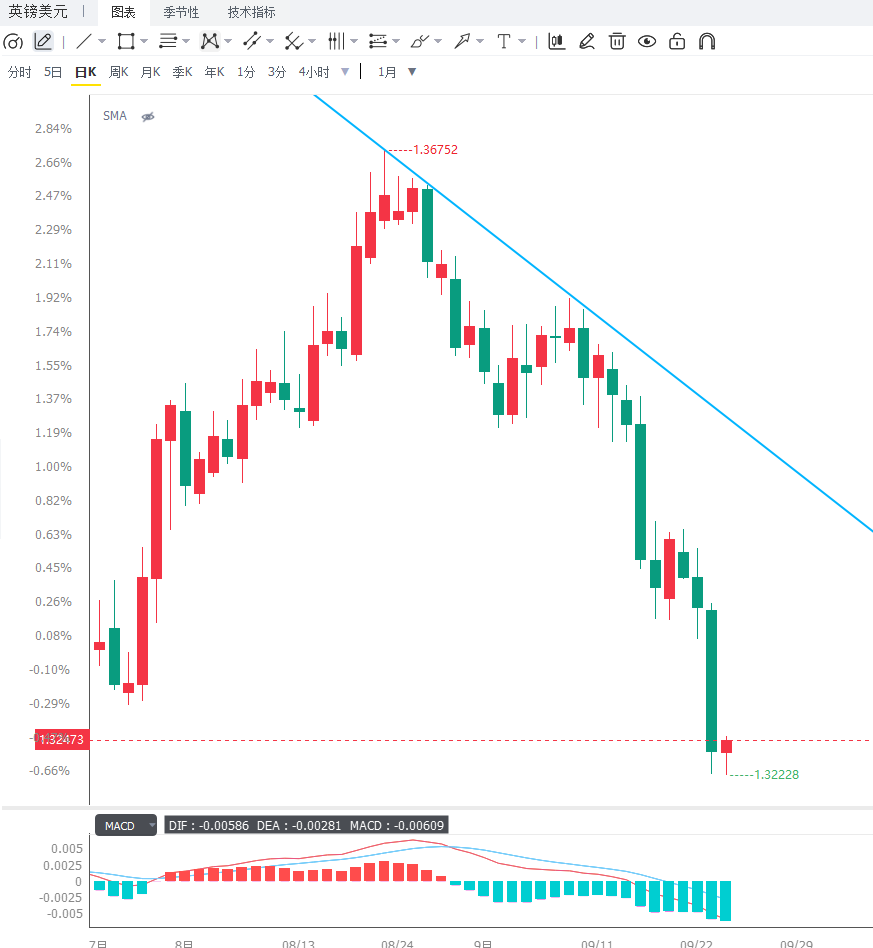 The core contradiction in the current GBP/USD exchange rate lies in the renewed divergence in expectations regarding US and UK monetary policy. Strong US business activity data and hawkish statements from the Federal Reserve continue to support the dollar, while the Bank of England, despite facing energy inflation pressures, faces significant market disagreement regarding the magnitude of future interest rate hikes. In the short term, 1.3258 is a key level that the pound needs to break through first for a rebound, while 1.3140 is a significant support level. Subsequent US economic data, Fed speeches, and expectations regarding UK inflation and Bank of England policy will continue to determine the short-term direction of GBP/USD.
US economic data has been a key driver of the recent strengthening of the US dollar. The preliminary reading of the S&P Global Composite PMI for September rose to 58.4, significantly higher than August's 56.0; the manufacturing PMI further rose to 57.0, a significant improvement from the previous reading of 53.9, and also higher than the market expectation of 53.5. The data indicates that US business activity remains strong, prompting the market to refocus on the impact of economic resilience on inflation and monetary policy. Meanwhile, the Federal Reserve's policy signals remain hawkish. Federal Reserve Governor Michael Barr stated that further policy adjustments may still be needed to control inflation. Earlier this week, Richmond Fed President Tom Barkin and Boston Fed President Susan Collins also supported a near-term rate hike and emphasized that inflationary pressures remain. If subsequent US employment and inflation data continue to show resilience, market expectations for further Fed tightening may continue to rise, providing additional support for the dollar. In the UK, rising energy prices have renewed inflationary pressures, making market judgments on the Bank of England's future policy more complex. Bank of America Global Research predicts that the Bank of England may raise interest rates twice in the next six months, mainly because rising energy prices may keep inflation at a high level. Meanwhile, the OECD believes that the UK's current monetary policy is already tight enough, and there is no need to further raise interest rates. This significant divergence means that the market currently has considerable uncertainty regarding the extent of future interest rate hikes by the Bank of England. The interest rate market has already priced in some of the Bank of England's expectations for further tightening. Data shows that the market currently expects a 67% probability of a rate hike by the Bank of England in November, and is further betting on a possible rate hike in December. However, Brown Brothers Harriman points out that the market's current pricing of the Bank of England's interest rate hikes over the next year may be too high. The institution believes that the UK economy is still operating below its potential capacity, current interest rates are already close to the upper end of its estimated neutral range, and fiscal policy may be further tightened. Therefore, the Bank of England may not need to raise interest rates significantly as the market currently prices. This means that the subsequent trend of GBP/USD will be highly dependent on changes in the US-UK interest rate differential. If the US economy continues to be significantly stronger than the UK economy, and the Federal Reserve maintains a hawkish stance, while UK economic data weakens and leads the Bank of England to lower its expectations for interest rate hikes, the pound may continue to be under pressure. Conversely, if UK inflation rebounds and forces the Bank of England to accelerate policy tightening, while US economic data shows a significant cooling, narrowing the policy divergence between the US and the UK, it could provide the pound with a temporary rebound momentum. From a market sentiment perspective, the recent rapid decline in GBP/USD has pushed the technical indicators into oversold territory. Therefore, continued dollar strength does not necessarily mean a sustained one-sided decline in the pound. Short-term investors need to be wary of a technical rebound after overselling, but given the still hawkish Fed policy expectations, whether the rebound can evolve into a trend reversal still requires more fundamental confirmation. The daily chart structure for GBP/USD remains bearish, with the exchange rate currently trading below major moving averages and the key Bollinger Band area, and the overall downtrend has not changed. The primary resistance level to watch is the lower Bollinger Band around 1.3258. If the exchange rate can regain a foothold above this level, the rebound may further test the 100-day moving average around 1.3428 and the middle Bollinger Band around 1.3455, which constitute strong resistance. Further upside, watch the upper Bollinger Band around 1.3652. The first support level to watch is around 1.3140, the low from June 24th. A break below this level would target 1.3038, and if that area is also broken, the psychological level of 1.3000 will become the next target. The RSI is around 25.44, already in oversold territory, indicating that bears are in control, but also suggesting a possible slowdown in short-term downward momentum. On the 4-hour chart, GBP/USD remains in a clear downtrend, and the current rebound around 1.3240 is more of a technical correction. If the price fails to break through 1.3258, bears may retest the support around 1.3140; if it breaks through 1.3258 and holds firmly, the short-term rebound could extend to the 1.3350-1.3430 area. Since the daily RSI is already in oversold territory, short-term attention should be paid to both a further strengthening of the US dollar leading to a trend reversal and a rapid rebound triggered by the oversold condition. The core contradiction in the current GBP/USD exchange rate lies in the renewed divergence in expectations regarding US and UK monetary policy. Strong US business activity data and hawkish statements from the Federal Reserve continue to support the dollar, while the Bank of England, despite facing energy inflation pressures, faces significant market disagreement regarding the magnitude of future interest rate hikes. In the short term, 1.3258 is a key level that the pound needs to break through first for a rebound, while 1.3140 is a significant support level. Subsequent US economic data, Fed speeches, and expectations regarding UK inflation and Bank of England policy will continue to determine the short-term direction of GBP/USD.
- Risk Warning and Disclaimer
- The market involves risk, and trading may not be suitable for all investors. This article is for reference only and does not constitute personal investment advice, nor does it take into account certain users’ specific investment objectives, financial situation, or other needs. Any investment decisions made based on this information are at your own risk.