After the euro fell below 1.14, where will it go next against the dollar?
2026-09-24 15:50:16
On Thursday (September 24) during the European session, the euro touched a low of 1.1368 against the dollar, its lowest level since July 29. It has since rebounded slightly to around 1.1390. The Danske Bank research team noted that strong US PMI data and hawkish pricing from the Federal Reserve weighed on the euro against the dollar. The sharp rise in the US composite PMI fueled market expectations of another Fed rate hike in October, pulling the euro below 1.14 against the dollar. The team emphasized that rising input prices in the service sector and tightening financial conditions were key drivers of the dollar's strength against the euro. 
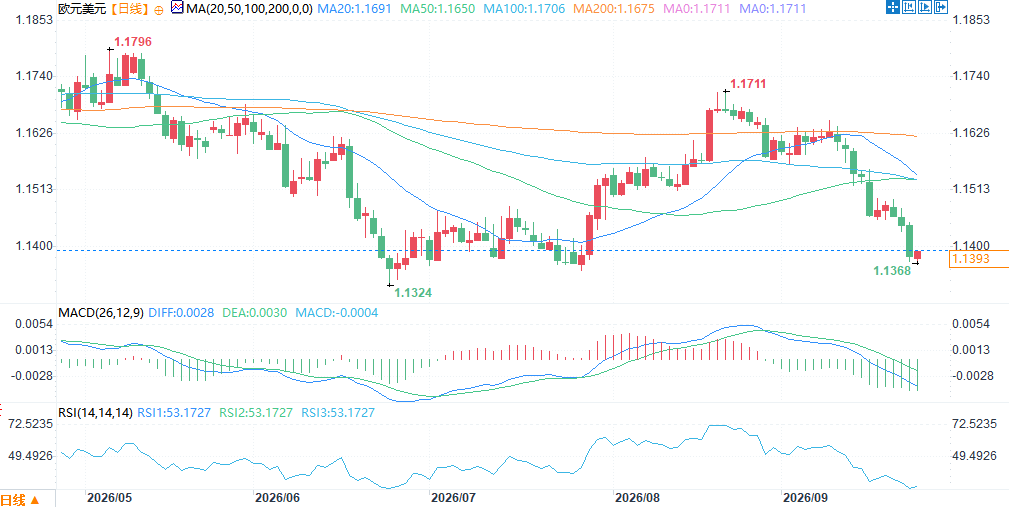 (Euro/USD daily chart, source: FX678) At 15:45 Beijing time, the euro was trading at 1.1393/94 against the US dollar.
Eurozone PMI rose more than expected, with the services sector leading the gains and price indicators rising across the board.
The Eurozone's September Composite Purchasing Managers' Index (PMI) surged to 53.1, significantly higher than the market expectation of 51.7 and August's 52.0, marking its highest level in over three years. The services sector was the main driver, rising to 53.0 (expected 51.4, previous 51.6), while manufacturing remained stable at 52.7 (expected 52.6, previous 52.7). Data showed that new orders grew at their fastest pace since May 2022, and backlogged orders increased for the first time since June 2022. While employment rose moderately, overall expansion momentum strengthened. Germany expanded for the third consecutive month, with growth near a one-year high, while France returned to growth territory after ten consecutive months of contraction, further solidifying the region's recovery. All price indices rose, with service sector output prices reaching their highest level since early 2024. This reflects that higher energy costs may be spreading to a wider range of sectors, although current absolute levels are not yet cause undue concern. Input costs and output prices both rose at their fastest pace in four months, indicating renewed inflationary pressures. The simultaneous rise in growth and inflation makes this data generally hawkish for the European Central Bank (ECB). Short-term interest rates climbed significantly after the data release. Danske Bank expects the ECB to have room for two more rate hikes, with energy price movements over the next month determining whether the first hike will occur as early as October. Overall, the Eurozone economy has shown strong resilience, but rising price pressures increase the likelihood of further monetary policy tightening.The US PMI also far exceeded expectations, with service sector input prices rising at their fastest pace since November 2022.
The US September Composite Purchasing Managers' Index (PMI) also significantly exceeded expectations, rising to 58.4 from 56.0 in August, marking the strongest growth momentum in recent years. The manufacturing index jumped from 53.9 to 57.0, with significant improvements in new orders, output, and employment; the services sector performed particularly well, rising from 56.5 to 58.7. Details show that input prices in the services sector are rising at the fastest pace since November 2022, indicating that current price pressures may not be solely explained by energy costs, and broader cost transmission is emerging. Job creation reached its fastest pace in over four years, with businesses actively increasing staff to meet demand, but rising backlogs and exacerbated supply chain delays also reflect tight capacity. This data, like that of the Eurozone, is generally hawkish, reinforcing market expectations of continued tightening by the Federal Reserve. The euro subsequently fell below 1.14 against the dollar, with the market pricing in a probability of another Fed rate hike in October rising to approximately 70%. The services-led expansion coupled with the manufacturing rebound indicates that US private sector activity accelerated to its fastest level in over five years, corresponding to strong potential GDP growth momentum. However, input costs have risen significantly due to soaring energy prices, further worsening the inflation outlook and making it more difficult for policymakers to balance growth and price stability. Overall, U.S. data not only supported a stronger dollar but also exacerbated upward pressure on global interest rate expectations.Financial conditions tightened sharply, and the US dollar strengthened against all G10 currencies.
Yesterday's overheated US September Composite Purchasing Managers' Index (PMI) data triggered a sharp tightening of financial conditions during the European evening trading session. Stock and bond markets fell in tandem as investors quickly adjusted their risk exposure. The US dollar strengthened against all other G10 currencies, reflecting a repricing of the Federal Reserve's policy path. The stronger-than-expected US data not only directly supported the dollar by raising interest rate expectations but also further enhanced its appeal as a safe-haven asset by reducing risk appetite and tightening financial conditions. The cross-asset reaction clearly shows that the stronger-than-expected resilience of the US economy is changing global capital flows. Rising bond yields put pressure on valuations, while the stock market correction amplified risk aversion. Currencies such as the euro weakened against the dollar despite their own hawkish data, highlighting the dominant role of US growth advantages. Tighter financial conditions may put pressure on risk assets going forward and will also test the policy coordination space of central banks in dealing with potential inflationary pressures. Overall market dynamics indicate that stronger-than-expected US data is becoming a core driver of short-term exchange rate and interest rate fluctuations. Investors need to closely monitor the further impact of subsequent inflation and employment data on policy expectations.Summarize
Danske Bank points out that both US and Eurozone PMIs exceeded expectations, but the US data was more robust, with service sector input prices rising at their fastest pace since November 2022. The market is pricing in a 70% probability of a Fed rate hike in October, pulling the euro below 1.14 against the dollar. The Eurozone PMI was also hawkish, with service sector output prices reaching their highest level since early 2024. Short-term interest rates rose significantly, and Danske expects the ECB to raise rates twice more, with the first potentially as early as October. Financial conditions tightened sharply, leading to a sell-off in both stocks and bonds, and a stronger dollar against all G10 currencies. Going forward, attention should be paid to the impact of energy prices over the next month on the ECB's October decision, the validation of the Fed's path by US inflation and employment data, and the continued pressure of tightening financial conditions on risk assets. (Euro/USD daily chart, source: FX678) At 15:45 Beijing time, the euro was trading at 1.1393/94 against the US dollar.
- Risk Warning and Disclaimer
- The market involves risk, and trading may not be suitable for all investors. This article is for reference only and does not constitute personal investment advice, nor does it take into account certain users’ specific investment objectives, financial situation, or other needs. Any investment decisions made based on this information are at your own risk.