Hawkish expectations from the Federal Reserve and uncertainty surrounding oil prices have put pressure on the USD/CAD pair, which hovers around 1.4100.
2026-09-24 14:30:14
The USD/CAD pair traded in a narrow range around 1.4100 during Thursday's Asian session, after rising for three consecutive trading days. The market is currently influenced by both a strong US dollar and the commodity-like nature of the Canadian dollar. Hawkish expectations for Federal Reserve policy provide the US dollar with an interest rate advantage; on the other hand, oil prices are supported by Middle East supply risks, and oil prices typically influence the Canadian dollar through expectations of Canadian energy exports, thus the Canadian dollar is showing some resilience for the time being.  Oil price movements remain a key variable influencing the Canadian dollar. While diplomatic contacts between the US and Iran continue, the progress of negotiations remains uncertain, with Iran maintaining a relatively hardline stance on shipping in the Strait of Hormuz. If oil supply risks escalate again, supporting oil prices, this could limit further upside for USD/CAD by improving expectations for Canadian energy export revenues. Conversely, if diplomatic progress leads to a rapid decline in the supply risk premium, a drop in oil prices could further weaken the Canadian dollar. Regarding the US dollar, US economic data continues to provide some support. The preliminary reading of the S&P Global Manufacturing PMI for September rose to 52.0, higher than August's 51.7 and exceeding market expectations of 51.4. Although the services and composite PMIs showed some decline, the improved manufacturing data still indicates the strong resilience of the US economy, providing a data basis for the Federal Reserve to maintain its restrictive policy. Market expectations for the Fed's policy path in October have also changed significantly. CME FedWatch data shows that the market currently expects a 25 basis point rate hike in October with a probability of approximately 69.7%, significantly higher than 48.7% a week ago. Federal Reserve Governor Michael Barr recently stated that further policy adjustments may still be needed to control inflation, and other Fed officials have also emphasized persistent price pressures. If subsequent US employment and inflation data remain strong, the US dollar may maintain its relative advantage. In contrast, the Canadian dollar faces increasing interest rate differential pressure. Scotiabank strategists point out that widening yield spreads are a major drag on the Canadian dollar's fundamentals, and the Canadian dollar exhibits seasonal weakness in the fourth quarter. If the US-Canada interest rate differential widens further, the incentive for capital flows into US dollar assets may increase, thus pushing USD/CAD to remain high. However, oil prices remain an important buffer for the Canadian dollar. Because the Canadian economy and export structure are closely linked to the energy market, high oil prices generally benefit Canadian trade and energy revenue expectations. If the situation in the Middle East further pushes up oil prices, the upside potential for USD/CAD may be limited. Therefore, the current exchange rate is not entirely driven by the US dollar alone, but is influenced by Fed policy, oil prices, and the US-Canada yield spread. The recent rise in USD/CAD reflects more the repricing of interest rate differentials and US dollar demand, but oil price movements may still alter the short-term balance. Investors should pay close attention to the US initial jobless claims, subsequent speeches by Fed officials, the US dollar index, US Treasury yields, and WTI oil price changes. If US economic data continues to be stronger than expected, and crude oil prices fall, USD/CAD may gain further upward momentum; if oil prices continue to strengthen, the Canadian dollar may receive some support. USD/CAD is currently trading around 1.4100 on the daily chart, with prices stable above the 9-day and 50-day exponential moving averages, maintaining a bullish trend in both the short and medium term. The RSI (14) is around 69.74, which is close to the overbought zone, indicating strong bullish momentum, but the risk of consolidation or technical correction after continuous rises is also increasing. The first support level to watch is the 9-day EMA around 1.4017, followed by the 50-day EMA around 1.3946. As long as the price remains above these two moving averages, the overall technical structure is still bullish, but if the RSI enters a clearly overbought zone, the pace of short-term upward movement may slow down. On the 4-hour chart, USD/CAD maintains a relatively clear upward structure, with price pullbacks temporarily supported by short-term moving averages. If the exchange rate can effectively hold above 1.4100 and break through the recent high, it is expected to test the 1.4150-1.4200 area. If significant profit-taking occurs near 1.4100, the support level at 1.4017 needs to be monitored; a break below this level could lead to a further pullback towards the 1.3946 area. The current technical outlook remains bullish, but the high RSI level indicates increasing risk of chasing the rally. In the short term, it is crucial to pay attention to the synchronized impact of the US dollar's performance and oil price changes on the exchange rate.
 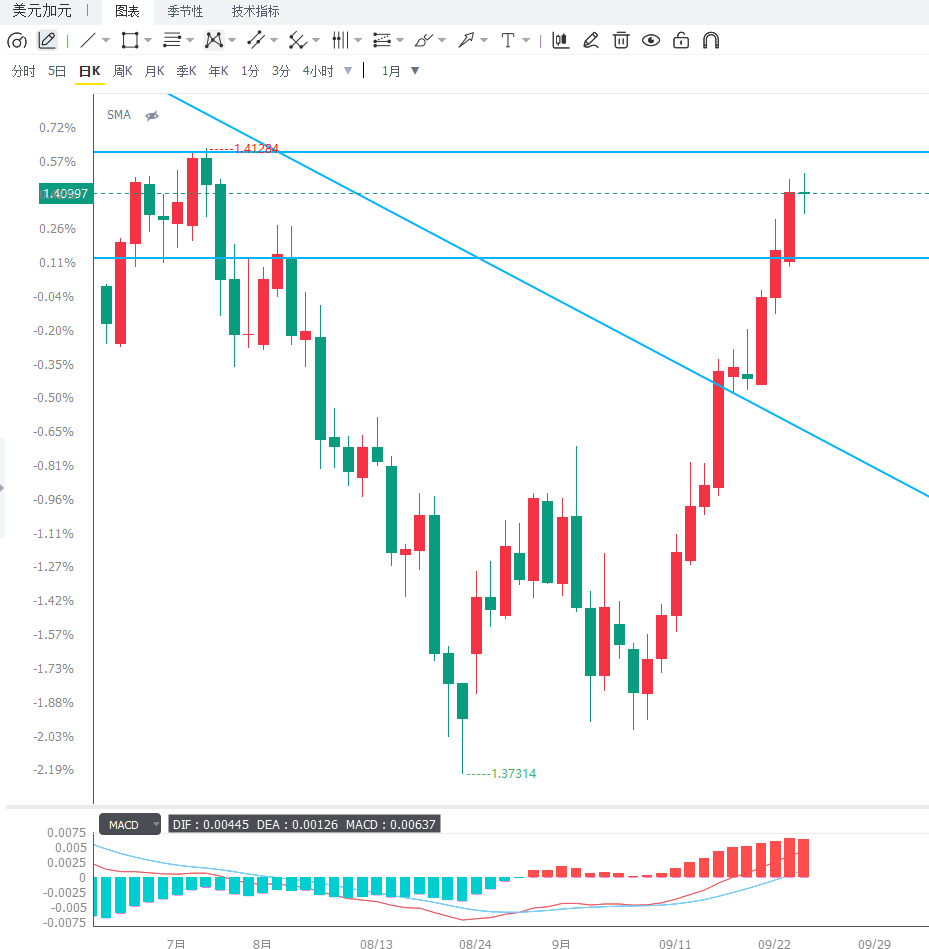 The USD/CAD pair is currently in a tug-of-war between the US dollar's interest rate advantage and oil price support for the Canadian dollar. Hawkish expectations from the Federal Reserve and the resilience of the US economy are supporting the dollar, while rising oil prices may limit further weakness in the Canadian dollar. Technically, the 1.4100 level remains a short-term battleground between bulls and bears, with 1.4017 and 1.3946 forming important support levels. If US data continues to be strong and the USD/CAD interest rate differential widens, the exchange rate still has room to rise; if oil prices continue to rise due to escalating supply risks, the Canadian dollar may find some support in the short term.
Oil price movements remain a key variable influencing the Canadian dollar. While diplomatic contacts between the US and Iran continue, the progress of negotiations remains uncertain, with Iran maintaining a relatively hardline stance on shipping in the Strait of Hormuz. If oil supply risks escalate again, supporting oil prices, this could limit further upside for USD/CAD by improving expectations for Canadian energy export revenues. Conversely, if diplomatic progress leads to a rapid decline in the supply risk premium, a drop in oil prices could further weaken the Canadian dollar. Regarding the US dollar, US economic data continues to provide some support. The preliminary reading of the S&P Global Manufacturing PMI for September rose to 52.0, higher than August's 51.7 and exceeding market expectations of 51.4. Although the services and composite PMIs showed some decline, the improved manufacturing data still indicates the strong resilience of the US economy, providing a data basis for the Federal Reserve to maintain its restrictive policy. Market expectations for the Fed's policy path in October have also changed significantly. CME FedWatch data shows that the market currently expects a 25 basis point rate hike in October with a probability of approximately 69.7%, significantly higher than 48.7% a week ago. Federal Reserve Governor Michael Barr recently stated that further policy adjustments may still be needed to control inflation, and other Fed officials have also emphasized persistent price pressures. If subsequent US employment and inflation data remain strong, the US dollar may maintain its relative advantage. In contrast, the Canadian dollar faces increasing interest rate differential pressure. Scotiabank strategists point out that widening yield spreads are a major drag on the Canadian dollar's fundamentals, and the Canadian dollar exhibits seasonal weakness in the fourth quarter. If the US-Canada interest rate differential widens further, the incentive for capital flows into US dollar assets may increase, thus pushing USD/CAD to remain high. However, oil prices remain an important buffer for the Canadian dollar. Because the Canadian economy and export structure are closely linked to the energy market, high oil prices generally benefit Canadian trade and energy revenue expectations. If the situation in the Middle East further pushes up oil prices, the upside potential for USD/CAD may be limited. Therefore, the current exchange rate is not entirely driven by the US dollar alone, but is influenced by Fed policy, oil prices, and the US-Canada yield spread. The recent rise in USD/CAD reflects more the repricing of interest rate differentials and US dollar demand, but oil price movements may still alter the short-term balance. Investors should pay close attention to the US initial jobless claims, subsequent speeches by Fed officials, the US dollar index, US Treasury yields, and WTI oil price changes. If US economic data continues to be stronger than expected, and crude oil prices fall, USD/CAD may gain further upward momentum; if oil prices continue to strengthen, the Canadian dollar may receive some support. USD/CAD is currently trading around 1.4100 on the daily chart, with prices stable above the 9-day and 50-day exponential moving averages, maintaining a bullish trend in both the short and medium term. The RSI (14) is around 69.74, which is close to the overbought zone, indicating strong bullish momentum, but the risk of consolidation or technical correction after continuous rises is also increasing. The first support level to watch is the 9-day EMA around 1.4017, followed by the 50-day EMA around 1.3946. As long as the price remains above these two moving averages, the overall technical structure is still bullish, but if the RSI enters a clearly overbought zone, the pace of short-term upward movement may slow down. On the 4-hour chart, USD/CAD maintains a relatively clear upward structure, with price pullbacks temporarily supported by short-term moving averages. If the exchange rate can effectively hold above 1.4100 and break through the recent high, it is expected to test the 1.4150-1.4200 area. If significant profit-taking occurs near 1.4100, the support level at 1.4017 needs to be monitored; a break below this level could lead to a further pullback towards the 1.3946 area. The current technical outlook remains bullish, but the high RSI level indicates increasing risk of chasing the rally. In the short term, it is crucial to pay attention to the synchronized impact of the US dollar's performance and oil price changes on the exchange rate. The USD/CAD pair is currently in a tug-of-war between the US dollar's interest rate advantage and oil price support for the Canadian dollar. Hawkish expectations from the Federal Reserve and the resilience of the US economy are supporting the dollar, while rising oil prices may limit further weakness in the Canadian dollar. Technically, the 1.4100 level remains a short-term battleground between bulls and bears, with 1.4017 and 1.3946 forming important support levels. If US data continues to be strong and the USD/CAD interest rate differential widens, the exchange rate still has room to rise; if oil prices continue to rise due to escalating supply risks, the Canadian dollar may find some support in the short term.
- Risk Warning and Disclaimer
- The market involves risk, and trading may not be suitable for all investors. This article is for reference only and does not constitute personal investment advice, nor does it take into account certain users’ specific investment objectives, financial situation, or other needs. Any investment decisions made based on this information are at your own risk.