US real interest rates hit new highs, plunging gold into a dark hour.
2026-09-24 17:18:17
On Thursday (September 24th) during the Asian and European sessions , gold prices continued to be under pressure. While the US real interest rate had already shown signs of a double top and was declining, recent hawkish pronouncements from the Federal Reserve, a significantly better-than-expected PMI, and the latest breakthroughs in the AI industry have reignited the narrative of a strong US economy. The main drivers of gold prices recently have been the US dollar index and real interest rates. Therefore, for investors, studying the endogenous variables of real interest rates (including the Federal Reserve's economic growth rate) is the most important task at present. Gold has recently faced a relatively dark period, but fortunately, the overall trend shows some strength amidst weakness. A high-interest-rate environment and a prosperous economy are most conducive to squeezing out excess liquidity in gold prices. We await the turning point in US economic data to create opportunities for gold investment. 
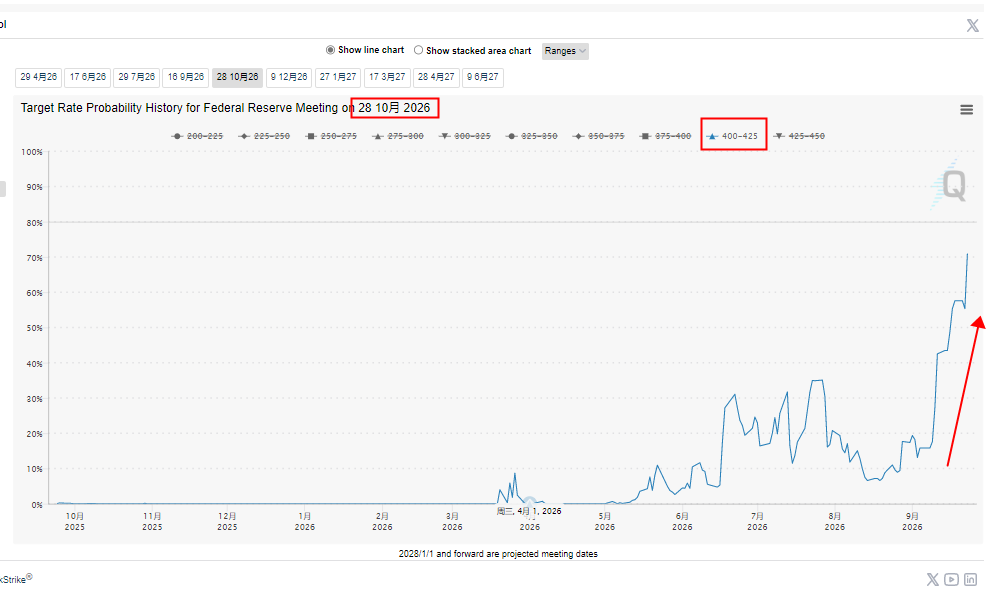 (FedWatch interest rate data, source: CME Group)
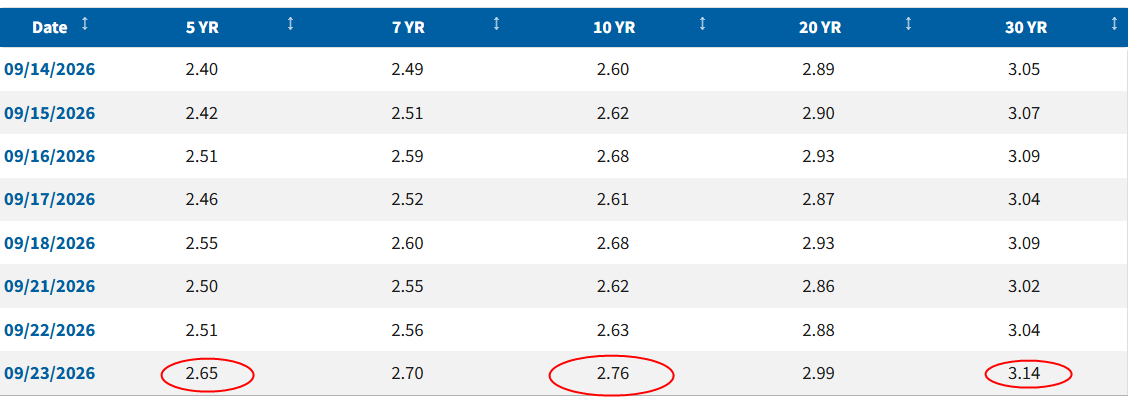 (10-year TIPS yield, source: Federal Reserve)
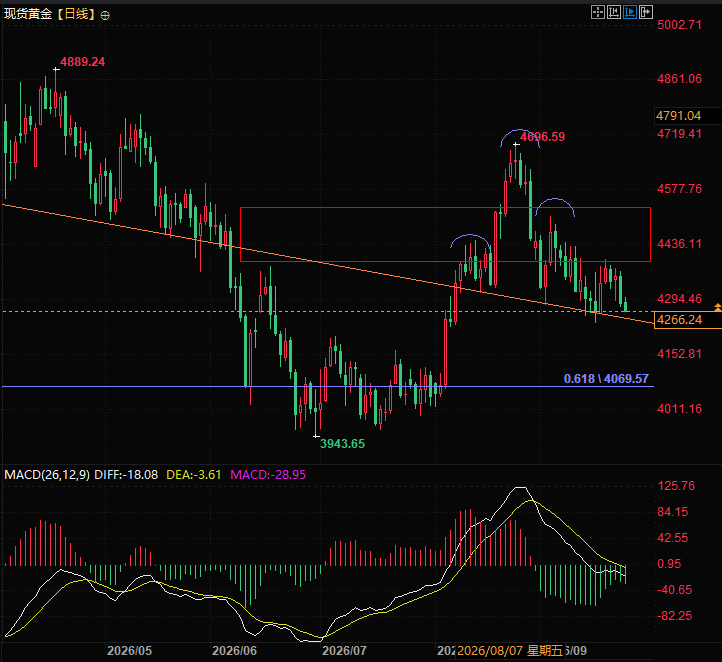 (Spot gold daily chart, source: EasyTrade) At 17:12 Beijing time, spot gold is currently trading at $4262 per ounce.
PMI significantly exceeded expectations, prompting a repricing of hawkish Fed expectations.
Several Federal Reserve voting members have released hawkish signals, coupled with a significantly stronger-than-expected US manufacturing PMI, becoming the policy and fundamental source of this round of rising real interest rates. We need to bring inflation back to the target level in a timely manner. The PMI is an indicator particularly favored by US fund managers. Purchasing managers are at the forefront of orders, production, and the supply chain; they need to place raw material orders and plan production capacity in advance. Their judgments lead GDP, industrial output, and corporate profits by 1-3 months . The preliminary value of the US manufacturing PMI in September showed a significant strengthening, with economic activity expansion reaching a multi-year high, indicating strong endogenous resilience in the US economy. Williams recently stated that the major challenge at present is inflation; the downside risks to achieving full employment have diminished, and we are currently seeing quite strong demand in the field of artificial intelligence. Barr pointed out that inflation has not yet shown a timely trend of falling back to the 2% target, and there is a need for further interest rate hikes under the baseline scenario. He also mentioned that tariffs, geopolitical conflicts, and a surge in AI infrastructure investment are pushing up price pressures. Barkin believes that interest rate hikes or expectations of interest rate hikes can suppress corporate inflation expectations and cool prices without significantly dragging down the economy, confirming that the US economy has the resilience to withstand higher interest rates. The FOMC dot plot, showing that most officials expect at least one more rate hike this year, has led the market to price in higher rates and a longer period of high interest rates, directly pushing up short-term real interest rates. The statements from Williams and Jefferson are merely liquidity safeguards for financial stability, focusing on the ample reserve framework, reforms to the centralized clearing of US Treasury bonds, and the discount window's buffer function. Their aim is to prevent a liquidity crunch in the short-term Treasury repurchase market and will not change the current tight monetary policy expectations, nor will they prevent real interest rates from rising. (FedWatch interest rate data, source: CME Group)AI applications are being implemented and realized, leading to a continued rise in intrinsic capital returns in the real economy.
The continued implementation of AI applications is changing the market's previous concerns about a single business model that relied solely on large-scale capital investment and highly dependent on advertising for profitability. Meta released Muse, a personal AI agent based on the Muse Spark model. Unlike traditional question-and-answer models, Muse can autonomously complete complex tasks such as online shopping, schedule management, and data organization across applications after authorization, relying on an independent cloud virtual machine. It plans to monetize through subscription fees and e-commerce transaction commissions. Simultaneously, Meta launched a new generation of Ray-Ban AI glasses equipped with Muse, including a cameraless audio version and a third-generation camera version, creating a 24/7 portable AI interaction portal. On the hardware side, Musk recently publicly stated that he is accelerating the large-scale mass production plan for Tesla's Optimus humanoid robot, transforming existing car production lines, initiating supply chain audits, and securing parts orders. He predicts that humanoid robots could reach a deployment size of one billion in the long term, capable of handling repetitive factory work and domestic services, driving capital expenditure across the entire supply chain, including sensors, motors, and computing power. With the integration of computing server leasing, short video intelligent agents, and other diversified businesses, the AI industry chain is gradually opening up multiple monetization paths, no longer relying solely on advertising revenue. Diversified profit expectations are boosting industry capital returns, stimulating companies to continuously increase capital expenditure on AI infrastructure, further supporting the upward trend of intrinsic capital returns in the real economy, as well as real interest rates (10-year TIPS yield). (10-year TIPS yield, source: Federal Reserve)Global supply and demand imbalance in duration funding has led to a continued widening of the long-term term premium.
The global imbalance between supply and demand for long-term funds is the core reason for the continued rise in long-term real interest rates and term premiums. US Treasury Secretary Bessenter expanded the scale of Treasury bond repurchase agreements in an attempt to support the bond market, but the positive news failed to translate into price increases. The repurchases were merely minor adjustments to the debt structure and could not offset the massive supply of new debt. With total US debt exceeding $40 trillion, the persistent fiscal deficit leads to a continuous stream of Treasury bond issuance, creating underlying structural pressure for rising long-term interest rates. Large-scale fiscal financing by European and American governments, coupled with massive capital expenditures on AI infrastructure, has led to a simultaneous competition between government debt financing and technology entity financing for global long-term funds. This funding pressure is evident in the primary market, with the auction of 5-year US Treasury bonds falling short of expectations and weak buying interest from both domestic and foreign investors. Simultaneously, changes in the US-EU interest rate differential have triggered asset rebalancing among overseas investors, with foreign capital flowing back from US Treasury bonds to their home countries, further weakening marginal buying interest in US Treasury bonds. These multiple supply shocks have combined to push up term premiums, driving long-term real interest rates higher.The real interest rate differential between the US and Europe has widened, and the US dollar index continues to be priced in with strength.
The core pricing anchor of the US dollar index is the real interest rate differential among G10 economies: the higher the US real interest rate relative to overseas economies, the higher the relative return on dollar assets, leading to a preference for buying dollar assets across borders and driving the dollar higher. At the same time, the US economy demonstrates greater resilience compared to Europe and Japan, and its monetary policy tightening is significantly stronger than that of major overseas economies, further amplifying the interest rate differential advantage and contributing significantly to the dollar's strength. A strong dollar and high real interest rates create a mutually reinforcing cycle, further suppressing the valuations of global non-interest-bearing assets and risk assets.This round of financing expansion raises concerns about overheating, and the sustainability of high interest rates is questionable.
However, the current market shows clear signs of overheating. Whether it's the US government's aggressive bond issuance or the tech industry's high-interest financing expansion, debt ultimately needs to be repaid with interest. If this round of financing expansion fails to deliver expected returns, coupled with continuously rising financing costs, the investment returns for businesses and the government are highly likely to fall short of expectations, disproving the current logic supporting rising real interest rates. We need to be wary of subsequent risks: once this expansionary boom cools down, the heavy interest burden could drag the economy into recession. During this period of market overheating and the disproven logic of rising real interest rates, gold's allocation value is expected to become more apparent, making it worthwhile to continuously monitor related investment opportunities.Gold is currently under extreme pressure, presenting a window of opportunity for medium- to long-term investment.
From the perspective of the underlying logic of asset pricing, the current strong US dollar coupled with high real interest rates puts gold at its highest opportunity cost, strongest capital suppression, and most passive valuation stage. This is the "most painful moment" in this cycle when gold sentiment and prices are under pressure. Gold, a non-interest-bearing asset, has almost no premium advantage in the environment of high interest rates and a strong dollar, with market pessimism fully released and short-selling pricing reaching its extreme. However, extreme suppression often corresponds to extreme opportunity. As the US high interest rates overdraw on the economy, the return on financing expansion declines, and the inflection point of rising real interest rates approaches, the current deep pressure range will become a rare medium- to long-term correction and investment window in this gold cycle. In fact, the imported inflation brought about by global energy has already eaten up a significant portion of the profits of global companies. Coupled with the draining effect of the AI industry, the profit distribution gap between global industries may continue to widen. Even if AI achieves phenomenal applications, those with the highest marginal propensity to consume will not receive a corresponding increase in profit distribution. Ultimately, overall consumption may still fail to improve, leading to an overall recession. Meanwhile, the recent hawkish comments from the Federal Reserve, besides suppressing inflation, are also aimed at curbing overheated investment in the AI industry. While the most profitable industries can indeed seize loan opportunities at high interest rates, this could also lead to other industries being unable to obtain loans and disappearing from the world in the short term—something the Federal Reserve does not want to see . Technical Analysis: Spot gold is approaching the bottom of its pattern, significantly increasing the probability of a short-term rebound. (Spot gold daily chart, source: EasyTrade) At 17:12 Beijing time, spot gold is currently trading at $4262 per ounce.
- Risk Warning and Disclaimer
- The market involves risk, and trading may not be suitable for all investors. This article is for reference only and does not constitute personal investment advice, nor does it take into account certain users’ specific investment objectives, financial situation, or other needs. Any investment decisions made based on this information are at your own risk.