Gold Outlook: Gold May Face Further Decline After Sharply Rising Yields
2026-09-24 21:42:15
Gold prices have fallen in recent days as the rally following last week's FOMC meeting has subsided due to rising interest rate expectations, higher oil prices, and a stronger dollar.  With oil prices remaining high and bond yields continuing to rise, it's difficult to change our cautious outlook on gold until the fundamentals shift. Yesterday, the bond market plummeted, with all-cycle US Treasury yields surging, further strengthening the US dollar. Better-than-expected US macroeconomic data, coupled with hawkish comments from Federal Reserve officials, also supported the dollar. As a result, gold and silver both fell; now that Brent crude has returned above $100 per barrel, precious metals may continue their decline today. Gold's outlook is under pressure: hawkish Fed stance, stronger dollar, and rising yields. This morning, the dollar saw a slight pullback, but there was no corresponding fundamental support. The dollar is likely to remain strong, especially if the stock market experiences further sell-offs, which would boost its safe-haven appeal. Fed policy remains the dominant factor in the foreign exchange market; after last week's rate hike, the hawkish statements from Fed officials are sufficient to maintain market demand for the dollar. Economic data also supported the US dollar: the S&P Global US Composite Purchasing Managers' Index (PMI) climbed to 58.4 from 56.0 in August, reaching a new high since July 2021. The service sector was the main driver of growth, and job recruitment activity rebounded, but businesses also reported further increases in input costs, indicating continued inflationary pressures and providing more justification for another Fed rate hike. Today, the market will focus on the meeting between the top leaders of China and the US; how the dollar will react remains to be seen. However, against the backdrop of increasing market bets on policy tightening, gold is likely to continue to be under pressure regardless. Rising yields increase the opportunity cost of holding gold. The weakening bond market is one of the core reasons for the sell-off of gold and other zero/low-yield assets. The yield on the 10-year US Treasury note surged past 5.0%, and the yield on the 30-year US Treasury note approached the high reached in 2007. The chart below visually illustrates the correlation between gold prices and US Treasury yields. The general logic behind gold's price movement is as follows: When yields fall, the opportunity cost of holding this zero-yield asset decreases, and gold prices tend to rise; conversely, when yields rise, gold prices often face downward pressure. Yesterday, US yields surged, with the 10-year Treasury yield rising above 5%, corresponding to a gold price drop of approximately 1.5%. Will gold then experience a larger plunge? However, if investors lose confidence in the Federal Reserve's ability to control inflation and yields, then the "dollar devaluation trade" may resurface. At that time, gold, silver, and currencies of countries with more stable fiscal situations are all expected to benefit. Gold Technical Analysis: Downward Pressure Accumulating From a technical perspective, the current market has not yet presented a signal sufficient to turn bullish on gold. Last week, gold broke out of a descending wedge pattern, a move very similar to the breakout in early August, but this pattern requires more confirmation. However, the subsequent upward movement in gold prices has not shown strong continuation, meaning that traders who entered long positions based on this breakout pattern are now trapped. Some long positions have set stop-loss orders near the recent low of $4,235, and gold prices will likely test that level next.
 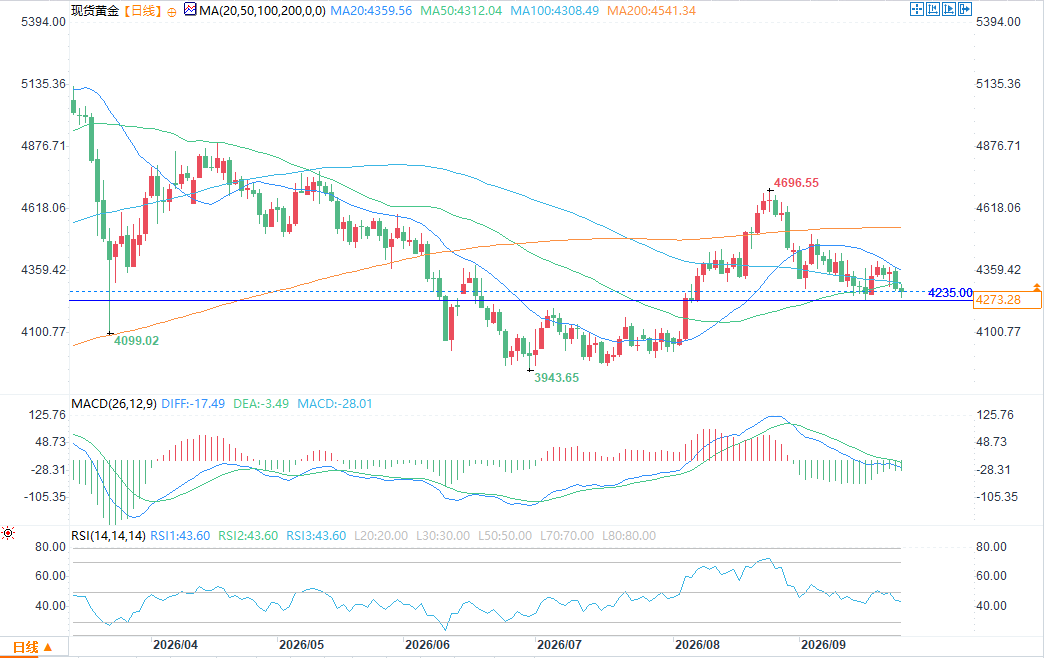 (Spot Gold Daily Chart Source: FX678) Since peaking in January, gold has been in a larger consolidation range, or a bear market trend. The price action has consistently shown a pattern of lower highs and lower lows, and this pattern remains unbroken, preventing a trend reversal to bullish. Therefore, the greater risk lies in the potential for further long position liquidation in the spot gold market, potentially exceeding previous levels. If gold prices continue to decline from their current positions and ultimately break below the $4235 support level, it will open up further downside potential, with the first target at $4100 and a further target of $4000. Key resistance lies around $4300-$4325, with the next resistance level at $4400. In my personal opinion, I will only abandon my bearish view on gold if the price closes above $4400.
With oil prices remaining high and bond yields continuing to rise, it's difficult to change our cautious outlook on gold until the fundamentals shift. Yesterday, the bond market plummeted, with all-cycle US Treasury yields surging, further strengthening the US dollar. Better-than-expected US macroeconomic data, coupled with hawkish comments from Federal Reserve officials, also supported the dollar. As a result, gold and silver both fell; now that Brent crude has returned above $100 per barrel, precious metals may continue their decline today. Gold's outlook is under pressure: hawkish Fed stance, stronger dollar, and rising yields. This morning, the dollar saw a slight pullback, but there was no corresponding fundamental support. The dollar is likely to remain strong, especially if the stock market experiences further sell-offs, which would boost its safe-haven appeal. Fed policy remains the dominant factor in the foreign exchange market; after last week's rate hike, the hawkish statements from Fed officials are sufficient to maintain market demand for the dollar. Economic data also supported the US dollar: the S&P Global US Composite Purchasing Managers' Index (PMI) climbed to 58.4 from 56.0 in August, reaching a new high since July 2021. The service sector was the main driver of growth, and job recruitment activity rebounded, but businesses also reported further increases in input costs, indicating continued inflationary pressures and providing more justification for another Fed rate hike. Today, the market will focus on the meeting between the top leaders of China and the US; how the dollar will react remains to be seen. However, against the backdrop of increasing market bets on policy tightening, gold is likely to continue to be under pressure regardless. Rising yields increase the opportunity cost of holding gold. The weakening bond market is one of the core reasons for the sell-off of gold and other zero/low-yield assets. The yield on the 10-year US Treasury note surged past 5.0%, and the yield on the 30-year US Treasury note approached the high reached in 2007. The chart below visually illustrates the correlation between gold prices and US Treasury yields. The general logic behind gold's price movement is as follows: When yields fall, the opportunity cost of holding this zero-yield asset decreases, and gold prices tend to rise; conversely, when yields rise, gold prices often face downward pressure. Yesterday, US yields surged, with the 10-year Treasury yield rising above 5%, corresponding to a gold price drop of approximately 1.5%. Will gold then experience a larger plunge? However, if investors lose confidence in the Federal Reserve's ability to control inflation and yields, then the "dollar devaluation trade" may resurface. At that time, gold, silver, and currencies of countries with more stable fiscal situations are all expected to benefit. Gold Technical Analysis: Downward Pressure Accumulating From a technical perspective, the current market has not yet presented a signal sufficient to turn bullish on gold. Last week, gold broke out of a descending wedge pattern, a move very similar to the breakout in early August, but this pattern requires more confirmation. However, the subsequent upward movement in gold prices has not shown strong continuation, meaning that traders who entered long positions based on this breakout pattern are now trapped. Some long positions have set stop-loss orders near the recent low of $4,235, and gold prices will likely test that level next. (Spot Gold Daily Chart Source: FX678) Since peaking in January, gold has been in a larger consolidation range, or a bear market trend. The price action has consistently shown a pattern of lower highs and lower lows, and this pattern remains unbroken, preventing a trend reversal to bullish. Therefore, the greater risk lies in the potential for further long position liquidation in the spot gold market, potentially exceeding previous levels. If gold prices continue to decline from their current positions and ultimately break below the $4235 support level, it will open up further downside potential, with the first target at $4100 and a further target of $4000. Key resistance lies around $4300-$4325, with the next resistance level at $4400. In my personal opinion, I will only abandon my bearish view on gold if the price closes above $4400.
- Risk Warning and Disclaimer
- The market involves risk, and trading may not be suitable for all investors. This article is for reference only and does not constitute personal investment advice, nor does it take into account certain users’ specific investment objectives, financial situation, or other needs. Any investment decisions made based on this information are at your own risk.