US-Iran negotiations disrupted oil prices, putting pressure on the Canadian dollar as it continued its five-day winning streak.
2026-09-25 10:42:12
The US dollar continued to rise against the Canadian dollar in Asian trading on Friday, trading around 1.4140, up about 0.05% on the day, extending its strong performance since last week. In late New York trading, the US dollar index closed at 101.285, a new eight-week high, putting pressure on non-US currencies. The core reason for the Canadian dollar's pressure came from the decline in oil prices. As a typical commodity currency, the Canadian dollar is highly correlated with international oil prices, and recent signs of easing tensions in US-Iran negotiations have directly pressured oil prices. According to market news, US and Iranian negotiators are discussing a phased agreement that includes Iran reopening the Strait of Hormuz and the US lifting its economic blockade of Iranian ports. Following this news, international crude oil futures briefly plunged.  Meanwhile, the escalating trade friction between the US and Canada further weakened the fundamental support for the Canadian dollar. On August 22, the US imposed a 50% tariff on approximately $20 billion worth of Canadian imports, and Canada retaliated on September 8 by imposing tariffs of 15%-50% on approximately $20 billion worth of US goods. The increased bilateral tariff barriers rapidly escalated the trade friction, causing the market to reprice Canadian export expectations and macroeconomic downside risks. The Canadian dollar struggled to recover its valuation based on rising energy prices, and the macroeconomic uncertainty premium driven by trade disruptions further increased downward pressure on the Canadian dollar. The US dollar, on the other hand, received multiple supports. Federal Reserve officials released a series of hawkish signals. Philadelphia Fed President Anna Paulson indicated that further interest rate hikes might be necessary, and Cleveland Fed President Beth Hammark also pointed out that inflation risks were skewed to the upside. According to the CME FedWatch Tool, the market's pricing in a 25 basis point rate hike in October has risen to approximately 67.5%, a significant increase from 55.4% a week ago and 11% a month ago. US Treasury yields continued to rise, with the 10-year yield climbing to around 5.2% and the 30-year yield touching above 5.5%, reaching their highest levels since 2004. This high-yield environment further increased the relative attractiveness of dollar assets, prompting a reallocation of funds to them. The divergence in monetary policy between the US and Canada was also a key driving factor. The Bank of Canada maintained its benchmark interest rate at 2.25% for the seventh consecutive month, while the Federal Reserve raised the federal funds rate to 3.75%-4.00%, widening the US-Canada policy spread to 175 basis points. This widening spread marginally weakened the relative yield premium of Canadian dollar-denominated assets, causing capital allocation preferences to shift towards the dollar. From a technical perspective, the USD/CAD daily chart shows a clear bullish pattern. The price has consistently traded above the 9-period EMA (1.4048) and the 50-period EMA (1.3955), with short-term moving averages crossing above long-term moving averages to form a golden cross, indicating a clear upward trend. The 14-day RSI reading reached 72.64, entering overbought territory, indicating strong upward momentum but also increasing the risk of consolidation or a technical pullback after continuous gains. As long as the price remains above the support of the two moving averages, the overall bullish structure remains intact, but the overbought signal suggests caution when chasing the price higher in the short term. Looking at the 4-hour chart, the exchange rate maintains a relatively clear upward structure, with pullbacks currently supported by short-term moving averages. If the exchange rate can effectively hold above 1.4100 and break through the recent high, it is expected to test the 1.4150-1.4200 area. If significant profit-taking occurs near 1.4100, attention should be paid to the 9-day EMA support near 1.4017; a break below this level could lead to a further pullback towards the 50-day EMA area near 1.3946.
 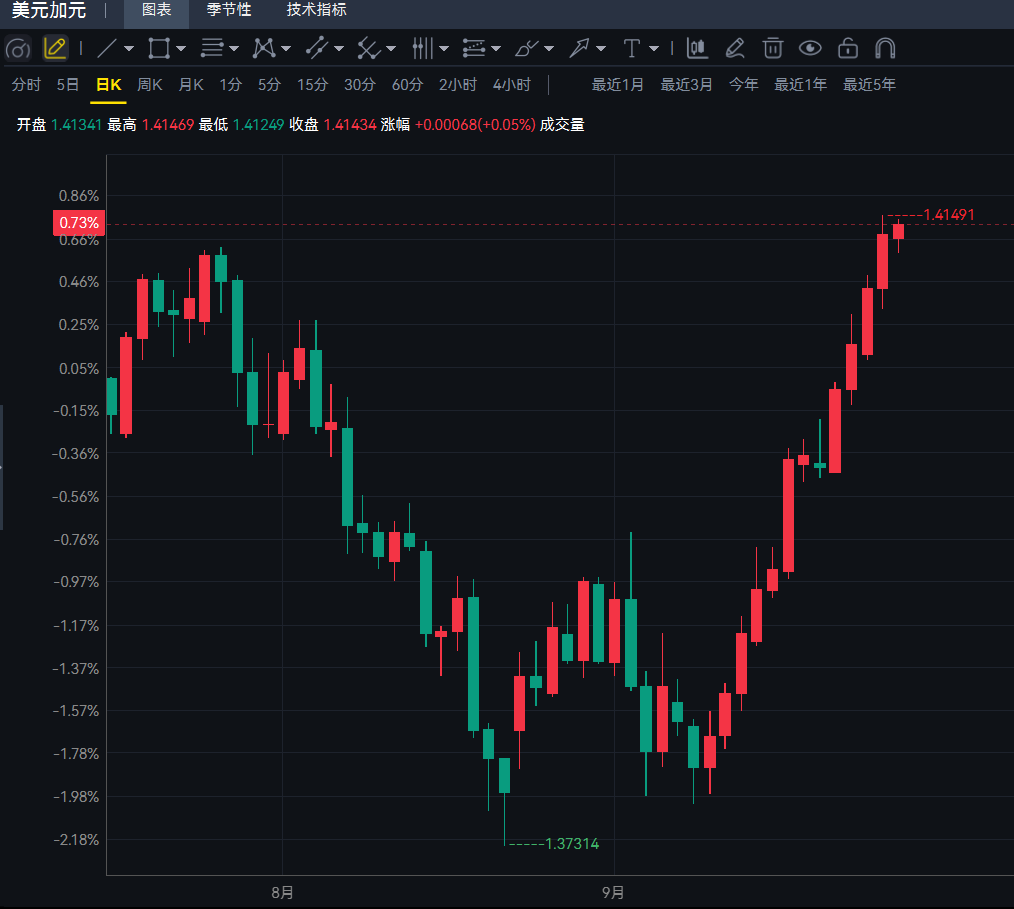 Editor's Summary: The USD/CAD pair is currently facing a triple negative environment: a strong US dollar, falling oil prices, and trade tensions. The Federal Reserve's hawkish stance continues to strengthen, and US Treasury yields have climbed to multi-decade highs, providing solid support for the US dollar. Expectations of easing tensions between the US and Iran are putting downward pressure on oil prices, putting pressure on the Canadian dollar as a commodity currency. Escalating trade tensions between the US and Canada are further weakening the Canadian dollar's fundamentals. These three factors combined are driving the exchange rate to continue its upward trend.
Meanwhile, the escalating trade friction between the US and Canada further weakened the fundamental support for the Canadian dollar. On August 22, the US imposed a 50% tariff on approximately $20 billion worth of Canadian imports, and Canada retaliated on September 8 by imposing tariffs of 15%-50% on approximately $20 billion worth of US goods. The increased bilateral tariff barriers rapidly escalated the trade friction, causing the market to reprice Canadian export expectations and macroeconomic downside risks. The Canadian dollar struggled to recover its valuation based on rising energy prices, and the macroeconomic uncertainty premium driven by trade disruptions further increased downward pressure on the Canadian dollar. The US dollar, on the other hand, received multiple supports. Federal Reserve officials released a series of hawkish signals. Philadelphia Fed President Anna Paulson indicated that further interest rate hikes might be necessary, and Cleveland Fed President Beth Hammark also pointed out that inflation risks were skewed to the upside. According to the CME FedWatch Tool, the market's pricing in a 25 basis point rate hike in October has risen to approximately 67.5%, a significant increase from 55.4% a week ago and 11% a month ago. US Treasury yields continued to rise, with the 10-year yield climbing to around 5.2% and the 30-year yield touching above 5.5%, reaching their highest levels since 2004. This high-yield environment further increased the relative attractiveness of dollar assets, prompting a reallocation of funds to them. The divergence in monetary policy between the US and Canada was also a key driving factor. The Bank of Canada maintained its benchmark interest rate at 2.25% for the seventh consecutive month, while the Federal Reserve raised the federal funds rate to 3.75%-4.00%, widening the US-Canada policy spread to 175 basis points. This widening spread marginally weakened the relative yield premium of Canadian dollar-denominated assets, causing capital allocation preferences to shift towards the dollar. From a technical perspective, the USD/CAD daily chart shows a clear bullish pattern. The price has consistently traded above the 9-period EMA (1.4048) and the 50-period EMA (1.3955), with short-term moving averages crossing above long-term moving averages to form a golden cross, indicating a clear upward trend. The 14-day RSI reading reached 72.64, entering overbought territory, indicating strong upward momentum but also increasing the risk of consolidation or a technical pullback after continuous gains. As long as the price remains above the support of the two moving averages, the overall bullish structure remains intact, but the overbought signal suggests caution when chasing the price higher in the short term. Looking at the 4-hour chart, the exchange rate maintains a relatively clear upward structure, with pullbacks currently supported by short-term moving averages. If the exchange rate can effectively hold above 1.4100 and break through the recent high, it is expected to test the 1.4150-1.4200 area. If significant profit-taking occurs near 1.4100, attention should be paid to the 9-day EMA support near 1.4017; a break below this level could lead to a further pullback towards the 50-day EMA area near 1.3946. Editor's Summary: The USD/CAD pair is currently facing a triple negative environment: a strong US dollar, falling oil prices, and trade tensions. The Federal Reserve's hawkish stance continues to strengthen, and US Treasury yields have climbed to multi-decade highs, providing solid support for the US dollar. Expectations of easing tensions between the US and Iran are putting downward pressure on oil prices, putting pressure on the Canadian dollar as a commodity currency. Escalating trade tensions between the US and Canada are further weakening the Canadian dollar's fundamentals. These three factors combined are driving the exchange rate to continue its upward trend.
- Risk Warning and Disclaimer
- The market involves risk, and trading may not be suitable for all investors. This article is for reference only and does not constitute personal investment advice, nor does it take into account certain users’ specific investment objectives, financial situation, or other needs. Any investment decisions made based on this information are at your own risk.