Oil prices on a rollercoaster! Amidst the conflict and diplomatic maneuvering surrounding Iran, crude oil prices experienced dramatic fluctuations this week.
2026-09-26 15:06:15
This week, the international crude oil market experienced a rollercoaster ride, with prices swinging wildly between supply concerns and hopes for peace. Both Brent and U.S. crude futures experienced significant volatility, influenced by the ongoing conflict with Iran, changes in shipping across the Strait of Hormuz, adjustments to Saudi oil exports, and repeated diplomatic signals from the U.S. and Iran. Oil prices fell to a 12-day low on Monday, then rebounded on strong statements and news of attacks, before falling again over the weekend due to increased hopes for a ceasefire. Overall, Brent crude futures for November rose less than 1% this week, while Brent crude futures for December fell 1.5%, and U.S. crude fell by about 8%. The price difference between the two benchmarks widened significantly, reflecting the market's high sensitivity to geopolitical risks and potential policy changes. The following analysis details the oil market's performance this week, key driving factors, and future outlook. 
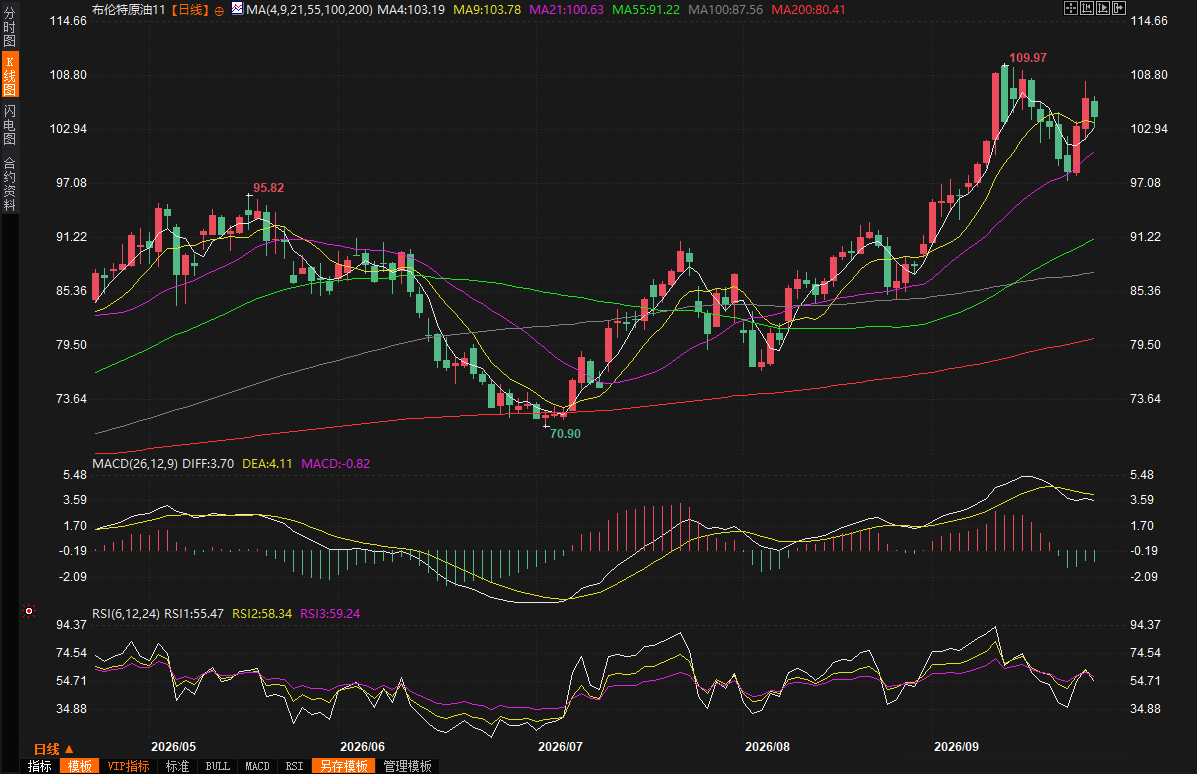 (Brent crude oil November futures daily chart, source: FX678)
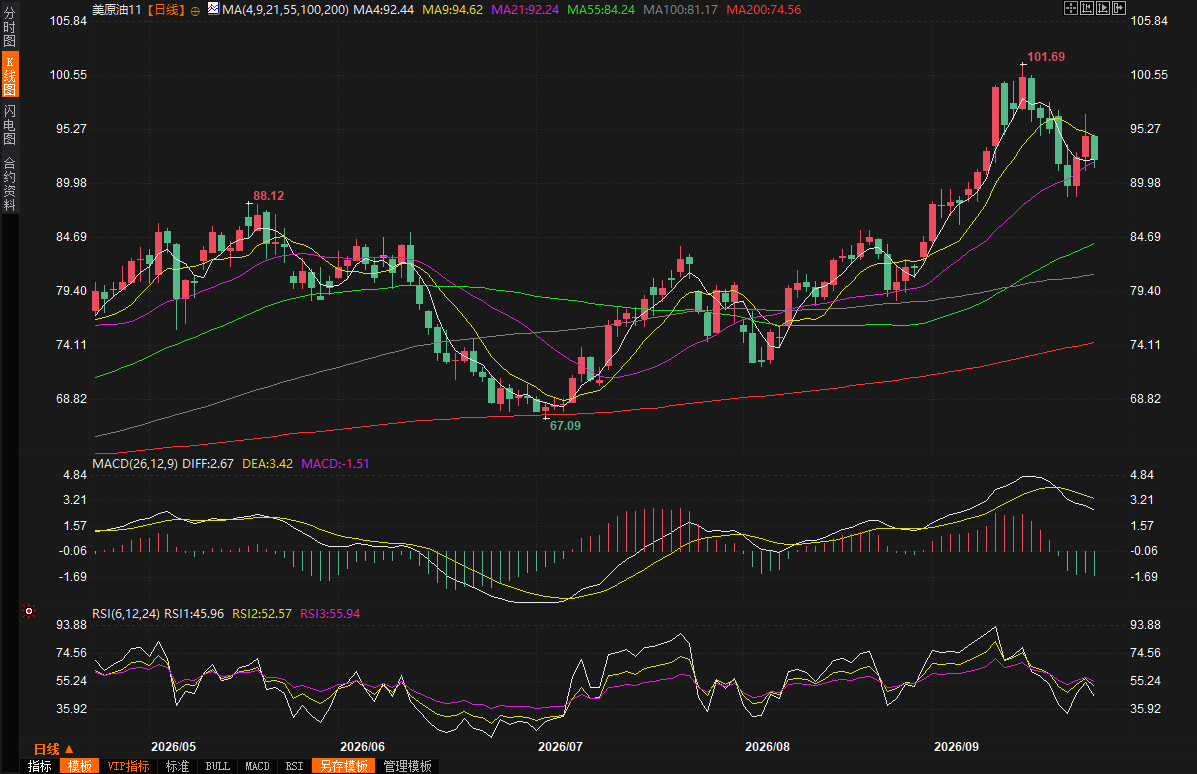 (US crude oil November futures daily chart, source: FX678)
Oil price movement this week: from a 12-day low to a sharp rebound and then a decline.
Oil prices opened lower on Monday. Brent crude for November delivery fell 3.4% to $100.34 a barrel; the expiring U.S. crude for October delivery plunged 4.51% to $95.78, while the November contract settled at $92.47. Both contracts hit their lowest levels since September 9. Market sentiment was primarily driven by investor optimism about a potential diplomatic breakthrough during the UN General Assembly. U.S. President Trump expressed his willingness to meet with Iranian President Pezeciyan, who is expected to attend the UN General Assembly in New York, and Al Jazeera reported that Iran had conveyed its conditions for restarting negotiations to the mediators. Analysts pointed out that peace talks, which seemed so distant just days ago, now appear to be moving in the right direction, triggering profit-taking and short-selling. Oil prices continued to fall on Tuesday, but the decline narrowed. Brent crude fell 1.09% to $99.25, and U.S. crude fell 1.24% to $94.99, with intraday lows briefly exceeding $2 per barrel. The main reason for the decline was the resumption of operation of Saudi Arabia's East-West oil pipeline and increased shipping traffic in the Strait of Hormuz, resulting in a significant increase in Saudi crude oil supply. Trump subsequently stated that a peace agreement might not be reached until after the US midterm elections in early November, and threatened to "completely destroy" Iran if no agreement was reached. This somewhat limited the decline, and oil prices recovered from their lows. On Wednesday, market sentiment shifted dramatically, with oil prices rebounding sharply by nearly 4%. Brent crude rose 3.86% to $103.08, and US crude rose 1.81% to $92.16. Traders assessed Iranian President Pezechiyan's tough stance of "never surrendering" while digesting the impact of Trump's previous threats. Meanwhile, data released by the US Energy Information Administration showed that US crude oil inventories increased by 3 million barrels in the week ending September 18, far exceeding market expectations of a decrease, while fuel inventories declined. Rumors of a diesel export ban also briefly impacted the market, with ultra-low sulfur diesel futures falling by about 5%, but the White House subsequently denied the reports. On Thursday, oil prices rose again by about 3%, reaching a one-week high. Brent crude rose 3.4% to $106.60, its highest closing price since September 15; U.S. crude rose 2.7% to $94.61, ending a six-day losing streak that had accumulated a 13% decline. Both contracts rose as much as 5% during the session. News of Houthi missile strikes against Saudi Arabia, which were intercepted, reignited market concerns about supply disruptions. Subsequent reports that the U.S. and Iran discussed reopening the Strait of Hormuz caused oil prices to retreat from their highs. On Friday, oil prices fell by about 2%. Brent crude closed down 2.1% at $104.32, while U.S. crude fell 2.3% to $92.41. Increased hopes for a ceasefire agreement between the U.S. and Iran, coupled with continued rumors of a diesel export ban putting pressure on the U.S. refining industry, led to the Brent-U.S. crude price spread widening to its highest level since May. Overall, Brent crude saw a slight increase this week, while U.S. crude fell sharply, reflecting differentiated pricing in different markets for potential policy changes. (Brent crude oil November futures daily chart, source: FX678)Key driving factors: a mix of diplomatic hopes, supply recovery, and geopolitical risks.
This week's oil market volatility has been centered on geopolitical issues related to the Iran-Iraq conflict. The Strait of Hormuz, a crucial passage for approximately 20% of global oil supply, directly impacts market sentiment. Before the war, the strait saw massive traffic, and Saudi Arabia has since increased exports through the Strait of Hormuz in response to Houthi attacks on the East-West oil pipeline. Satellite and ship tracking data show that Saudi crude oil transported through the strait averaged 2.9 million barrels per day over the past six days, significantly higher than the 700,000 barrels per day in August; the volume so far this week has reached 33.7 million barrels, roughly the same as the previous week. Saudi Aramco loaded approximately 14 million barrels of crude oil onto seven supertankers in the Gulf region and is gradually resuming operations on the East-West pipeline and exports from Yanbu port, effectively alleviating short-term supply tensions. Meanwhile, diplomatic signals have repeatedly acted as a catalyst for price fluctuations. The statements made by Trump and Peskov during the UN General Assembly present a stark contrast: one side expressed willingness to meet and discuss ending hostilities, while the other vowed never to surrender but still believed in diplomatic means. Sources close to the negotiations revealed that both sides are exploring a phased approach to ending the war, including Iran reopening the Strait of Hormuz, and the US lifting its naval blockade and economic sanctions against Iranian ports. Senior Iranian officials stated that even if the US accepts these proposals, Tehran will not show flexibility on its nuclear program. These developments have raised market hopes for a peaceful breakthrough, but are also fraught with uncertainty due to neither side's unwillingness to easily relinquish bargaining power. Institutions such as Capital Economics point out that diplomatic efforts may be working, but issues such as transit fees could still pose obstacles. Houthi attacks continue to fuel supply concerns. The group has repeatedly targeted Saudi targets, including facilities in Riyadh and Yanbu, and the Saudi-led coalition successfully intercepted six ballistic missiles. Military leaders from Saudi Arabia, Turkey, and Pakistan will discuss aid. Furthermore, the US's expansion of secondary sanctions has led neighboring countries, including the UAE and Oman, to ban Iranian airlines from entering the country, prompting Iran to threaten retaliation. These chain reactions have exacerbated tensions in the Middle East. Domestic factors in the US are also significant. An unexpected increase in EIA inventories and rumors of a diesel export ban have put additional pressure on the US crude oil and refined product markets. Analysts warn that even if a ban is implemented, its effect on alleviating high energy prices will be limited, and it may even exacerbate global supply shortages. Institutions such as Saxo Bank believe that there is limited room for further declines in oil prices, especially for refined products, before supplies from the Strait of Hormuz increase.Market Outlook: High volatility is expected to continue; focus should be placed on substantive diplomatic progress and actual changes in supply.
Overall, the international crude oil market this week is caught in a tug-of-war between geopolitical risks and supply recovery. Alternating hopes for peace and hardline statements have made it difficult for oil prices to form a unilateral trend, instead exhibiting a high-level consolidation pattern. If the US-Iran negotiations achieve substantial progress in reopening the Strait of Hormuz and lifting the blockade, supply pressure is expected to ease further, potentially putting downward pressure on oil prices. Conversely, if Houthi attacks escalate or the diplomatic deadlock continues, the risk of supply disruptions will push prices up again. The market also needs to closely monitor the actual progress of Saudi exports, US inventory data, and potential policy changes. The widening Brent-US crude oil price spread reflects concerns about diesel export restrictions at the refining end. In the medium to long term, the combined impact of the Iranian war and the Ukraine conflict on major oil-producing countries' exports remains fundamentally unchanged, and tight supplies of refined oil products, especially diesel, may continue to support the bottom of oil prices. In general, this week's crude oil market fully demonstrated the powerful influence of geopolitical events on energy prices. While investors hope for diplomatic breakthroughs, they must also prepare for supply disruptions. In the coming weeks, developments in the UN General Assembly negotiations, Saudi transportation data, and signals from US-Iran interactions will continue to be key variables determining oil price direction. In the current highly uncertain environment, market participants need to remain cautious and closely monitor the latest developments. (US crude oil November futures daily chart, source: FX678)
- Risk Warning and Disclaimer
- The market involves risk, and trading may not be suitable for all investors. This article is for reference only and does not constitute personal investment advice, nor does it take into account certain users’ specific investment objectives, financial situation, or other needs. Any investment decisions made based on this information are at your own risk.